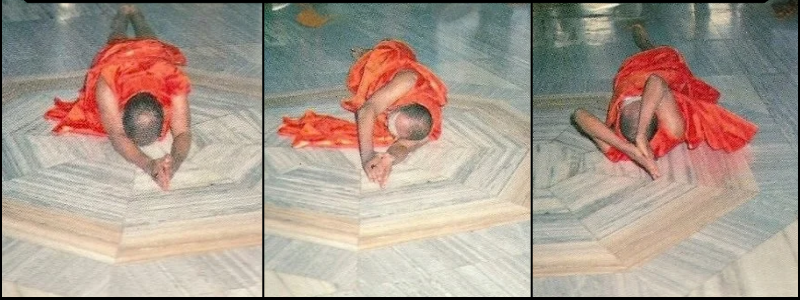
As a resident of Svaroopa® Vidya Ashram, I feel that I live in heaven on earth. I felt the same when I went to live with my Baba, that I was moving into heaven.
The environs, especially in Baba’s India Ashram, were heavenly. Three meditation halls opened daily at 3:00 am. I walked past night-blooming jasmine in the gardens to get there, along pathways with sacred statues in every corner.
We had a lotus pond and 100 acres of mango orchards. Our little café served chai, lattes and croissants next to a reflecting pool with a fountain in the middle.
You also have your own setup, perhaps with a meditation room or nook, gardens or plants for you to enjoy as well as delectable coffees and treats in your own kitchen. Does that make it feel like heaven for you? Maybe you would simply call it “comfortable.”
I quickly discovered the heaven I was experiencing wasn’t about nature nor interior décor. Having also stayed in beautiful hotels and retreat centers, I know the difference. It was Baba that made the place heavenly.
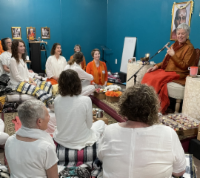
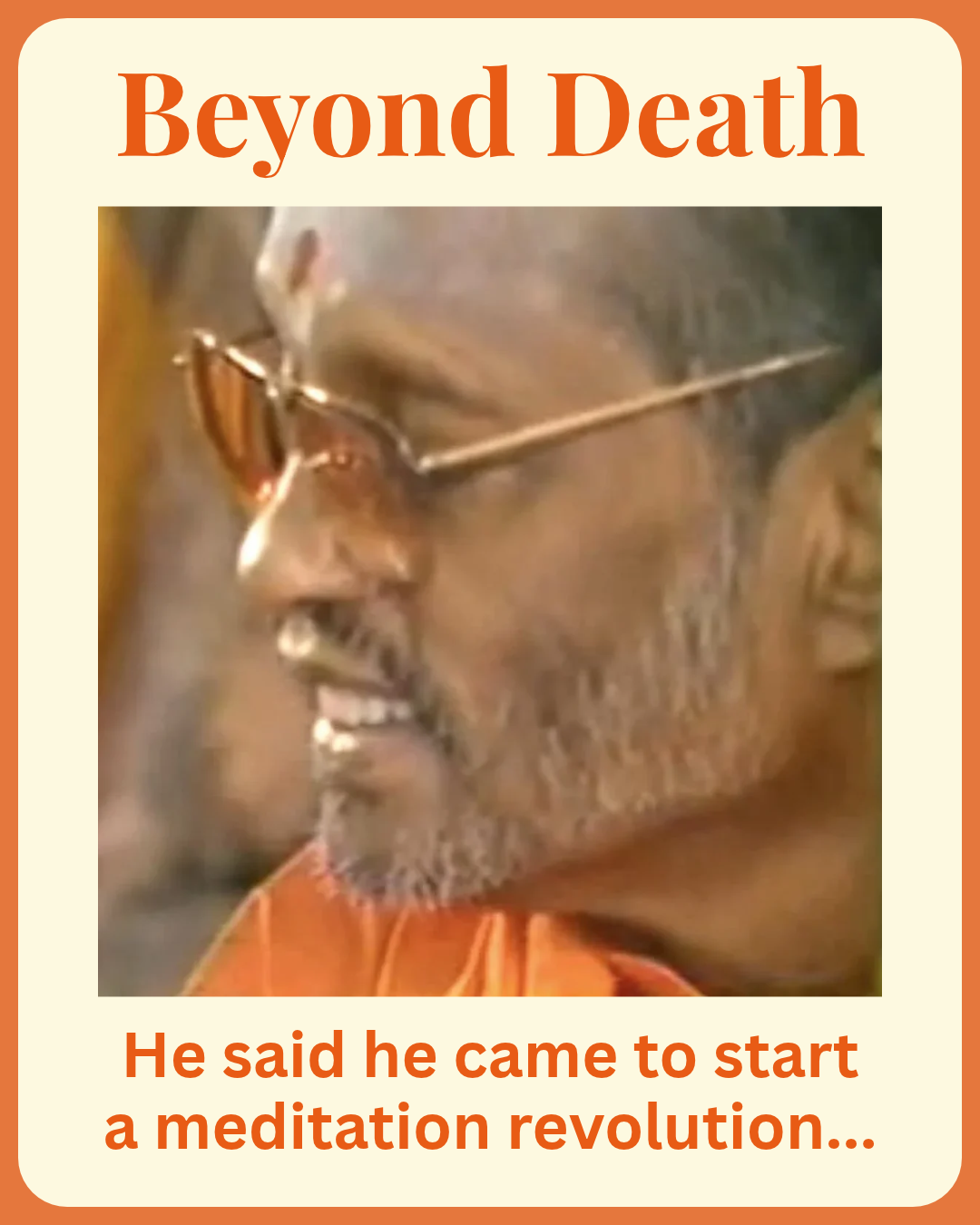
I got up for 3 a.m. meditation, followed by chai and chanting. Baba is why we gathered in the central courtyard at 10 a.m. and 3 p.m., to sit with him as he fingered his amber mala, doing japa (mantra repetition) for all of us.
I say he did mantra for us because, while I was sitting with him, I was not repeating mantra. My mind was flowing with mantra-virya, the mantric energy he emanated. Deeper than peace, thicker than bliss, more full-filling than love, I couldn’t jump-start a thought, not even a sense of awe or gratitude.
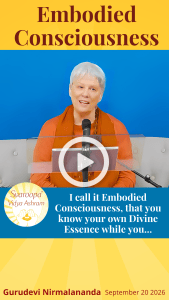
I was absorbed in ever-deepening inner realms, experiencing an open-eyed meditation simply by focusing on him. Looking outward at Baba was the same as looking inward at my own Self, except Baba made it easier and deeper.
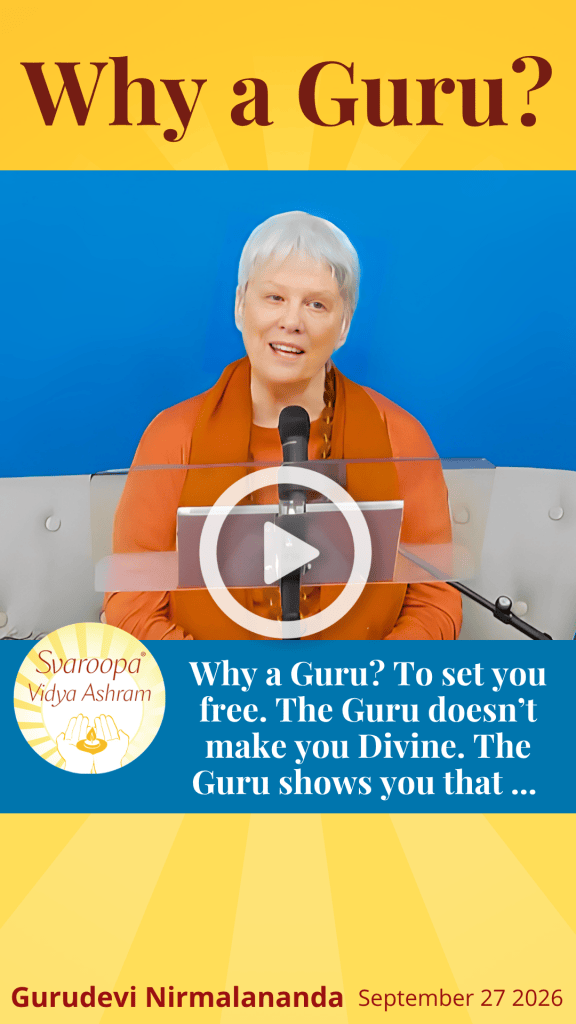
That’s what the Guru does — makes it easier and deeper for you. Everything they do is to help you find you. They make themselves available…
Happy birthday, America, 250 years and counting! May you live a long and honorable life.
I am grateful to live in a land where I am free to follow a yogic lifestyle. In many ways, this country meets the criteria listed in a yoga text from 1,000 years ago:
The yogi should live in a quiet place, in a prosperous land that is well-governed. The dwelling should be small, level with the ground, with a raised platform and fresh water nearby, and be kept clean and free from insects. Seated there, the yogi should free their mind from all distracting thoughts and practice yoga as instructed by his Guru. — Hatha Yoga Pradipika 1.12-14
I live only an hour’s drive from the birthplace of America. The founding documents are displayed in a Philadelphia museum, treated with the reverence that is usually given to sacred objects. These are very secular papers, yet they were inspired by ancient principles from Greek and Latin texts.
The men declaring our freedom also drew on the European Enlightenment philosophers. However, those great thinkers were similarly tapping into ancient sources, including Socrates, Plato, Aristotle and others. And if you dig a little further, you discover their sources, bumping into the sages of India whose influence was felt in ancient Greece. America’s philosophical roots run deep.
Bringing principles into practicalities is always challenging. This is true not only for an individual but also for a nation. But the principles have inspired me since I was a schoolgirl. Maybe I caught a whiff of India’s incense still wafting through?
This is the USA’s “semiquincentennial.” I love the title! It means we are halfway (semi) to the 500-year mark (quin-centennial). Yet longevity is not the goal.
Happiness, technically the “pursuit of happiness,” is the stated goal, along with life, liberty and equality. If you’re noticing that there are some bumps in the road, they are unfortunately part of the journey. We’ve still got a ways to go.
Yes, we want happiness, along with life, liberty and equality. Yoga sees these, not as a goal, but as the starting point for a greater objective. The true goal is yogic freedom — enlightenment. It is not something you attain by comparing yourself to others, not individually and not within groups. Called moksha, it is an inner state, a spacious quality of being that opens your mind and heart along with your breath and body.
Our tantric system focuses on your spiritual development while you live in the world. You go through the process of inner expansion while in the relationships you choose, in the actions and location of your choice.
Yet you get there by letting go, not by stockpiling people and things. I liken it to holding a butterfly on your palm. No squeezing! You must relax and breathe softly if you want it to stay. As a yogi, you do the practices that make you able to live in openness and ease. Yes, the road will still have some bumps in it, but you keep breathing all the way through.
You learn how to do this from those who know how. Like our Founding Fathers drew on time-honored principles, you follow the path laid out by those who succeeded in this visionary quest. Some of these yoga masters lived quiet lives, based in their Divine Essence, which enriched their life and those around them.
Only a few such Siddhas made themselves available by writing and teaching. They are our guides today. They make principles practical, approachable and accessible. They give you access to your own deeper dimensionality. This enriches your life more than any outer circumstances could provide. And you still will choose to live in a quiet place, in a land of plenty. You may even find you want to declutter, so the space in which you live matches the spaciousness inside.
And you step into life with clarity, arising from your inner freedom, seeing where you can make a difference and doing it. Yogis don’t need to withdraw from the world to protect their state. Yogis shine like the sun and find ways to share their light with the world — yes, with their family and friends, as well as standing up for the principles they believe in. That’s called politics, folks…
Are you contributing toward making the world better? It’s part of yoga.
Your soul is great and Divine, even if it’s carrying some baggage. You know how when you’re wearing a heavy backpack, or carrying a suitcase or two, it can throw you off-center? So, you might be trying to live your life while balancing all the baggage, meaning you’re living off-center. The good news is that you’re shedding the baggage with every yoga practice, with every meditation, with every mantra repetition, with every pose and yogic breath, with every chant. And even listening to these teachings, you’re shedding baggage and getting more and more centered. More and more based in your own Divine Essence.
You are always invited to join in chanting the Guru Mantra. It is included in Gurudevi’s opening mantras, which begin her Ashram programs and classes.
The Guru Mantra honors Gurudevi’s Guru and all who have preceded him in our lineage. Through Guru’s Grace, with every discourse, mantra repetition and meditation, Gurudevi brings us closer to this realization within ourselves.
With this chant, we celebrate her. We revere the Guru as one who knows her own Self. Thus, she gives us the knowing of our own Self, the one Self being all. We express gratitude for being fortunate heirs of this Grace-full lineage.
This small, framed poster of the Guru Mantra presents the words in three ways: ancient Devanagari script, transliteration of the Sanskrit words into our modern-day Latin letters, and the English translation. It is adorned by a lotus graphic. A blooming lotus, rooted in mud, evokes the profound process of becoming enlightened.
This small poster comes in two sizes (8 ½ x 11 and 5 x 7) in a choice of frames. You can either hang your framed Guru Mantra on your wall or set it on a table, nicely preparing your space for July’s Guru Purnima celebration.
Here’s the secret that nobody wants to know about desire. The more you fulfill your desires, the more desires you will have. When you don’t fulfill a desire, it comes back. You don’t fulfill it; it comes back again. When you don’t fulfill it again, it takes longer for it to come back. And you don’t fulfil it, it takes even longer for the desire to arise and it is…
— Gurudevi Nirmalananda
From Gurudevi’s full discourse “Timeless Beingness“
Interviewed by Lissa (Yogyananda) Fountain, Yogaratna
I am at every online Swami Sunday and Wednesday satsang as well as the daily Meditation Club.
Gurudevi inspires me with her thoughtful and entertaining discourses and articles. She makes the process of enlightenment so accessible, if you just put in the effort.
I thank Gurudevi for her endless patience in guiding and encouraging me through this process. I appreciate that she sees the Divine light in me, even when I can’t.
My experience reminds me of Sally Fields 1985 Academy Awards acceptance speech: “You like me, you really, really like me!” Better yet, I like me. In fact, I am loving myself more.
Gurudevi helps me become more resilient as l age. I look for purpose and connections in my life.
I started Svaroopa®yoga classes 25 years ago. The poses release spinal tension and strengthen my bones, joints and muscles. A recent bone density exam confirmed I’m in better shape than the average seventy-year-old!
And there’s more! I’ve dedicated my time and resources towards online Ashram participation these past five years. The more yoga I do, the more benefits I reap. I now feel a whole new level of awareness and deepening. And by Guru’s Grace, knowing my capital “S” Self has become my life’s purpose.
My resilience from Gurudevi’s practices and programs takes many forms. I’m able to let go of things that challenge me more quickly. My self-talk is more positive. I am able to be more engaged in what’s happening in the present moment.
When issues with my family come up, I accept the reality, even if I can’t repair it. I allow them time to sort it out for themselves. Gurudevi has helped me shift from a state of fear and anxiety to clarity. My daily meditation calms my mind, and I feel more blissful and focused.
I wish I lived closer to the Ashram so I could attend the satsangs in person. I’d hang around to chat and eat goodies, and pitch in to help.
Instead, I arrive early at my local Monday morning yoga class. I set up the room for my teacher. This feels like an Ashram seva that I can do, and it’s meaningful to me. I’m looking forward to my first visit to the Ashram for a Shaktipat retreat in July!
Take a breath. And another one, slower. Now, one more…
This simple stress reduction technique comes from yoga. Along with the “Relaxation Response,” these methodologies were mainstreamed in the 1950’s to 1970’s.
Yoga poses were first taught in America by Swami Vivekananda in the 1890’s. While his focus was meditation and yoga philosophy, he taught poses in some of his week-long retreats. Most of the participants were wealthy women who had servants who could take care of their household while they were gone.
In the 1930’s, the cosmetics mogul Elizabeth Arden opened a women’s spa in Maine. Along with beauty techniques, the guests learned yoga poses from teachers that Arden brought from India. They took yoga home with them, along with their new creams and cosmetics.
Theos Bernard made his first trip to India in 1936. On his return, he taught yoga to New York socialites. Many years later, I met one of Theos’ students. In her 70s by then, she shared a 16mm movie of her doing extreme yoga poses from her studies with him. It was impressive, but not user-friendly.
Indra Devi began teaching yoga in Los Angeles in 1948, where she relocated from India. She repackaged yoga as a relaxing health and beauty routine, which attracted Hollywood elite. She had been a famous actress in India, so she understood that world very well.
By the time I got interested, Richard Hittleman was teaching on television, with women demonstrating the poses as he gave instruction. He included tidbits of yoga philosophy in his shows. His books included meditation. His shows were on daytime TV in the USA, so the viewers were mainly women.
Lilias Folan’s TV classes began in 1970, again showing on daytime TV. She demonstrated the poses herself while teaching, making them seem very accessible. Every women’s magazine featured yoga poses — for decades.
My first in-person yoga class was in 1975, with a teacher trained by Indra Devi. She taught at my local Parks & Recreation Department as well as in her own home. By then, every California suburb had a yoga teacher offering classes in her home. Soon I was one of them.
While meditation was an undercurrent in all these classes, it got lost as yoga moved into the athletic clubs in the 1990’s. It began to attract more men, though it is still over 70% women in America. Athletic and aerobic yoga styles grew exponentially, overshadowing the slower and meditative approach originated by the ancient sages.
From 1997-2002, I helped with the founding of Yoga Alliance, setting Teacher Training standards that included the historic roots and philosophy.
The therapeutic approach was pioneered by Michael Lee with Phoenix Rising Yoga Therapy. Within Svaroopa® yoga, I introduced yoga therapeutics in 2000, with a growing concentration of classes in this area since then.
In 2014, the United Nations established International Day of Yoga by a rare unanimous vote. The resolution notes “the importance of individuals and populations making healthier choices and following lifestyle patterns that foster good health.”
The Prime Minister of India, Narendra Modi, spoke to the cosmic perspective of the ancient sages. “Yoga is an invaluable gift from our ancient tradition. Yoga embodies unity of mind and body, thought and action… Yoga is not just about exercise; it is a way to discover the sense of oneness with yourself, the world and the nature.”
We are the beneficiaries of many generations of Western yoga teachers, making this time-honored tradition accessible today. The rich diversity of yoga styles means you can find your niche, whether it is therapeutics or a gymnastic approach. At Downingtown Yoga, we focus on therapeutics as well as the meditative practices.
Please join us for this 12th International Day of Yoga. We will honor the occasion at our Sunday meditation program:
Swami Sunday (On-Site or Online) Led by Gurudevi Nirmalananda June 21 from 10:00 – 11:30 am
And you can do more yoga on Yoga Day by coming to our afternoon class:
Yoga & Meditation Class (Online) With Swami Prajñananda June 21 from 4:00 – 6:00 pm (Eastern Time)
I feel fortunate to have watched yoga’s seeds bloom in America. Many of the events and teachers I have described are significant parts of my life story, for which I am very grateful.
Yoga keeps me healthy and happy, even as I complete my 80th year of life. Beyond mere happiness, I delight in yoga’s deep roots and spiritual heritage, which can be accessed by turning inward. One way to begin is by taking a slow deep breath…
However, there is a danger in the relationship with a Siddha. In this yoga of relationship, you can get so wonderfully overwhelmed with the Guru’s light that you forget to look for your own. You have to listen and learn. You have to watch closely for the Guru honors you, as much as they…
Go with Gurudevi to Ganeshpuri for profound spiritual upliftment.
Ganeshpuri is the home of Gurudevi’s Guru, Baba Muktananda, and his Guru, Bhagawan Nityananda. This sacred place is Gurudevi’s spiritual hometown.
Accept her invitation to join her there for her Golden Jubilee, the celebration of her 50 years of teaching and 80th birthday.
Our newly discounted rates come from an adjustment in the foreign exchange rate as well as the improved planning by our new Tour Manager. Click for more information.
At Fire Mountain Retreat Center, right across the river from Nityananda’s temple, you will join Gurudevi for meals, classes and satsangs. The traditional ceremonies of the Nityananda temple begin and end our days.
Two special events are happening. On the day before her birthday, Gurudevi will have a fire ceremony only for 80-year-olds. Sahasrara Chandra Darshanam honors that she has lived through 1,000 full moons. It expresses gratitude, longevity and spiritual maturity.
On her birth anniversary, Gurudevi will participate in the morning ceremonies for Nityananda in his temple. She has done this several times before, and says:
I am grateful to be able to honor Nityananda in such an intimate and personal way. This ceremony always gives me the feeling I had when sitting with my Baba. What a glorious way to honor my Baba — by honoring his Baba.
You are invited to join her for the transformative effects of immersion in this sacred place, where her teachings and practices will be generously amplified.
The travel information package is now available; email our Enrollment Advisor at programs@svaroopayoga.org or call 610.806.2119.
Previous travelers to Ganeshpuri with Gurudevi describe their transformative experiences:
After the early morning ceremony in the temple, I experienced a sweet bhav — a quiet bliss inside and outside. Even the dust along the road glimmered with shakti. I would meditate in Nityananda’s house or in his Mahasamadhi Shrine. I can still hear the village waking up, birds chirping and sacred-building caretakers going about their early morning chores. Now, eleven years later, remembering this experience of Ganeshpuri, I’m filled full, from the inside, with ecstatic bliss!