
 By Matrika Gast
In college I hated to talk in classes. Preferring to take notes in a lecture or write essays, I felt discussion was a barrier to my learning. Back then, I didn’t learn the importance of speaking up and listening in community. Decades later, our Ashram community has changed me. I am transformed from a lone-wolf yogi into a grateful member of the pack!
Karuna Beaver, our Boise Meditation Group Leader, always invites us to describe our experience. She gently encourages us with a question, “Who else can you share this stuff with?” For me, this triggers another question, ‘Why would I want to share my experience?’ Now I know the answer: because communicating in community is a major component of true learning.
A community is comprised of individuals who share common interests, values and goals — and who talk with each other. Each speaks the same language. Our Svaroopa® Vidya Ashram community is a virtual assembly of seekers who engage in the Svaroopa® Sciences practices. There are many practices, so many of us have entered through different doors. Yet we all speak the same language, communicating our experiences of the Svaroopa® Sciences practices.

etsy.com
You’re not asked to believe anything. You are given practices, and the practices give you experiences. You come to knowledge from articulating your own experience, and from listening to what others say about theirs. Yoga is experiential learning.
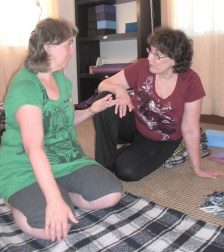
In Svaroopa® Yoga Teacher Training (YTT), a partner-pairing process teaches us how to apply what we have seen in demonstrations and have on our pose handouts. But it’s in the communication between a pair of partners that experiential learning happens. Receiving a pose alignment from our partner, we describe our own experience of it, complimenting and coaching as appropriate. We team-teach our practicum classes, giving compliments and coaching to each other, while receiving both from our supervisor as well.
 Swami Nirmalananda shares, “When I served as the President of the San Diego yoga teachers association, I was surprised to hear a comment from a teacher of another style. She said, ‘The teachers you train know how to work together, in a classroom and outside. None of the rest of us do.’”
Returning home from Teacher Training, many of us keep in touch with each other and reconnect in future trainings. We ask questions, compare notes and encourage, continuing to learn and evolve together. Thus we form relationships that continue across distance and through time, creating community. The conversation revolves around the teachings of Swami Nirmalananda, delivered by her as well as by our Teacher Trainers whom she has taught and certified.
Swamiji’s Yoga of Food phone course gave me an even deeper learning in community. She didn’t tell us what to eat. On each phone call, she gave us practices. One was simply to sit before your food, look at it, smell it and get to know it. On the next call, she asked us to describe our experience. I felt timid. Yet I went ahead and said, “I felt a sense of love flowing from my meal.”
Swamiji replied that ancient yogic texts talk about flowers blooming and plants producing fruits and vegetables out of love for humanity. When I remember this, I am overwhelmed with gratitude. Swamiji’s response to my description gave me a sense of the Love of God outside and inside.
Some Shishyas (disciples of Swami Nirmalananda) joined the Ashram community by coming into relationship with Swamiji directly. They immediately recognized her as a revered teacher on their spiritual path. Some resonated with an Ashram ad in a yoga magazine, and found Swamiji’s online Freebies (writings and recorded satsangs). Others became Shishyas gradually over time and others are in the process of deciding how much they want.
 No matter the entry door, all of us community members come into relationship with Swamiji as well as with each other. We talk, formally in programs and casually anywhere, anytime. Many of us take on seva (selfless service). In serving others, and serving with others in our particular seva, we talk. We communicate about our experiences and develop enduring relationships. These connections weave the tapestry of community. It is a container in which together we deepen and expand our experiences of opening more and more to Self.
I have learned that communication in community is transformative. I must speak out loud about my experience to those who are really listening. And I as I listen to them, I hear of something I never imagined and am inspired. Or I hear my own experience in their words and am affirmed. Only then do I grasp what I am coming to know. Being listened to by my Guru and my fellow Svaroopis makes it Real.
I sense their presence — their Presence — as Consciousness-ItSelf. The verbal interchange in the context of Conscious communication is transformative. It gives a glimpse of Self-Realization, the goal of the practices, even before the mind can understand it.
 By Deena Rotches
 I discovered that Lunge was “the one” a decade ago, returning home from a long drive to visit my mother. My total drive time was about four hours. If I went to bed without doing a Lunge, I wouldn’t get any sleep. If I did a Lunge, I was OK. I learned to release my tailbone, sacrum and spinal waist area all at once by doing Lunge very slowly.
 After my recent Shaktipat Retreat with Swamiji, another student remarked on how faithfully I adhere to daily, 4 am yoga routine. I explained to her that it prepares me for the
  By Yogeshwari Fountain
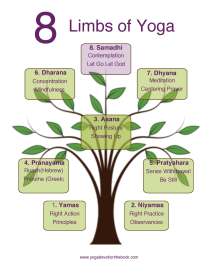 I recently re-read my 1998 notes on Sutra 2.29. It was clear that I had my work cut out for me even then. Scribbled on the page’s margin was encouragement like “Just say no!” or “You must restrain yourself from these things.” I struggled with the question “How do you live a yogic life 24 hours a day?” It all seemed beyond my grasp. My mind was so busy, I had no idea where to begin. You see, I didn’t understand Grace, the wind that has always been beneath my wings, even before I knew it.
 Guru’s Grace is the shortcut to the knowing of your Divinity, your own Self. Swami Nirmalananda awakens the arising of your own inner spiritual energy. She describes it this way, “Patanjali teaches you how to dissolve the clouds. By contrast, my Guru simply gave me the sky.” She is comparing the practices you learn from Patanjali with Guru’s Grace.
 By Raj~ni King
 When I took Meditation Teacher Training, I had to write and teach about Consciousness. This helped me to understand and more tangibly experience what I had been getting all along. The yoga process and the purpose of asana was so clear. It is spiritual upliftment, rather than just the reliable physical, mental and emotional improvement that begins the process. Knowing and more fully experiencing the purpose of practicing asana shifted my teaching profoundly. Even though I was saying the same words and teaching the same asanas, my understanding of the goal shifted.
 When I go into the studio to teach, I light a candle and do arati to the Gurus from our lineage. Then, because the space is shared, I always do a round of incense with the mantra to clear the energy. These practices help me to settle into my Self before I teach. The clearing also opens the way to the inflow of Grace from our lineage. It becomes tangible, not only for me, but my students as well. They know that they’re different when they leave. At the end of class this week, a new student exclaimed that she felt like a whole new person. She was glowing; they were all glowing.
 By Mangala Allen
 SVA Blog