By Gurudevi Nirmalananda
What’s up with all the names?
Bottom line, all yoga is good yoga — even when they are all different. It’s like lunch. No matter what you eat midday, it’s still called lunch.
Hot Yoga is done in a hot room (98°), making it easier for your muscles to lengthen. It is also called Bikram Yoga, honoring the yogi who brought it to America from India.
Yin Yoga is about cooling down and slowing down. You lean into cushions and blocks to make your muscles able to lengthen more easily.
Why this emphasis on muscle lengthening? When your muscles lengthen, your nervous system tells your brain to stand down from red alert. This helps your mind become more peaceful. When your mind is peaceful, you can see deeper within. Yoga is all about looking inward to discover your own essence and beingness.
Ashtanga Vinyasa gets you moving fast and breathing fast, like aerobics. The dance-like sequences are repeated again and again. Power Yoga and Jivanmukti Yoga are variations on this theme. Viniyoga slows it down, still keeping you moving with a methodology focused on the healing sequencing of the poses.
Kundalini Yoga gives you lots of fast breathing, coordinated with repetitive physical movements. You might experience inner heat from the energy moving through your spine, which is its purpose.
Moving and breathing are good for your body. They are good for your mind as well as for your emotions.
Yet beyond mere exercise, yoga is about your discovery of the deeper dimensionality within you. In these fast-moving yoga systems, what matters most is the inner stillness that you experience when you stop pumping your breath and body.
The classical yoga systems focus more on the inner stillness. While you do poses and yogic breathing, there is usually a pause between the poses, specifically for the refinement of your awareness.
Hatha Yoga is the classical system, meaning a yoga that you “hatha,” you apply yourself to — using will power, time and effort. The Sanskrit texts clearly describe that you are working on getting enlightened by beginning with your body and breath. The focus is on awakening Kundalini, the energy of the cosmos which lies hidden in your spine.
Variations on the classical system include Sivananda Yoga, Integral Yoga and Indra Devi Yoga, which was the first Yoga Teacher Training that I took. Their emphasis on yogic relaxation has expanded to a modern system of its own, Yoga Nidra. Kripalu Yoga is also related, emphasizing that you simply do what you can and don’t worry about perfecting the pose.
Iyengar Yoga comes from hatha yoga, an eponymous approach featuring many innovations by its founder. You move into a position and stay there while finessing your technique, a sophisticated form of isometrics. Then you do another pose, followed by another. Anusara Yoga and Restorative Yoga are variations on this approach.
These systems have their roots in a classical methodology that spans millennia. While the modern focus is on limber, lithe and lean, yoga’s poses come from the tantric yogis in the Himalayas. Tantra means loom, where the interweaving of warp and woof threads happens. Among the tantrics’ many secrets were poses, yogic breathing, mantra and the inner awakening by a great master.
I was graced by this inner awakening almost 50 years ago, which fired up my transformational process. The fuel propelling my rocket ship through the inner stratosphere was Cosmic Consciousness climbing my spine — Kundalini. She taught me how the poses are supposed to work, from the inside out. This is why I teach:
Svaroopa® yoga is a spine-centric yoga. It is a slower-paced yoga. Every pose targets your spine, to decompress it and restore it to full health and resiliency. “You are as young as your spine,” the saying goes. It is true.
Yet there is more going on in your spine, a mystical center for the blossoming forth of Consciousness from within. We use alignments, yoga props and careful pose adjustments by your teacher to dissolve your deepest spinal tensions. Not only does it keep you young, it opens up the flow of life energy within.
With time and practice, this opening leads to the inner awakening, as described in the classical hatha yoga texts. Easier still, the inner awakening is available in a weekend workshop, the Shaktipat Retreat.
While Svaroopa® yoga is based in Consciousness, it utilizes many of the tools you find in other yogic systems. Our yogic breathing is a slower type than you find in a Kundalini Yoga class, but deeply effective for energizing and enlivening your whole body-mind-soul system.
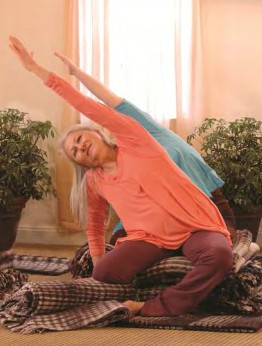
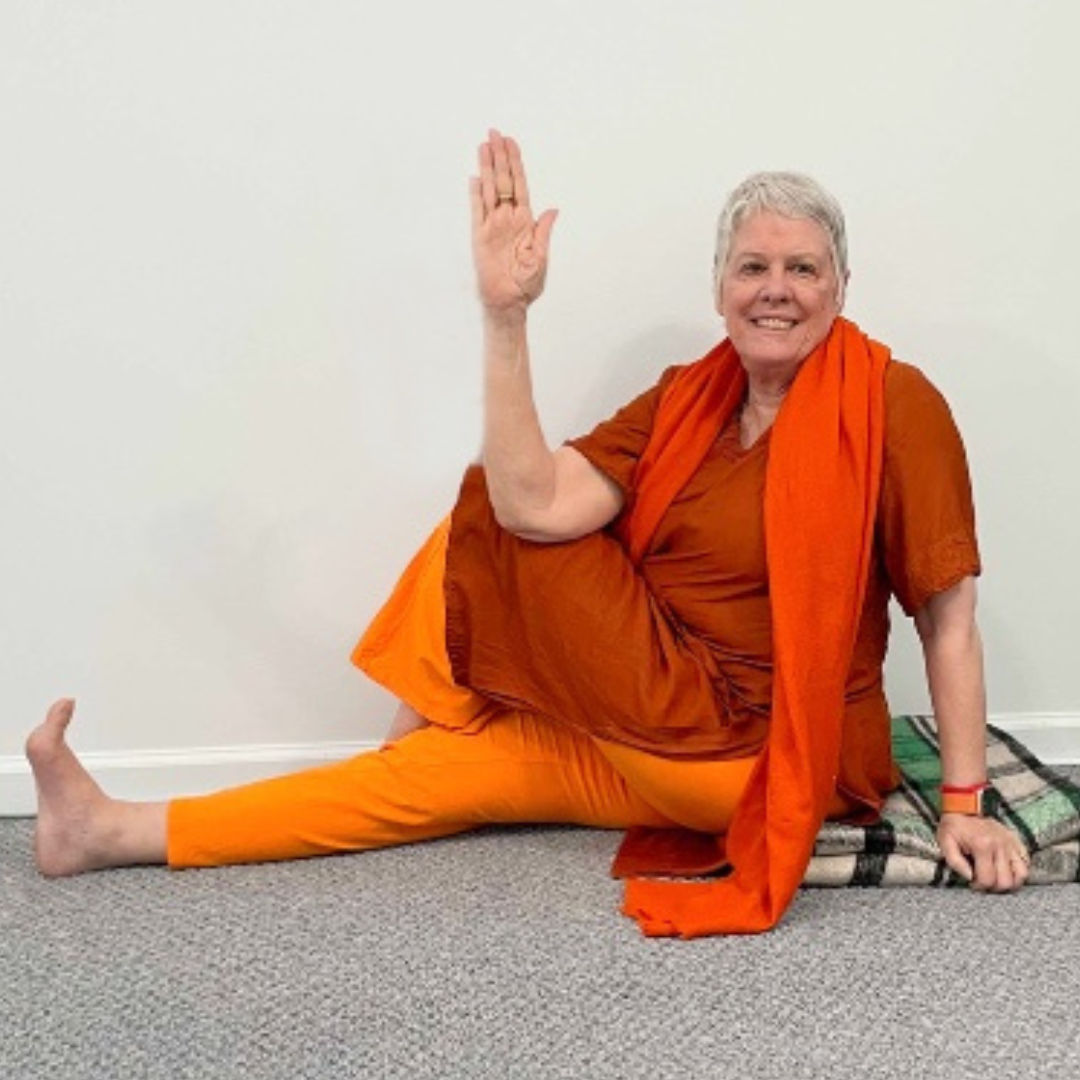
When we have you reach your arm up in the air, it’s not about how far you can go. Instead, we use the angle of your arm as a way to access your spine, like a laser beam shining from your hand, through your arm, through your shoulder and into your spine.
We repeat certain pose sequences, similar to Viniyoga, for their ease and effectiveness. We enjoy a slower paced class, similar to Yin Yoga, and we use yoga props like in Iyengar Yoga.
You get hot in Svaroopa® yoga, but it is inner heat, the most delicious and powerful kind. It dissolves muscular tensions while it untangles your limiting thoughts and beliefs. It’s all for the purpose of setting you free. Yoga is about liberation!




 SVA Blog