Author Archives: Swami Nirmalananda

Unknown's avatar

About Swami Nirmalananda

Swami Nirmalananda is a teacher of the highest integrity since 1976. In 2009 she was honored with initiation into the ancient order of Saraswati monks. Now wearing the traditional orange, she has openly dedicated her life to serving others. Usually called Gurudevi, she makes the highest teachings easily accessible, guiding seekers to the knowledge and experience of their own Divine Essence.

A Sweet Surrender

Gratitude and devotion are not the same thing.  Gratitude is always for something, it’s transactional.  You get x, so you feel grateful for it.  You say, “Thank you.”  You even know how to say thank you whether you’re grateful or not.  But hopefully you get to enjoy being grateful. Still, it’s a transaction.  Devotion is unfounded, even unbounded.  When you experience devotion, it’s…  

—  Gurudevi Nirmalananda

From Gurudevi’s full discourse “An Attitude of Gratitude

What Kind of Yoga?

By Gurudevi Nirmalananda

What’s up with all the names?

Bottom line, all yoga is good yoga — even when they are all different. It’s like lunch. No matter what you eat midday, it’s still called lunch.

Hot Yoga is done in a hot room (98°), making it easier for your muscles to lengthen. It is also called Bikram Yoga, honoring the yogi who brought it to America from India.

Yin Yoga is about cooling down and slowing down. You lean into cushions and blocks to make your muscles able to lengthen more easily.

Why this emphasis on muscle lengthening? When your muscles lengthen, your nervous system tells your brain to stand down from red alert. This helps your mind become more peaceful. When your mind is peaceful, you can see deeper within. Yoga is all about looking inward to discover your own essence and beingness.

Ashtanga Vinyasa gets you moving fast and breathing fast, like aerobics. The dance-like sequences are repeated again and again. Power Yoga and Jivanmukti Yoga are variations on this theme. Viniyoga slows it down, still keeping you moving with a methodology focused on the healing sequencing of the poses.

Kundalini Yoga gives you lots of fast breathing, coordinated with repetitive physical movements. You might experience inner heat from the energy moving through your spine, which is its purpose.

Moving and breathing are good for your body. They are good for your mind as well as for your emotions.

Yet beyond mere exercise, yoga is about your discovery of the deeper dimensionality within you. In these fast-moving yoga systems, what matters most is the inner stillness that you experience when you stop pumping your breath and body.

The classical yoga systems focus more on the inner stillness. While you do poses and yogic breathing, there is usually a pause between the poses, specifically for the refinement of your awareness.

Hatha Yoga is the classical system, meaning a yoga that you “hatha,” you apply yourself to — using will power, time and effort. The Sanskrit texts clearly describe that you are working on getting enlightened by beginning with your body and breath. The focus is on awakening Kundalini, the energy of the cosmos which lies hidden in your spine.

Variations on the classical system include Sivananda Yoga, Integral Yoga and Indra Devi Yoga, which was the first Yoga Teacher Training that I took. Their emphasis on yogic relaxation has expanded to a modern system of its own, Yoga Nidra. Kripalu Yoga is also related, emphasizing that you simply do what you can and don’t worry about perfecting the pose.

Iyengar Yoga comes from hatha yoga, an eponymous approach featuring many innovations by its founder. You move into a position and stay there while finessing your technique, a sophisticated form of isometrics. Then you do another pose, followed by another. Anusara Yoga and Restorative Yoga are variations on this approach.

These systems have their roots in a classical methodology that spans millennia. While the modern focus is on limber, lithe and lean, yoga’s poses come from the tantric yogis in the Himalayas. Tantra means loom, where the interweaving of warp and woof threads happens. Among the tantrics’ many secrets were poses, yogic breathing, mantra and the inner awakening by a great master.

I was graced by this inner awakening almost 50 years ago, which fired up my transformational process. The fuel propelling my rocket ship through the inner stratosphere was Cosmic Consciousness climbing my spine — Kundalini. She taught me how the poses are supposed to work, from the inside out. This is why I teach:

Svaroopa® yoga is a spine-centric yoga. It is a slower-paced yoga. Every pose targets your spine, to decompress it and restore it to full health and resiliency. “You are as young as your spine,” the saying goes. It is true.

Yet there is more going on in your spine, a mystical center for the blossoming forth of Consciousness from within. We use alignments, yoga props and careful pose adjustments by your teacher to dissolve your deepest spinal tensions. Not only does it keep you young, it opens up the flow of life energy within.

With time and practice, this opening leads to the inner awakening, as described in the classical hatha yoga texts. Easier still, the inner awakening is available in a weekend workshop, the Shaktipat Retreat.

While Svaroopa® yoga is based in Consciousness, it utilizes many of the tools you find in other yogic systems. Our yogic breathing is a slower type than you find in a Kundalini Yoga class, but deeply effective for energizing and enlivening your whole body-mind-soul system.

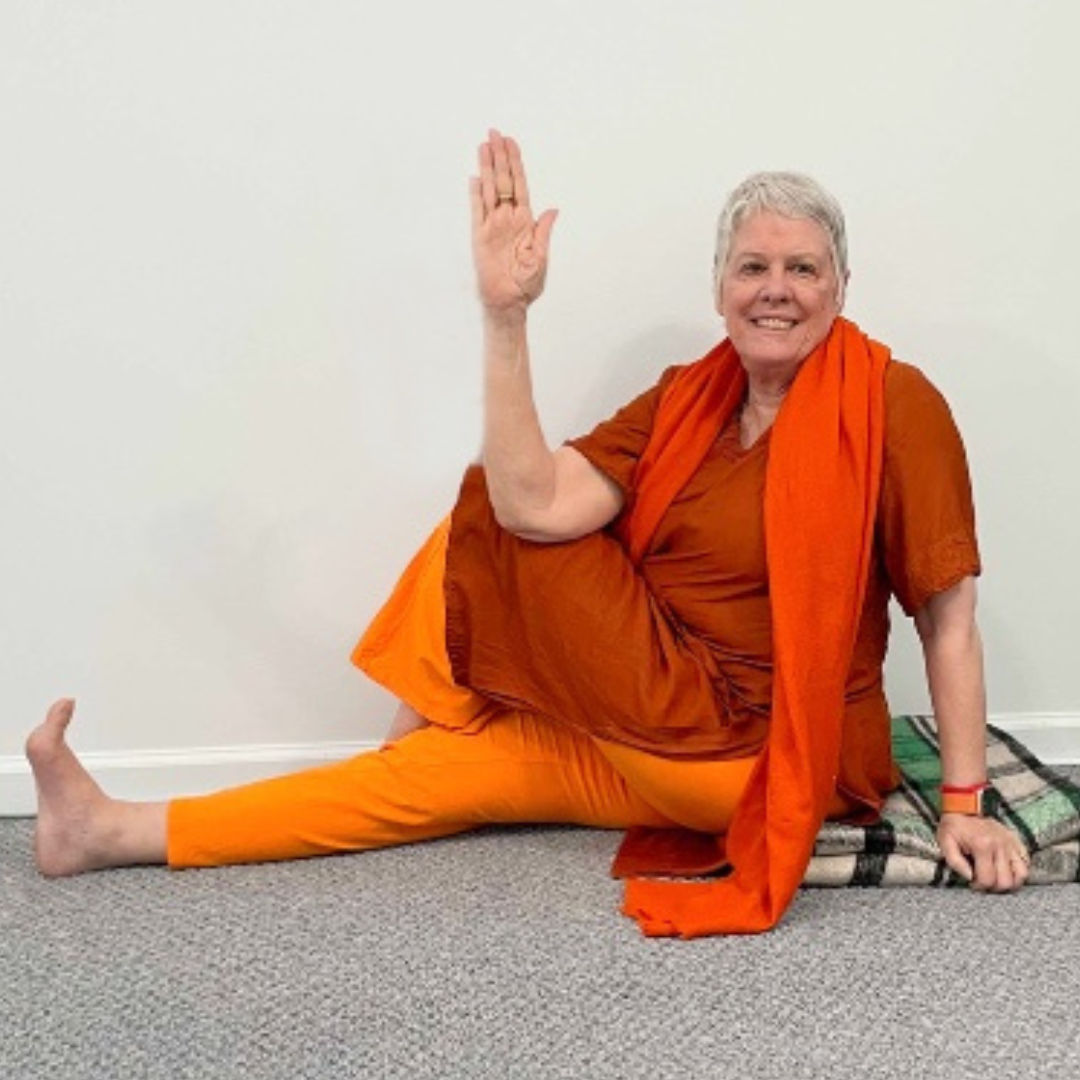
When we have you reach your arm up in the air, it’s not about how far you can go. Instead, we use the angle of your arm as a way to access your spine, like a laser beam shining from your hand, through your arm, through your shoulder and into your spine.

We repeat certain pose sequences, similar to Viniyoga, for their ease and effectiveness. We enjoy a slower paced class, similar to Yin Yoga, and we use yoga props like in Iyengar Yoga.

You get hot in Svaroopa® yoga, but it is inner heat, the most delicious and powerful kind. It dissolves muscular tensions while it untangles your limiting thoughts and beliefs. It’s all for the purpose of setting you free. Yoga is about liberation!

The Sword of Mantra

In the fourth century BCE, Alexander the Great arrived in Phrygia, a kingdom in what is now Turkey. There, outside the castle, an oxcart was parked tied to a post with a complex knot called the Gordion knot.  An oracle had declared that any man who could unravel the knot was destined to become the ruler of all of Asia.  Alexander the Great took a look at that. And he reasoned his way through it, thinking that it…  

—  Gurudevi Nirmalananda

From Gurudevi’s full discourse “Mind, Heart and Soul

Your Words

The splendor of Shiva-Consciousness is imprisoned within you.  The prison cell bars are made of words.  You lock Shiva down and hide him away by the words you use.  You are so powerful.  You can imprison Divine Consciousness.  You can hide God.  You can dim…  

—  Gurudevi Nirmalananda

From Gurudevi’s full discourse “Your Words Create Your Reality

Your Words Create Your Reality

Words create realities. What you say comes into being. It’s as simple as saying, “I’m going to wash the car.” And then the car is clean. But if you said, “I probably should wash the car,” is it going to get clean?

Nope. Not unless someone else contributes their words, “Come on, let’s do it. I’ll help you.” A few simple words change the quality of your day and, for days afterward, the quality of your driving experience.

Words lead to action. That’s because words are an action in themselves.  When you speak words, you are speaking, which is an action.  Even thinking is an action, so every one of your thoughts is an action you are carrying out. Words are powerful, whether they are spoken or not.

Words are described in the Shiva Sutras:

Words have a tremendous influence in shaping our ideas which do not allow us to realize the splendor of Shiva-Consciousness, imprisoned within ourselves.

Wow! This says you use words to imprison Shiva within you. You lock Divine Consciousness up, out of sight, out of mind — by your words.  Your words and ideas shape your whole sense of self…

The splendor of Shiva-Consciousness is imprisoned within you. The prison cell bars are made of words. You lock Shiva down and hide him away by using the words you use.

You are so powerful! You can imprison Divine Consciousness. You can hide God. You can dim your own inner light.  You are able to make the all-pervasive seem to be absent. You can turn this Divine universe into a desolate landscape, all with your choice of words.

Does this incredible power have another outlet? Is there another way to use it?

Excerpt from Gurudevi’s Satsang Discourse, November 10 2024

Giving Thanks?

By Gurudevi Nirmalananda

Focused on family, giving thanks – it sounds like a recipe for worldly bliss, an important part of life.  While you may have found that family time is not always blissful, gratitude certainly is.

When you focus on gratitude, your thoughts change. Instead of fixating on problems or on a checkered past, you make a choice to stay present in the present, even loving and appreciating the best in each and in all. Yes, this will make it be a beautiful day.

Your focus on gratitude changes your brain chemicals. When you express gratitude, your brain releases dopamine and serotonin, two crucial neurotransmitters responsible for you feeling good. They enhance your mood immediately.

Research has shown gratitude to be a ‘natural antidepressant’. When practiced daily, the effects can be almost the same as medications. It provides a long-lasting feeling of happiness and contentment. Gratitude is also linked to more vitality, energy, and enthusiasm to work harder.

The word gratitude is related to the word Grace. They both come from the root gwere, meaning “to favor,” dating back to 4500-2500 BCE. It also shows up in Sanskrit as grinati[3] which means to sing, to praise and to announce.

I sing your praises, that you are here and choose to receive these teachings. On this American Thanksgiving day, I am grateful for the opportunity to serve you. I share what I received from my Baba, which brings me to more gratitude!  Yes, it is going to be a beautiful day.

Breakthrough!

Breakthrough!  Once I received Shaktipat, the old identities couldn’t limit me anymore.  Oh, I still did daughtering. I still did worker-bee. I still did pay-my-taxes, vote-in-elections. I still renewed my driver’s license when it was due.  But they were things I did, not…

—  Gurudevi Nirmalananda  

From Gurudevi’s full discourse “Open The Curtains

Chanting Shree Guru Gita  

By Gurudevi Nirmalananda

The first time you chant Shree Guru Gita can be a powerful experience, whether it’s due to the beauty and power of the chant or because your tongue can’t quite wrap itself around the Sanskrit syllables. You have options about how to participate:

Close your eyes and listen, coasting on the Shakti (energy).

Open youvr eyes and follow along with the Sanskrit.

Read the English silently while the group is chanting the Sanskrit.

Mouth the Sanskrit words silently, or even breathe into them.

Chant quietly, even if your chanting isn’t perfect.

Open your mouth and sing along, even perhaps using a finger to track each word!

Beyond your experience of the chant itself, notice what the chant does for you. Your “Marker Pose” is your state before and after the chant: what is the condition of your body, breath, mind, and heart? How do you feel within yourself — at what depth are you sitting within? By assessing these changes, you can determine the value of this practice for yourself.

Excerpt from Yoga’s Sacred Songs, pages 149‒150

Yogic Transformation

Yoga tells you to focus on your own inner process.  Support your yogic transformation with yoga practices. 

You will change, it is guaranteed.  And the world will change as you change.  When you become healthier and stronger… 

—  Gurudevi Nirmalananda  

From Gurudevi’s full discourse “A Personal Upgrade