Author Archives: Swami Nirmalananda

Unknown's avatar

About Swami Nirmalananda

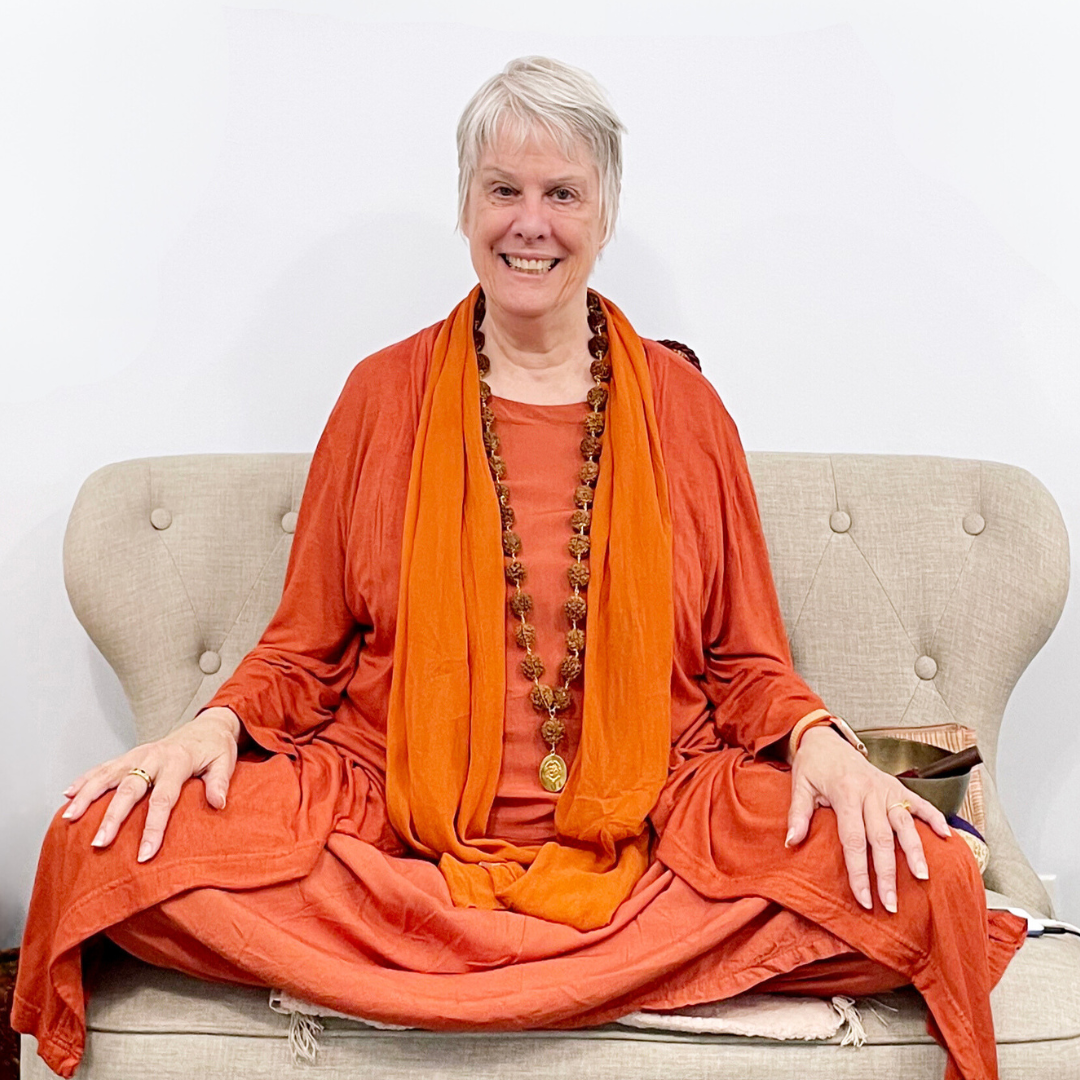
Swami Nirmalananda is a teacher of the highest integrity since 1976. In 2009 she was honored with initiation into the ancient order of Saraswati monks. Now wearing the traditional orange, she has openly dedicated her life to serving others. Usually called Gurudevi, she makes the highest teachings easily accessible, guiding seekers to the knowledge and experience of their own Divine Essence.

The Blue Pearl

By Gurudevi Nirmalananda 

 The universe exploded out from a Big Bang, they say. This scientific theory was proposed in 1927. Scientists studied it for decades with a critical piece of evidence provided in 1964. It was enough that a press conference was held. The next-day newspapers announced, in big headlines, “Big Bang Proved.”

Since then, the scientists continue to refine their theory and come up with new terminology. They now say there was something there before the bang. I call it the “something that banged.”

What was there? What banged? It was a single point, a dot. They call it a singularity. In Sanskrit it is “bindu.” It still exists. It was not destroyed in the bang. You find the bindu inside. It is blue.

My Baba called it the “Blue Pearl.” When you see it in meditation, you are assured of liberation in this lifetime. It is the mystical form of your own Self, which is the source of the universe yet containing the whole.

The sages drew this as the mystical syllable OM. A multilayered sound, you may hear it or see the character when in a deep meditative state. It shows what preceded the Big Bang.

The two stacked semi-circles (like a numeral 3) are the vibration of the One, echoing itself within itself. You can replicate this sound by…

A Yogic Tool for Your Mind

By Gurudevi Nirmalananda

The quality of your life is determined by how you use your mind, not by external events and situations.  

One person can feel crushed about losing her or his job, while another person feels grateful for the chance to reinvent herself or himself.  When you lose someone dear to you, a person or even a pet, you can focus on the loss or you can focus on your gratitude for the way they enriched your life for so long.

Because of the complexity of the mind, yoga offers many tools to help you with your mind.  Yoga has more tools for your mind than for your body.  

One of the most important yogic techniques for your mind is substitution.  Whenever you notice that you are caught up in thoughts that tighten your body or upset you, you can choose to substitute something better.  For example, you may be a worrier. Instead of worrying, you can say a little prayer or send a yogic blessing.

This is a very simple, yet sophisticated technique.  It is based on the understanding that you only worry about people or things that you care about.  The worrying is a way of reminding yourself that you love them.  Unfortunately, every worry makes your body live through the experience as though it is really happening, even though it probably never will…

Excerpt from Yoga: Inside & Outside, pages 166‒167

Yoga For Your Mind

By Gurudevi Nirmalananda

Clarity is when you look inside for answers, even about external things.

Integrity is when you base your words and actions in the inner levels of your being.

Transparency is when you let your inner radiance shine through your mind and life.

They are all based in one thing — your own Self, the light of your own divinity. When your life is based on anything else, you experience the opposite: confusion, fragmentation and density. I call that “normal” because yoga says this is the norm; it’s how most people live. Getting from normal (confusion, fragmentation and density) to a yogic state (clarity, integrity and transparency) is a process.

The process is a complex and multi-layered journey. Yoga’s practices keep you moving and support you along the way. Each time you do your breathing (pranayama) and poses (asana), you open in an inward direction. Svaroopa® yoga makes the opening tangible and even blissful, decompressing your spine from tail to top in every class, in every yoga therapy session or in your personal practice session.

Unfortunately, you can go from blissful inner openness to painful relapse in minutes if you don’t begin to work with your mind. It only takes a short conversation or even just a few of your own thoughts to create the tensions that you spent an hour or more unraveling. Your mind must do more yoga, too. Fortunately, yoga offers practices for your mind.

Excerpt from A Yogic Lifestyle, page 33

The Radical Practice of Contentment

By Gurudevi Nirmalananda

To practice contentment might make you a disruptive element in our modern world. 

Yoga names contentment, samtosha, as a primary practice. But the everyday influences of society propel you to an endless stream of desires. All you have to do is watch one television show and your “Discontent Factor” increases. It is not the shows themselves as much as it is the ads.

They are exceptionally effective at stimulating your desires, which makes you more and more dis-content. Yoga makes you content.

I remember the first time I felt content. I was sitting in my bedroom in a yoga ashram (residential yoga center), and I realized I felt strange. Something was missing on the inside. Something familiar was gone, and I did not feel quite like the “me” that I had known for so many years. But I did not know what it was. I cast about, looking for what was missing, and could not find it. So, I tried instead to describe to myself more specifically how I was feeling.  

Finally, I realized that I felt content. That scared me! While it felt so good to feel such deep contentment, I instantly felt fear that I would never strive for anything again. I realized that all the activities of my life had been motivated by a deep discontent, and now it was gone. It seemed that there was no reason to do anything, ever again.

Excerpt from Yoga in Every Moment, page 46

God’s Grace

By Gurudevi Nirmalananda

When I lead a meditation, at the end I ring the gong quietly five times. It invokes Grace, the fifth of the five powers of God.  

Creation marks the beginning. However, from Shiva’s perspective, this universe is part of the continuity of his own existence, which continues whether there is a universe or not. Creating the universe out of his own energy is a Divine act of great joy and playfulness, like a dog jumping around and spinning in circles. 

Maintaining what he has brought forth is another of Shiva’s cosmic powers, supporting and nurturing its continuation. Bringing things to an end when their time is up is another Divine act, called destruction. This includes unforeseen endings as well as the end of winter. Shiva as the destroyer is greatly honored by yogis, for he grants enlightenment by ending delusion. 

These three actions are frequently cited in the Old Testament, naming God as the creator, the nurturer, and the chastiser. The book of Psalms includes all three: 

O Lord, how manifold are your works! In wisdom you have made them all; the earth is full of your creatures. (104.24) 

God is our refuge and strength, a very present help in trouble. (46:1) 

He opposes the wicked and condemns them. (34:18) 

Yoga recognizes two additional Divine actions: concealment and revelation. Of many Sanskrit names for God, it is specifically Shiva that conceals and reveals. Shiva is the mysterious one, the mystical one, the most benevolent, the revealer of the hidden dimensions within every human being. 

Concealment is accomplished by Shiva masquerading as the mundane world, hidden within all beings, all objects and all actions. God disappears by… 

Uncovering Your Own Self

By Gurudevi Nirmalananda

Yoga says that if you quiet your mind, even for a moment, you will experience your own “capital-S Self.”

You don’t have to create a Divine Essence because your Essence is already Divine.  You don’t have to become somebody or something.  You are already radiant Consciousness.  All you need to do is uncover it. 

Yoga practices essentially subtract away the stuff that gets in the way.  They remove the blockages until your own capital-S Self is revealed. 

This is why, at the beginning and at the end of programs, I bow to your own Divine Essence.  I chant: “OM svaroopa svasvabhava namo namah.”  Namo means “I bow to,” and namah means “I bow to.”  So I translate namo namah as “again and again I bow.” 

To what do I bow?  To svaroopa, your own Divine Essence.  Yet while I am bowing to you, I am bowing to my own Divine Essence.  Because there is only one Divine Essence.  The One Reality is being each of us and all of us at the same time. 

It is like light that shines through a window with many panes; the reflection on the floor looks like different squares.  Yet there is only one light.  The one light takes on all the different shapes so it can shine in all the different forms.  The One Reality has become you, me and all that exists…

— Excerpt from Yoga: Embodied Spirituality, pages 17‒18

The Importance of Connection

By Gurudevi Nirmalananda

Yoga says that your need for connection is a spiritual need, not a social need. 

The superficial conversations about the weather and traffic conditions are entertaining, but they don’t fill your need for connection. You make a connection in that shared moment of frustration over the traffic jam or the shared joy during the first snowfall. 

Even if it is only a moment of connection, a whole hour of superficial conversation is worth it. When the connection doesn’t happen, you think that person is a waste of time and you try to avoid them in the future.

Here’s what happens. When you share an experience with someone else, you have an understanding of the other person, while they understand you.  This understanding is a type of validation, making you feel that you are worthwhile as an individual — you are understood and accepted, in your frustration with the traffic or joy of the snow. 

Yet that is still superficial. If you both agree that snow is a big hassle, and there’s all that scraping and shoveling to do now, you have a shared experience, but you don’t yet have a connection. It is only a shared experience.

But if your eyes meet or there is a silent pause, that shared experience turns into connection. In that moment of connection, something happens inside of you. Something opens on the inside. 

Excerpt from Yoga: Inside & Outside, pages 205‒206

Your Wholeness & Radiance

By Gurudevi Nirmalananda


Integrity is a wholeness that makes you invulnerable.

All the levels of your being and your life are fully aligned. What you say is also what you think and feel. What you do matches up to all your other levels.

No one can undermine you when you live in integrity with yourself. It’s an easy way to live because you’re always consistent, both with others as well as with yourself.

You gain this integrity by using your mind differently than most people do. They look outside for answers but, as a yogi, your mind always looks inward for guidance. Thus, you select your words and make decisions to do things that are in integrity with your own Divine Essence.

Transparency means you have nothing to hide. The old ditty bag that you carried around for so many lifetimes has been completely emptied out, so you have no grudges waiting to be fulfilled, no obsessions or aversions to limit your joy, no “gotta’s” that propel you in slavery to your animal instincts and no neediness to infect your relationships or your decisions.

The radiance of your own being shines through without impediment, allowing you to enjoy the perpetual sunshine inside plus share it with the others in your life…

Excerpt from A Yogic Lifestyle, page 32

The Formless Being Form

By Gurudevi Nirmalananda

The four-fold model of Consciousness details how the One, being formless, manifests into form. As one of his honored names, Shiva is called jagat-sharira, universe-bodied.

Like water becomes ice, yet is still water, Shiva becomes the universe. But he is not limited by it. Nor is he limited to the universe, for he is beyond the universe as well as being in it and being it. You are a form of the formless as am I and everyone you know.

Shiva is also being everyone you don’t know, as well as being everything that exists. Shiva is also everything that doesn’t exist, for if you can think of it, your thought is made of Shiva.

How does this come to be? He coalesces into physical matter through four dimensions. We look at this because my Baba urged us to understand the physical and subtle principles from Shiva to the earth. This gives you mastery over the world as well as a pathway to follow inward.

Shunya — the Void is Shiva’s way of hiding from himself. Since he is Beingness-Itself, he masquerades as Nothingness. In the vastness of his own being, he appears as non-being, like a vacuum. Yet when you experience the void, you are…

Who Are You?

By Gurudevi Nirmalananda

You don’t have to become somebody or something. You are already radiant Consciousness. All you need to do is uncover it. Yoga practices essentially subtract away the stuff that gets in the way. They remove the blockages until your own capital-S Self is revealed. 

This is why, at the beginning and at the end of programs, I bow to your own Divine Essence. I chant: “OM svaroopa svasvabhava namo namah.” Namo means “I bow to,” and namah means “I bow to.” So I translate namo namah as “again and again I bow.” 

To what do I bow? To svaroopa, your own Divine Essence. Yet while I am bowing to you, I am bowing to my own Divine Essence. Because there is only one Divine Essence. The One Reality is being each of us and all of us at the same time. 

https://www.pinterest.com/pin/198158452344896421/

It is like light that shines through a window with many panes; the reflection on the floor looks like different squares. Yet there is only one light. The one light takes on all the different shapes so it can shine in all the different forms. The One Reality has become you, me and all that exists. 

In this phrase, I love the word svasvabhavah. It comes from Abhinavagupta, a Kashmiri Shaivite sage who lived a thousand years ago. He wrote…

— Excerpt from Yoga: Embodied Spirituality, pages 17‒19