Author Archives: Swami Nirmalananda

Unknown's avatar

About Swami Nirmalananda

Swami Nirmalananda is a teacher of the highest integrity since 1976. In 2009 she was honored with initiation into the ancient order of Saraswati monks. Now wearing the traditional orange, she has openly dedicated her life to serving others. Usually called Gurudevi, she makes the highest teachings easily accessible, guiding seekers to the knowledge and experience of their own Divine Essence.

Living Mysticism 2024 Calendar Journal

NEW BOOK by Gurudevi Nirmalananda

Make your life spiritual, brimming with joy and peace. Such a life knows neither pain nor agitation.

I received this promise from my Guru and extend it on to you. May these modern-day sutras, short quotes from my writings and discourses, help you base yourself in the inner infinity of your own Divinity.

There are many ways to use these pages.  It’s small enough to fit in your purse, yet substantial enough to hold your whole year for you.

▼ As a calendar, these pages can help you organize your days.

▼ As a journal, you have space to write or draw about your meditations or your life – or both.

▼ You can fill the pages with mantras or prayers, invoking Divine blessings with each one.

▼ Or use the daily sutra as a jumping off point, to contemplate the teaching more deeply.

When you weave these teachings and practices through your life, your meaning and purpose are easily fulfilled. Your eyes shine with light and your heart overflows, giving you clarity, understanding and generosity. What a way to live!

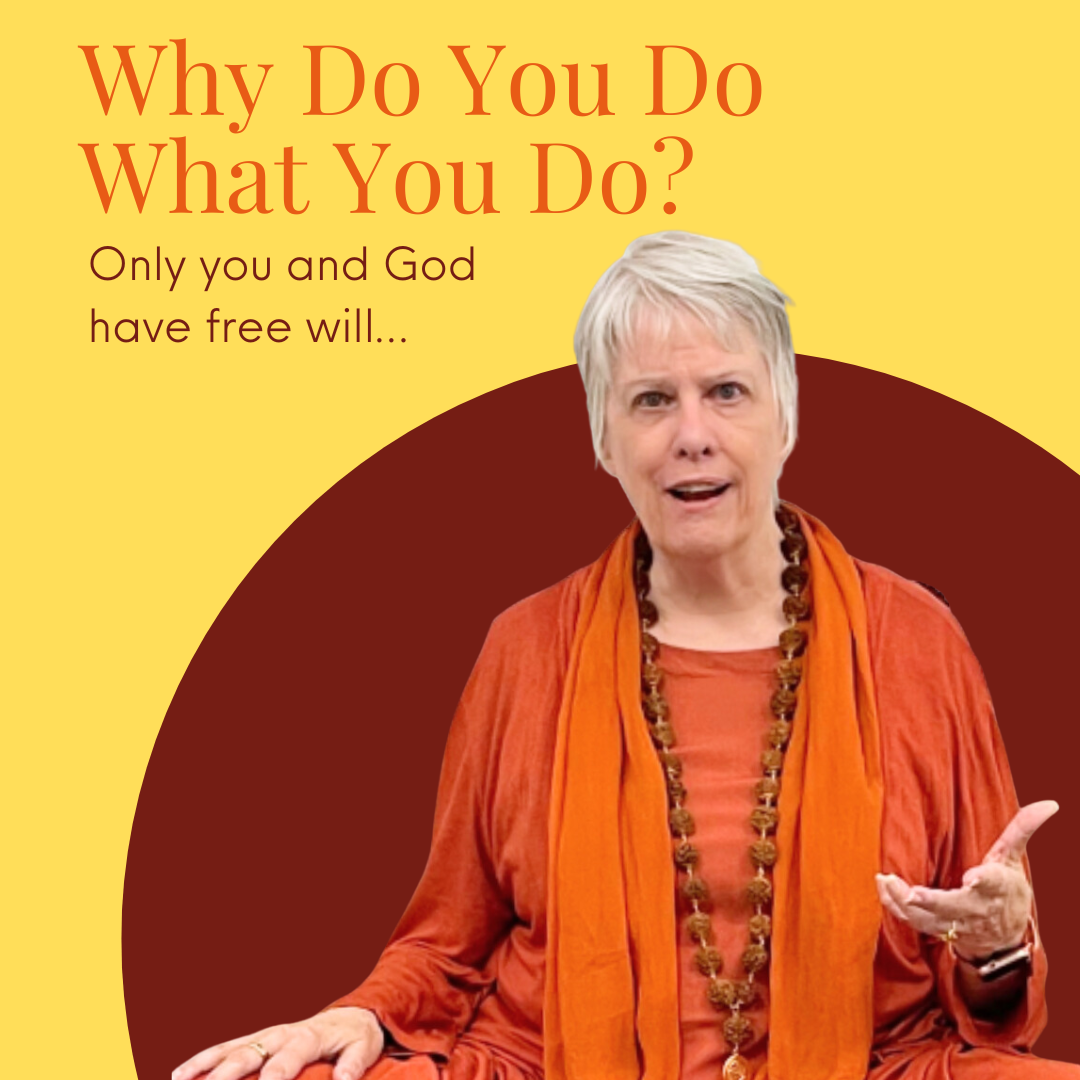
Why Do You Do What You Do?

By Gurudevi Nirmalananda

There’s always a reason behind your actions. You are a volitional being, meaning you have free will. Animals function by instinct but humans have more options. What is it that motivates you?

When you lack any of the basics, they are your priority… Yoga honors the reality of such needs and reactions. You must prioritize basic issues, perhaps making yoga part of your support system when setting up a better quality of life. I have been fortunate to help a few yoga students facing such difficulties. Yet I recognize that most people come to yoga only when their basics are managed.

Once you have room to look at yourself and your own process, I ask — why do you do what you do? Hopefully you’re not focused on the instinctual level anymore. You have some breathing space in your life, enough that you’re interested in yoga. That means you have freedom of choice.

As an adolescent, I made choices based on anger. I was deeply frustrated at the incongruity between the ideals I’d been taught compared to the reality of the world around me. The prevailing message seemed to be, “Do what I say, not what I do.” My knee-jerk response was to try both what was recommended as well as what was advised against. What I learned in the process fueled my aspirations for something greater. I first sought it in higher education, but intellectual achievements were not enough for me.

Only yoga’s timeless teachings satisfied me. Now, for five decades, I’ve deliberately deepened my yogic knowledge and the experiences it has opened up in me. This is truly a bottomless well! Yoga has empowered me to live up to the highest ideals, yet in a down-to-earth way.

I think of my life’s path as a good use of my free will. Svatantra means free will. Svatantrya is God’s free will. Only you and God have free will. It is the distinguishing characteristic of…

The Yoga of Relationship

By Gurudevi Nirmalananda

The intimate connection that you seek with another person is more than a meeting of minds and more than a meeting of bodies.

The point at which com­munication becomes communion is the experience of union. This is the goal of yoga, and the meaning of the Sanskrit word “yoga” itself — union. 

Once your innate yearning connects with your own inner source that fills it, you experi­ence this connection and communion with everyone. It is the natural outward expression of the inner experience. 

My own experience of relationships has been transformed by yoga. I have dif­ficulty naming it “love.” It is somehow both more and less than what I always thought love was. Whatever you want to call it, it is yoga. This is what makes our relationships work.

For me, it includes a deep respect for every person, along with a genuine interest and caring for how they think, how they feel, and for what is going on in their lives. 

Because of this, I never tire of talking with students about their lives, about their body, about their feelings, and especially about their experiences of yoga. I feel deeply honored by their sharing with me. I am grateful for this opportu­nity to share my understanding and my experience of yoga with you..

– excerpt from Yoga in Every Moment, page 2 

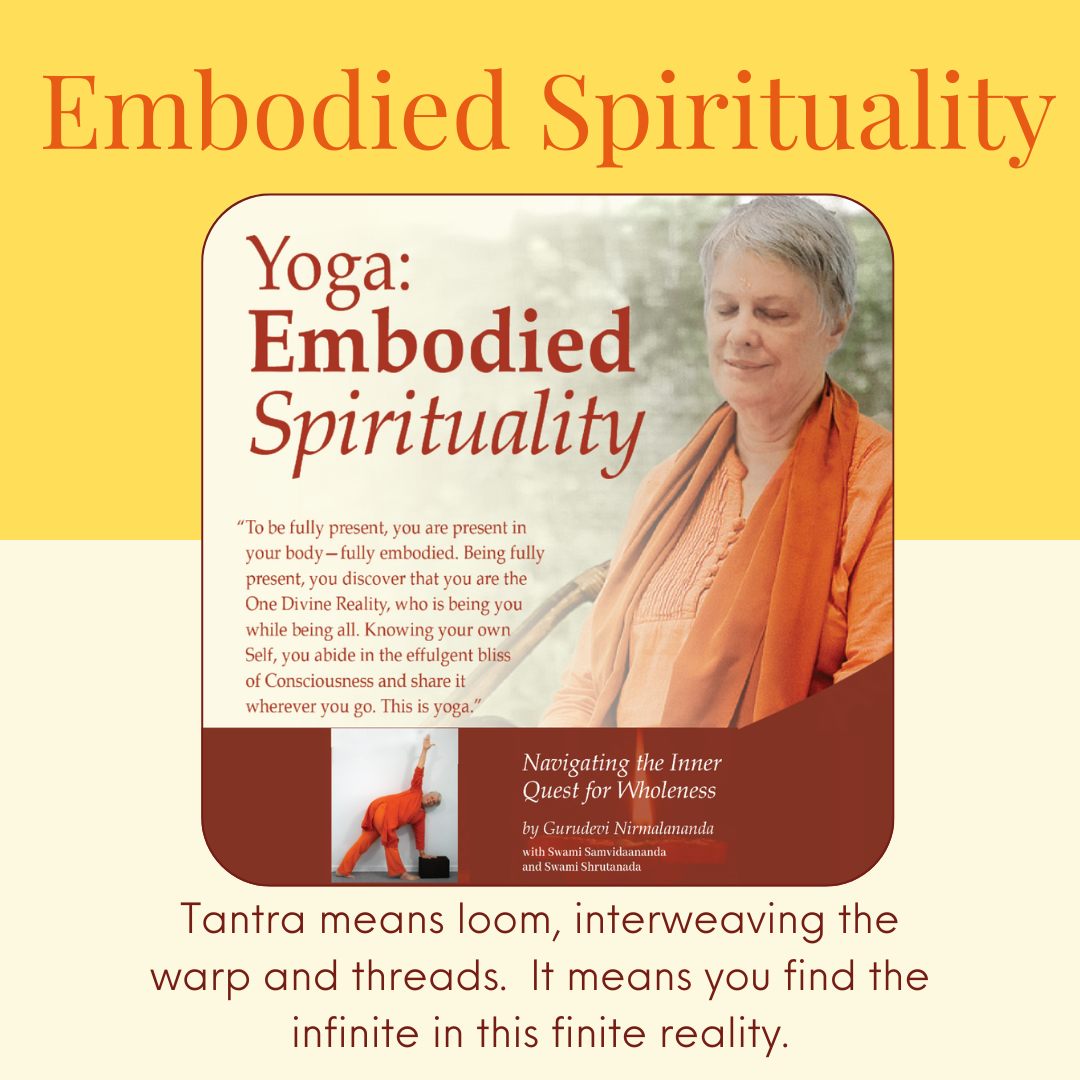
Embodied Spirituality

By Gurudevi Nirmalananda 

Tantra means loom, like a weaver’s loom that interweaves the warp and the woof threads.  It means that you find the infinite in this finite reality.  

You discover the Divine which is already present within the mundane.  The tantric sages say that the One Reality, which has always existed, decided to manifest the entire world and everyone in it. Everything is Shiva being the world as well as being beyond the world.  

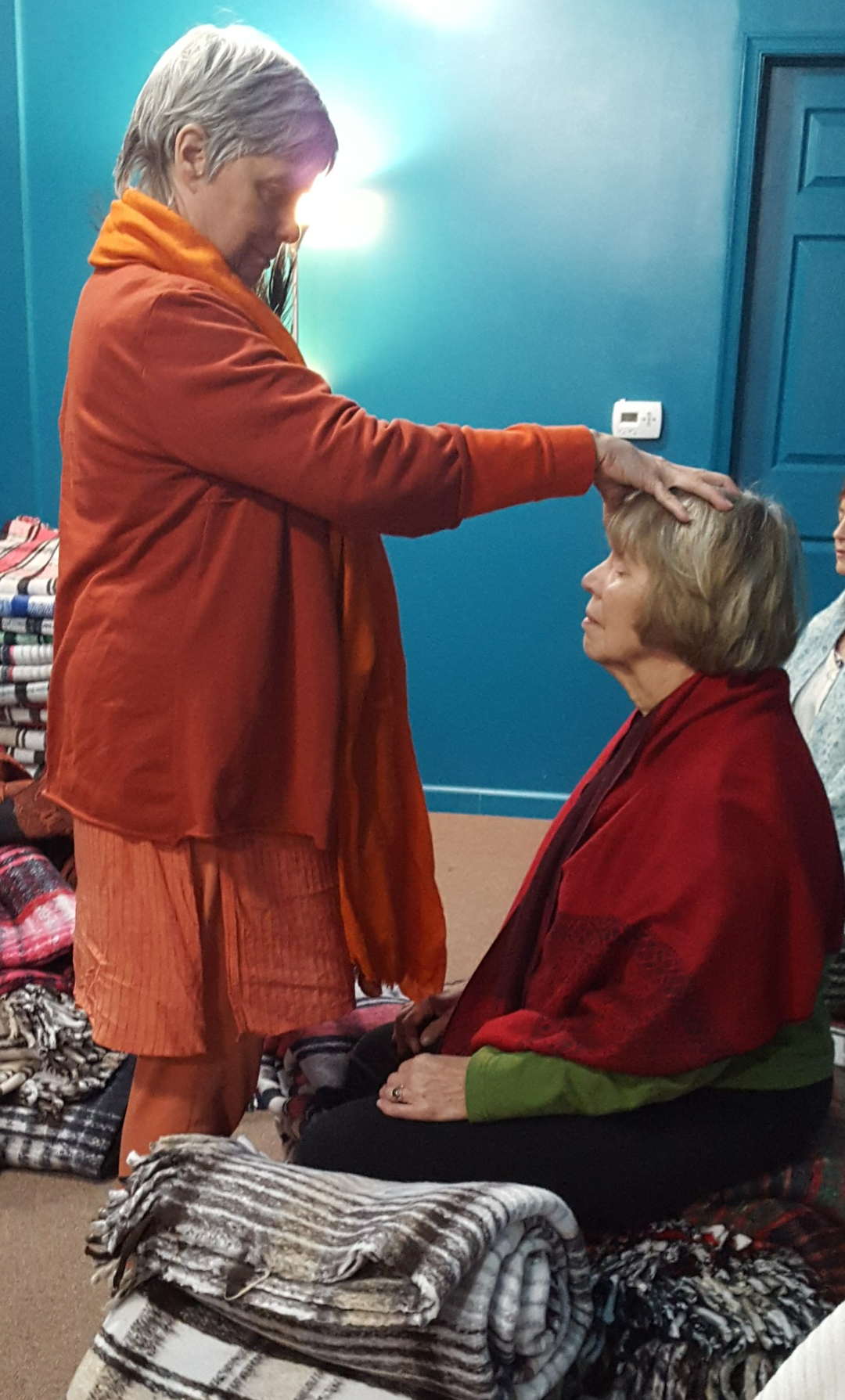
The doorway into this tantric tradition is through initiation — Shaktipat.  It is a transmission of energy that awakens your own dormant energy, hidden within.  Your awakened energy then climbs your spine from the tip of your tailbone to the top of your head.  The purpose of all Svaroopa® practices is to awaken and support the blossoming of this spiritual energy in you.  

During meditation, signs of this inner awakening include little swaying movements, even small little jerks that deepen your meditation.  You may feel an inner heat climbing up your spine and spreading through your body.  You can be drawn into a deep and profound meditative state, so deep that it feels like sleep.  It is a deep meditative immersion into Consciousness.  

In your inner explorations, you may see lights, colors and visions, or you may hear divine inner sounds.  Or sudden and profound insights may be revealed.  These are all the results of Shaktipat — the inner awakening.  This is the beginning of embodied spirituality.  

Once you have received Shaktipat, the end goal is guaranteed — enlightenment in this lifetime.  I describe it like this: Once a baby is born, puberty is guaranteed.  Once you receive Shaktipat, realization is guaranteed.  

As cosmic energy moves through your spine, it vitalizes your body.  I can’t say revitalize because that would imply you were getting energy you’d previously had.  Rather, this is a vitality you never knew.  Your body undergoes energetic and cellular changes, profoundly beneficial.  

Yet the most important effect is that a profound inner state opens up for you.  Your new inner stability and depth provide additional physical benefits.  Your inner essence is expressed through your body and is experienced in your body, even while there is so much more.  

Svaroopa® yoga poses create and support this process.  Our sequencing always starts at the tip of your tailbone, followed by poses that mirror the inner opening of Shaktipat.  These practices support your inner upliftment, helping to dissolve blockages along the way.  Yet, as powerful, beautiful, wonderful and blissful as the poses are, they are only the starting point.  

Ultimately, the real work is accomplished in meditation. Meditation is where you let your Divine inner energy move through your spine.  This energy restructures your body and opens up your mind.  Your most powerful practices are mantra and meditation.  They will fulfill the promise of the sages, embodied spirituality: 

to know without thought

to BE without effort

to experience without fear or desire

to abide in the bliss of Consciousness

to live in the multidimensionality of your own being

to know your own Self as the Divine Incarnation that you already are.

-Excerpt, pages 22-24

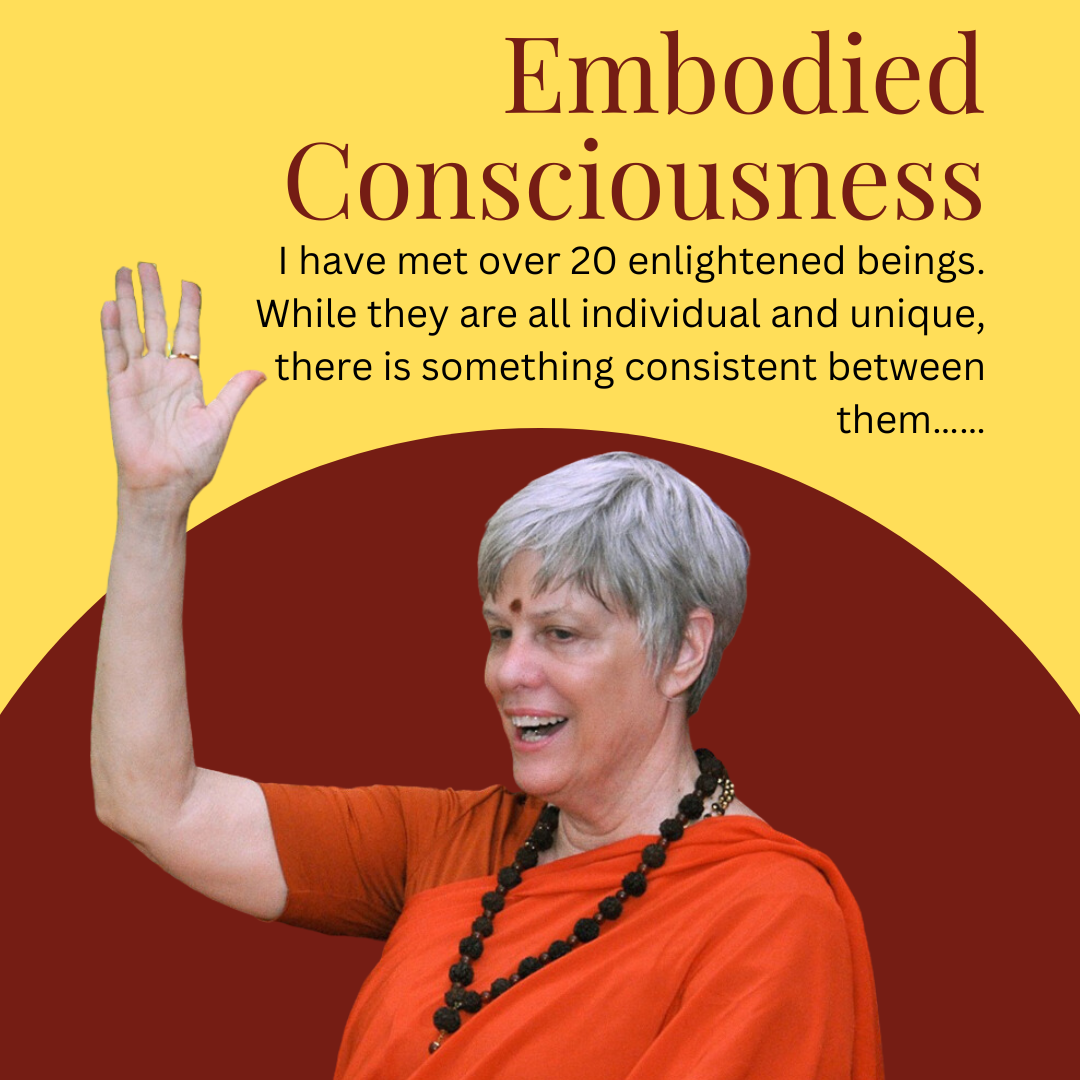
Embodied Consciousness

By Gurudevi Nirmalananda

The goal of spirituality is not merely “Consciousness,” but “Embodied Consciousness.”  What does that mean?

It means you attain the ultimate state WHILE you live in a body, not after you leave it. Many spiritual traditions honor only those who have left their bodies.   In the West, no one can be called a saint until they’ve been dead for 50 years or more.

Some traditions focus on getting enlightened on the way out.  Tibetan Buddhism is well-known for its “Book of the Dead,” which is an instruction manual for your departure. Krishna-Consciousness has the goal to merge after you finish your life on earth.

The Kashmiri Shaivite tantric tradition says you can be enlightened and enlivened at the same time.  The goal is embodied Consciousness.

Tantra means loom, referring to the interweaving of the warp and woof threads, the Divine Reality and the mundane realities. The goal is to know your inherent Divinity while you are alive, and to see that same Reality in all others, all of the time.

Is this even attainable? You might wonder at the possibility for yourself.  Tantra says yes and that you need help from an enlightened Master to get there yourself.

Gururupaaya.h. — Shiva Sutras 2.6

The Guru is both the means and the goal.  

If enlightened living is possible, surely someone must have made it.  Many different someone’s, throughout the ages, not merely one who lived 2,000 years ago.  Were there others?  Are there others?

Yes.  Emphatically yes!  I have been blessed by meeting over 20 enlightened beings, from my own tradition as well as others. While they are all individual and unique, there is something consistent between them – their inner state is expanded beyond the norm.  And it is visible to others.

This is great in two ways:  1) that there are many enlightened beings living now, and 2) that you can see they are different.  They embody the goal.  Remember, the goal is embodied Consciousness.

You might decide, as I did, to get out there and meet as many as you can. Yet each one of them will tell you, “Pick one of us and focus.  Do the practices that we share, for we know that they work.  Cultivate your ability to be in relationship by developing your relationship with me.  It will overflow into your life and all your relationships.”

I was fortunate that I already had a decade with my own Guru before I went to meet others. I didn’t get confused by their different approaches.  Why do they bring so many different approaches to spirituality?  Because there are so many different kinds of people.

I was able to see their Divine light and to honor them without being pulled off my path. My roots grew deeply into Consciousness with my Baba, for which I am ever grateful.

It was easy, for Baba was “rupa” — the form, the embodiment of Consciousness-Itself.  And he was the consummate “Guru” — teacher, guide and protector.  He sheltered and nurtured me for all the years I needed it, then sent me with his blessings when it was time for me to fly.

Yes, the Guru is the goal. Baba emanated Divine Consciousness. Sitting in his presence was like sunbathing, something I know from my California adolescence.  I got warmed all the way into my bones, into my soul and deeper.  I melted into the Divine Essence that I already was.  Baba showed me it was possible.  And he showed me the way.

Yes, the Guru is the means to the goal.  The Guru dispenses Divine Energy, the energy of upliftment, which is most concentrated when giving Shaktipat.  The Guru dispenses teachings, the flashlight you use to find your way through the inner darkness.  

The Guru lives in the constant flow of inner illumination and shares it abundantly.  You need all of this in order to attain the highest – which is the knowing of the One Divine Reality that you already are.  Thus you become embodied Consciousness.

Yoga and Nutrition

Consistent mealtimes. Delicious food in measured quantities.  Your burp means you ate enough.  

Vegetarian food, but of the highest quality, including being protein rich – which is why yogis in India include dairy in their diet.

I have been healthier since I began eating this way than I ever had been. Raised as an omnivore, when I ate meat, I was consistently anemic.  

It disappeared when I became vegetarian.  I attribute it to a more efficient digestion process.  Meat is incredibly hard on the human digestive system.  Better yet, I can tell that my innards work more efficiently – smooth and easy.  It’s wonderful!

When I was a child, my mom fed us meatless meals one or two days weekly, just like she ate when growing up on the farm.  They couldn’t afford to kill off all their farm animals.  They needed them for producing eggs and milk, as well as pulling the plow, etc.  Tractors came along later.  I remember riding on my uncle’s brand-new tractor when I was 10 years old.  It was very exciting.

Good news!  The FDA and American Heart Association approve of vegetarian eating.  But that’s not why yogis do it.  Yoga’s first ethical principle is ahimsa, non-harming.  It is clearly harmful to the animal to eat it.  George Bernard Shaw was more graphic about it, saying:

I choose not to make a graveyard of my body with the rotting corpses of dead animals…

A man of my spiritual intensity does not eat corpses.

Yes, spiritual intensity goes along with vegetarianism.  Spiritual depth is the purpose of yoga, as described by the ancient sages who created it.  You may have to get beyond the hard breathing and sweat before you discover the inner spaciousness that is found only in stillness.  This is yoga’s specialty.

In the beginning of my vegetarian process, I thought tofu was a little scary.  I knew about beans from my mom’s cooking and from Mexican food, one of my lifelong favorites.  Then I discovered Indian food, later Egyptian and Ethiopian cooking.  All of these feature bean-and-grain combos, the cornerstone of vegetarian nutrition.

Wheat is a big boon to humankind!  I recognize that a current food fad is gluten-free, but I’m hoping it will pass soon.  Every person I’ve met who is proudly gluten-free is also unfortunately protein deficient. 

Wheat is a high protein grain, readily available in many forms.  It was the cultivation of wheat that made civilization possible.  When the early humans found they could grow their protein instead of following the herds on their seasonal migrations, they were able to settle into villages.  Later came cities.

I had a profound and ecstatic meditation experience where I found the whole universe within my own being. I realized I could never eat meat again, as it would be like eating my own body.  Yes, spiritual intensity.  Blissful, life-changing spiritual intensity, for which I am ever grateful.

I had to learn how to cook all over again.  I went to school back in the day where we had “Home Ec” classes.  We were taught about nutrition as well as cost-conscious meal preparation.  I knew how to make the cheapest cuts of meat both tender and tasty, though now I confess that the idea turns my stomach.

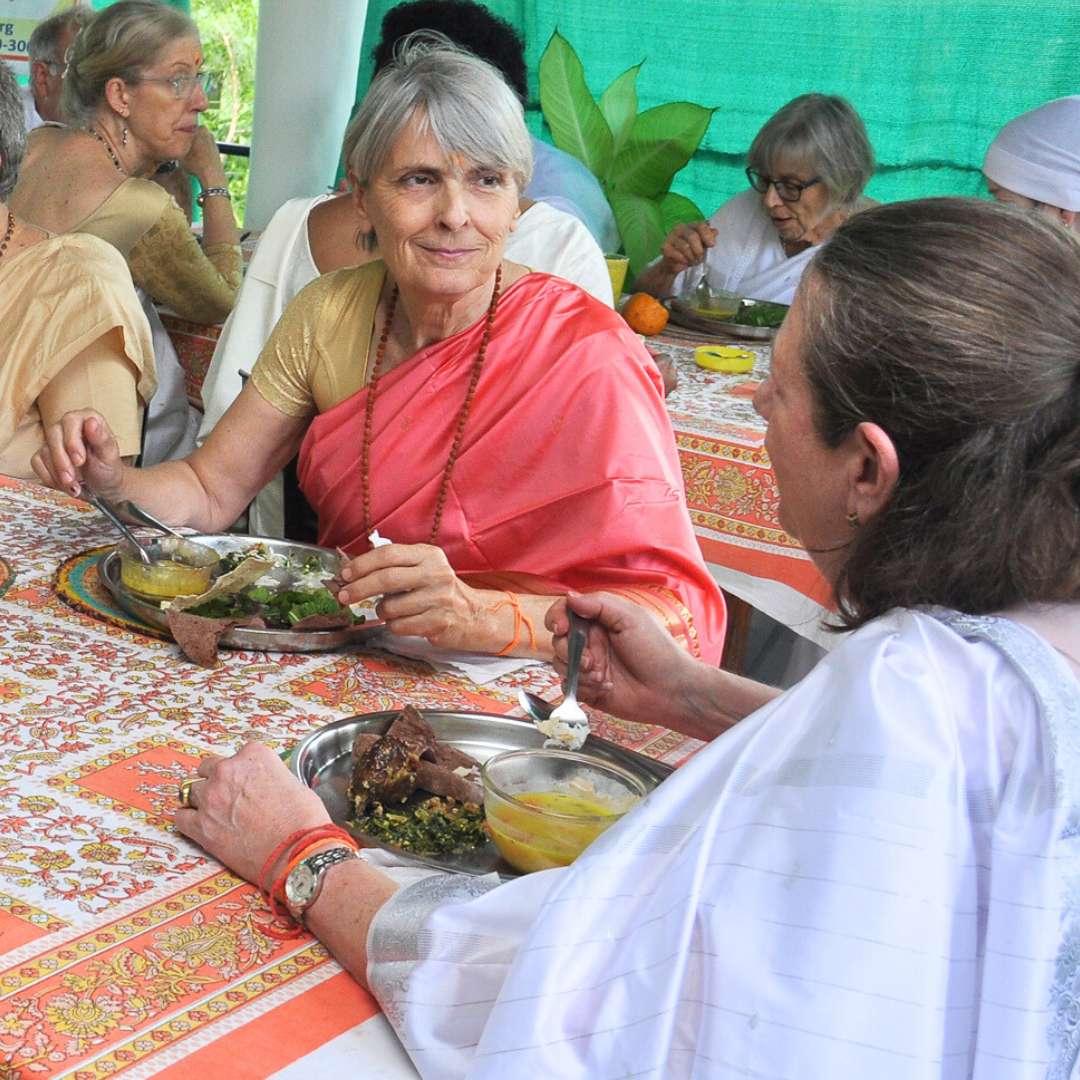
I am still responsible for feeding groups of people every day.  In addition to the Ashram residents, we often host yogis on retreat.  Making sure they have delicious food is not enough. It must also be nutritious, so they can do the deep practices we enjoy.  We get 20 grams of protein in every meal, working with variations on four themes:

  1. Beans and Grains together (including wheat)
  2. Nuts
  3. Tofu (a cheese made from soybeans, another bean)
  4. Dairy (including cheese)

It is easy to create a variety of palate pleasing meals, especially with the many online recipes now available.  We also include all six tastes in every meal, as described by Ayurveda, the medical system aligned with yoga.  The combination of the six tastes along with sufficient protein does away with all cravings.

It also makes it easy to give your belly a rest between meals.  Yoga recommends 4-6 hours between meals, so your digestive organs can process your food and then rest before their next task.  A heathy belly is the key to overall health, according to Ayurveda.  Beyond that, it makes you happy.

Consistent meals, this is where I started above.  It was when I moved into my Guru’s Ashram that I began eating at the same time every day.  I was amazed at how anxiety fell away, both from my mind as well as my body.  Food anxiety is a real problem for many people, even if they have the money to feed themselves.

Creating a food discipline is a beautiful yogic discipline.  It supports early-to-bed, early-to-rise, as recommended by Ben Franklin, another famous Westerner.  Yogis love the pre-dawn hours, where meditation is so easily accessible.  The sweet quiet time, on the cusp of sunrise, and the ecstatic energy of the rising sun are the best way to start your day.

When you’ve begun your yoga at 3 or 4 in the morning, maybe as late as 5 am, you’re ready for a real meal soon after.  The rest of your meals follow the sun – midday and sunset, or maybe dinner will be a little later in the winter hours or regions near the earth’s poles.

Food!  What a glorious punctuation point in the day!  However, choosing food that supports your spiritual upliftment may require some retraining.  Even your taste buds change.  You start to like things you never imagined.  It was quite a shock to my mind to discover that my body likes cilantro.  I now sprinkle it on lavishly.

Nutrition can be quite complicated.  Well, the science of it is fairly simple, whether you’re looking at modern medicine or the ancient medical system of Ayurveda.  But we get it all mixed up with family and worse – with need, greed and fear. Fortunately, yoga frees you from these limiting emotions, thus contributing to yogic nutrition and even a yogic family life.  Can you imagine?

Resources:

  • Search online for “Converting to Vegetarianism” or invest in one of the many books on this important topic.
  • The six tastes of Ayurveda are detailed in many online sites, easy to find and to implement in your food choices.
  • Swami Nirmalananda teaches a “Yogic Nutrition” course, which covers these many topics in detail.  It also features in-kitchen cooking lessons in each class.  Check our Program Calendar for dates. Or email us at programs@svaroopayoga.org

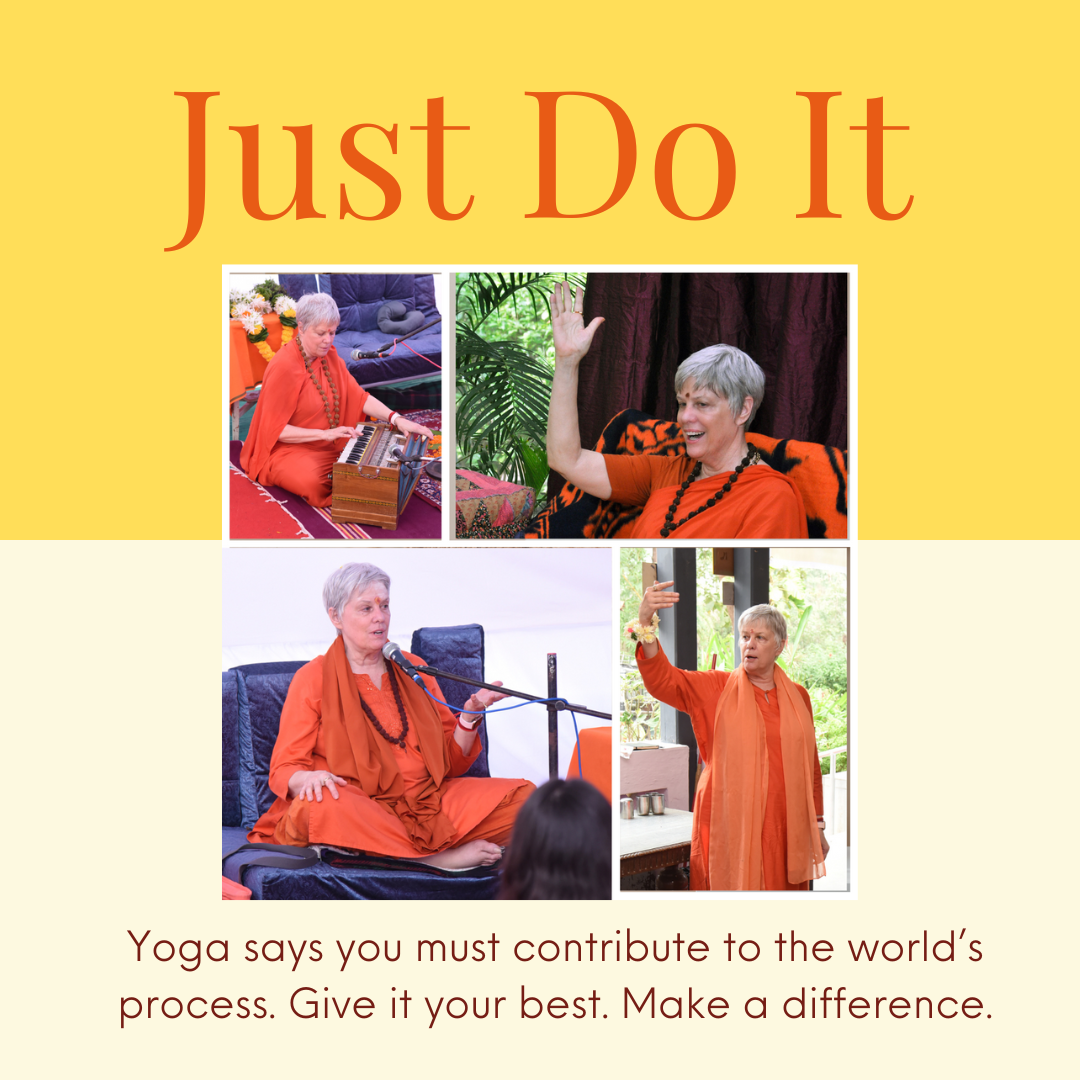
Just Do It!

By Gurudevi Nirmalananda 

This is not only good advice, it’s a famous advertising slogan — Just Do It. It captured the zeitgeist of the time, a great sense of possibilities. It’s a perfect slogan for a tantric yogi, one who brings their spirituality into the world.

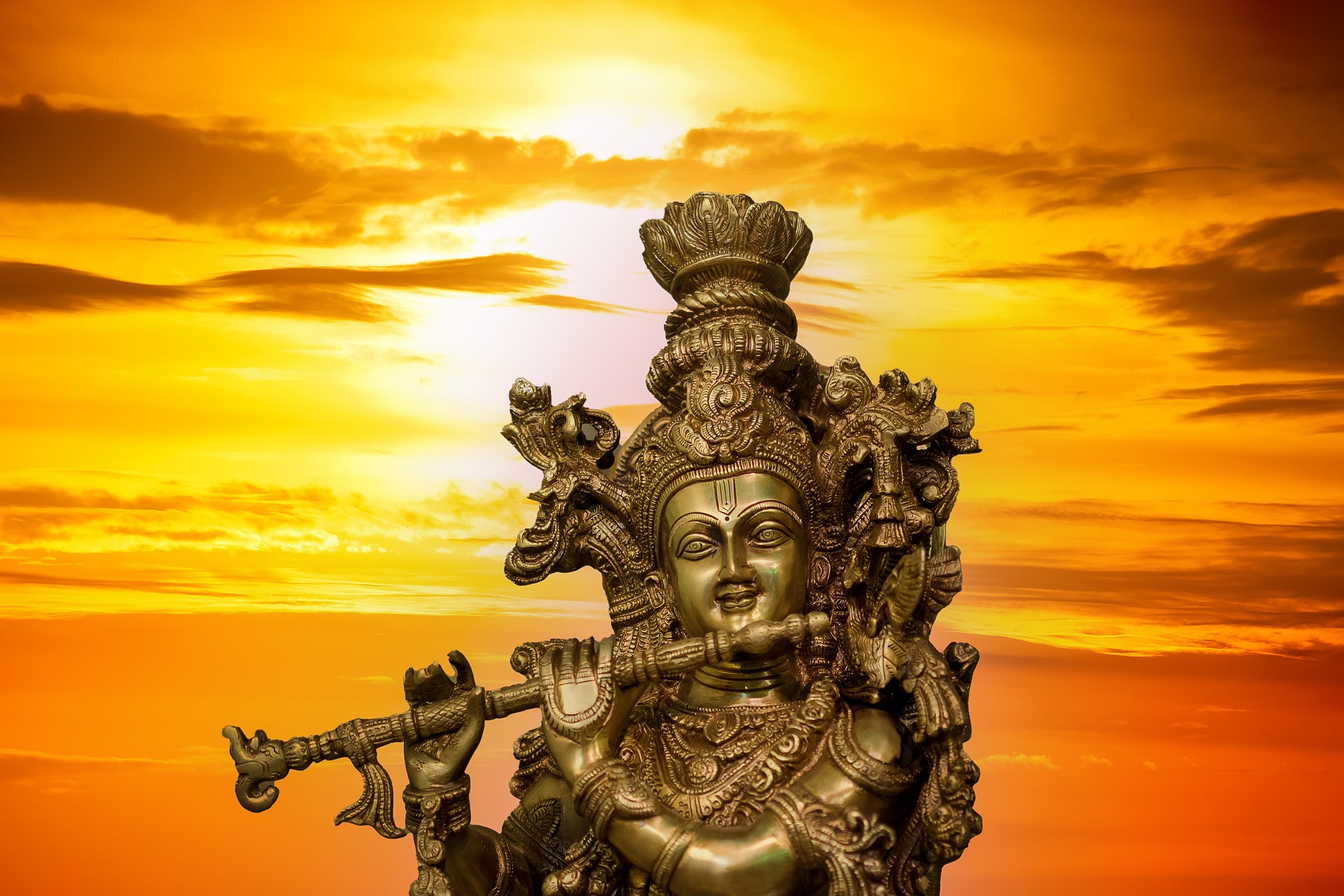
The Bhagavadgita defined this yogic approach to the world. Krishna says you must contribute to the world’s process. Give it your best. Make a difference.

Buddhi-yukto jahaatiiha ubhe suk.rita-du.sk.rite,

tasmaad yogaaya yujyasva yoga.h karmasu kau”salam.

— Bhagavadgita 2.50

Established in clarity, shed selfish motivations that create

pleasurable and painful karmas.

Devote yourself to yoga. Skillful action is yoga.

Yogis of yore withdrew from mainstream society to live in nearby forests. Similarly, in Egypt the desert hermits lived in remote caves. Hearing of these spiritual extremists, you might think that you should leave the world, to try to get enlightened by yourself. However, those living in the Indian forests and Egyptian deserts were not solo seekers. They lived together in small groups under the guidance of experienced teachers. They were not into DIY spirituality. 

Krishna’s teaching was a radical revamp of the tradition. He said, “Get out there and make a difference in the world.” Why such a change? It was because the world had changed. He lived on the cusp of Kali Yuga, our modern age, predicted to be a time of increasing darkness. Krishna said the world needs the yogis. You must bring your light into the world. Get up and get going. Just do it.

His teaching was revolutionary in another way. While you choose to act in the world, doing your absolute best, a yogi’s motivation is different than that of worldly-minded people. You’re not doing things so you can get a karmic payoff. While people will work hard to get a promotion, their improved status and salary are karmic payoff for their efforts. Doing something nice for others, so they appreciate you, means you’re looking for the karmic payoff. Krishna says, “See what needs to be done and do it. No payoff needed.”

Proactive. Professional. Proficient. And not looking for the results to make you feel good about yourself. Instead you analyze the results of your efforts as a way to…

Inclined Towards Enlightenment

By Gurudevi Nirmalananda 

Then your mind is inclined

towards discernment and

 is heading toward liberation.

Tadaa viveka-nimna.m kaivalya-

praagbhaara.m cittam.   

— Yoga Sutras 4.26

This sutra is near the end of his text, meaning you’ve done the deep spiritual work he describes.  Then, having trained your mind for a while, it becomes inclined towards two things:  discernment and liberation.  Discernment means you easily distinguish between what uplifts you compared to what tears you down, and that you make intelligent choices. Liberation means you become free from the cycle of reincarnation, thus this is your last lifetime.

There’s a hitch.  First you have to train your mind for a while.  How long?  Well, just like training your dog to sit, it depends on how much time you put into it every day.  If you make a stab at it once a week for 10 minutes, it will take much longer than if you spend an hour on it daily.  You choose, basing your choice on what’s important to you.  If you want to get enlightened, you like to put time and energy into it, just like with anything else for which you might aspire.

A research study proves that Patanjali’s promise is valid.  When you put some time and energy into upliftment, you get uplifted.  

Burton & King1 asked participants to write about IPEs (intensely positive experiences) for 20 minutes daily for three days.  The members of their control group wrote about different topics.

They were all evaluated for mood and health at the beginning and three months later.  Those who wrote about IPEs for 3 days had enhanced positive mood scores compared to the control group. They also had significantly fewer medical visits for illness in the three months.

Do you want to improve your mood and be healthier?  Write about the happiest moments of your life for three days, 20 minutes a day.  Amazingly easy!  And the effects will last at least three months.  If you want them to last longer, you may have to continue your writing assignment or redo it.

Do you want to get enlightened?  It will take more than three days.  But it’s worth it because enlightenment is so much greater than mere mood management. Enlightenment is about shining with the light of your own Beingness all the time.

This light is already there within you, but covered over by things that weigh you down and tear you up.  Yoga’s meditative practices lighten your load and reweave the fragmented parts of your being back into wholeness.

In ancient India, yoga was not an athletic endeavor.  In the 1900s, one yoga teacher mixed British calisthenics into his classes.  He became famous, starting a trend that continues today, with athletic yoga, aerobic yoga and even gymnastic and aerial yoga.  But for thousands of years prior to that, yoga was always a meditative process. 

I call it “slow yoga.” That’s what we do – slow you down so you can go through three reliable stages:

1, Healing – both body and mind need some TLC.  Slow yoga gives you the recovery time and deep reconditioning you need.

2. Transformation – the upliftment of your mind brings your emotions along.  It starts with inner peace, gradually expanding into happiness, generosity and bliss.

3. Illumination – enlightenment is within your reach as your mind becomes naturally inclined toward discernment and liberation, just as the sage describes.  He calls it “svaroopa,” which names your own Divine Essence.  That’s why our yoga is named Svaroopa® yoga.

However, you don’t actually “reach” for enlightenment.  You settle into it.  That’s because Divine Light, as in the word en-lighten-ment, is already within.  You are an incarnation of Divine Light. You merely need to look within in order to find it.  That’s called meditation. 

  1. https://www.sciencedirect.com/science/article/abs/pii/S0092656603000588?via%3Dihub ↩︎

Pleasure, Happiness & Bliss

By Gurudevi Nirmalananda

At the end of a busy day, you look for something pleasurable to do. You may even have sought out pleasure during your day. Your choice of foods and drinks, maybe going for a walk or taking a nap, filling your ears with music or your eyes with beauty – pleasure seeking is a dominant theme in most people’s lives. Why?

To find out why, simply refrain from pleasure when you feel the need. Notice how you feel without a sensory indulgence, including any discomfort in your body as well as your emotional state. You may also find that your mind is crazy-busy. No wonder you want something to distract you!

Pleasure is a pathway to happiness. When you do something pleasurable, you get happy for a short while. When the happiness ends, you need another indulgence to trigger a few more moments of happiness. Like a frog, you hop from one thing to another, seeking brief moments of happiness. Bliss is better.  It lasts longer than happiness.

Mystical bliss is hidden in every pleasure… (read more)

Leaps & Bounds

By Gurudevi Nirmalananda

Breakthroughs are not dependent on receiving Shaktipat.  Grace is not so limited.  Grace is part of life, always available. 

You’ve been lifted out of your small-s self so many times by Divine Grace.  Shaktipat is the form of Grace that awakens your inner meditative energy, so the upliftment keeps coming, again and again, every time you meditate.  It arises within.

While Svaroopa® yoga specializes in Shaktipat, you were uplifted and sheltered by Grace before yoga.  Your life has had many moments of Grace.  Like a child sitting on daddy’s shoulders, Grace shows you what you could not see.  Yet you still have to come down to earth and go through the process of growing into your own future. 

It’s easier to navigate to your future when you’ve seen where you’re going, and even easier when you have a GPS.  Yoga’s teachings provide both:  the description of your goal as well as how you get there.  They describe levels and stages that can help you understand where you’re at, and give you practices that help you make the next leap forward. 

That’s what I’m presenting in this Telecourse – the levels and stages of your upliftment.  It tends to happen in leaps and bounds.