Author Archives: Swami Nirmalananda

Unknown's avatar

About Swami Nirmalananda

Swami Nirmalananda is a teacher of the highest integrity since 1976. In 2009 she was honored with initiation into the ancient order of Saraswati monks. Now wearing the traditional orange, she has openly dedicated her life to serving others. Usually called Gurudevi, she makes the highest teachings easily accessible, guiding seekers to the knowledge and experience of their own Divine Essence.

Making a Difference

By Gurudevi Nirmalananda 

When I became a swami, I was surprised to feel a startlingly powerful impulse arising within — I wanted to feed people. Having been kitchen-averse for decades, it was a shock to me that I actually enjoyed cooking for others. I soon realized it’s because of the sutra:

J~naanam annam — Shiva Sutras 2.9 / True knowledge is food.

It means that a seeker hungers to know the Truth of their own Beingness. One who knows and shares that knowing is truly feeding you. Pure knowledge is the only real nourishment, that which gives satisfaction.

I remember giving a discourse on sutras where one yogini cried all the way through. She never sobbed, but tears ran down her face the whole time, more than an hour. I paused a couple of times to check in with her, but she waved me off.  When finished, I asked her, “What are the tears?” She answered, “I feel like I’ve been waiting my whole life to hear these words. I feel fed for the first time in my life.”

This is truly what I want to give, that which nourishes you at a level that mere foodstuffs cannot reach. But when you allow me to give you a meal or snack, I pump it full of Divine energy so it feeds you on both the physical and subtle levels. 

I live a dedicated life. A consecrated life. This is a sacred way of living, where every breath is holy. Every thought comes from God and is put into words or actions that serve God. That’s what a swami strives for, to be a light unto the world. That’s what everyone wants, even if they don’t yet admit it to themselves.  That’s why we love the children’s song, “This Little Light of Mine.”

The first step is to find your own light. Then you can shine into the world. Ah, but there’s a catch here…

Yogic Nutrition with Gurudevi 

Online beginning March 29

What does a yogi eat?  To achieve health as well as pleasure and (most importantly) spiritual development, yogis feed themselves consciously.  

Drawing on yoga, Ayurveda and scientific nutritional guidelines, Gurudevi gives you easy ways to improve your nutritional profile.  

As these principles begin working for you, you’ll notice a change in your digestion, assimilation and elimination. 

Taste is also important, especially as it contributes to your nutrition as well as your quality of life.  Each class includes a tasting session with discussion.  Enrollment is limited, so everyone can participate in the discussions as well as get personalized support and recommendations from Gurudevi.

Yoga Laughter

By Swami Nirmalananda 

The yoga of laughter is a pranayama, a breathing technique.  It works because it gets your breath moving, aerating deeply into your lungs as you get your laugh going.  Everyone thinks they feel better because they mimicked being happy, but it really works because you’re breathing deeply.  Better yet, your breath emphasizes the pause after each exhale breath.

This practice works best in a group.  In the beginning, you force a laugh, maybe a “ha-ha” or a little titter.  Then you do it again.  Hearing others also make these somewhat phony laughs, it’s so silly that it actually makes you want to laugh.  Soon your laugh is not forced.

The yogic science of breath is so profound!  Your stairstep exhalation has a delightful effect on your mind, for each time your breath stops, your mind stops.  This is the real secret to pranayama – using the quiet spaces in between breaths to quiet your mind.

Tasmin sati “svaasa-pra”svaasayor gati-viccheda.h praa.naayaama.h. 

– Patanjali’s Yoga Sutras 2.49

By sitting in stillness, pranayama naturally follows, which is the cessation of breath movement.

This tells the secret of using breath to master your mind – that your mind becomes still because you’re sitting quietly and your breath settles.  This happens naturally when you’re sitting in your garden or, for me, watching the ocean.  I love to sit and watch the waves.  

The wave forms from underneath, the water pushing upward from the ocean floor.  The wave crests and then tips over and crashes down.  It’s mesmerizing for your mind.

Then you see the wave wash up the sandy shore.  At the top, it stops.  It becomes motionless for a moment. That’s the best!  The moment of stillness, an moment of eternity. Then the wave glides back down the slope to merge into the sea again.  

Your breath does the same thing. You don’t have to force it because it happens with every breath, whether you’re paying attention or not.  Your breath comes in and then, for a brief moment, it stops in an internal pause.  Then your breath goes out and again pauses briefly.  The inner pause is called antara kumbhaka; the outer is bahya kumbhaka.  These pauses are already there.  They are happening right now.

When you sit for a while, your body eases into stillness.  So does your breath.  Your natural pause naturally lengthens.  Your mind now settles into stillness.  In meditation, it happens too —  usually easier and for longer pauses.

When your body needs breath, it moves another breath spontaneously.  And your mind starts up again.  Yogis do pranayama, breathing practices so they can build up pranic reserves to make it easy to linger in the pause longer.  It is an entry point into the blissful Beingness that is hidden in the deeper dimensions of your own being.

Once you dive deeper within, your breath can move without disturbing your mind.  This is how your meditation can lengthen.  This is how a Meditation Master lives, based in the deeper dimensionality within, even while they use their mind to participate in the world.

So when you do yoga laughter, you’re getting little bits of this.  With each “ha,” your breath stops momentarily, giving you a glimpse of the doorway inside.  Then you “ha” again.  Lots of little peeks add up to a sense of what is hidden within.  It’s like watching a train go by, you can see what’s on the other side in the little peeks between the moving cars.  And when the train is gone, you can really see what’s there.

With yoga laughter, you get happy.  You’re happy because you got a glimpse of the deeper dimensions of your own being.  With pranayama and meditation, you get to enter into those deeper dimensions.  It is mystical, not merely happy. 

Somewhere Over The Rainbow

By Gurudevi Nirmalananda
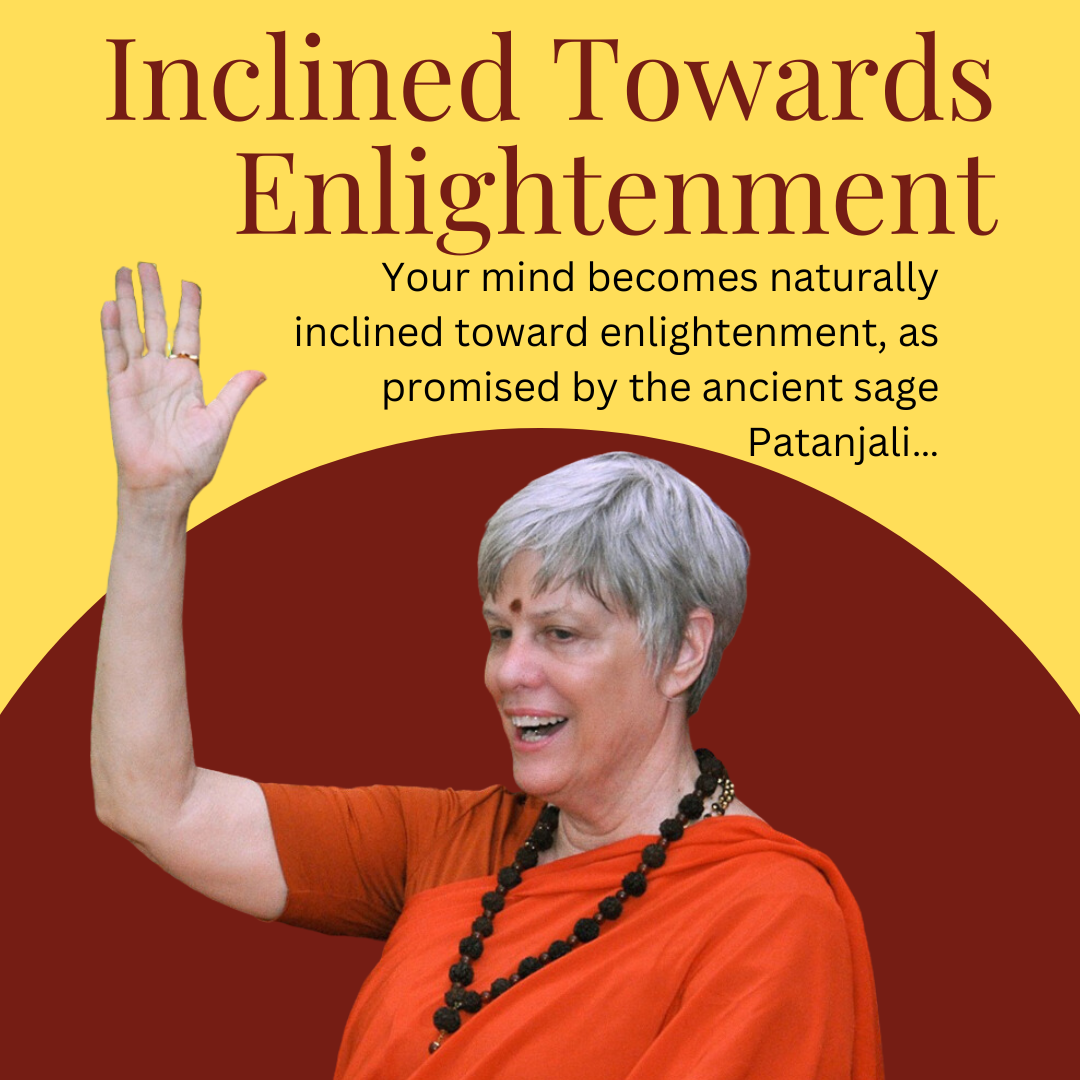
I loved this song when I was growing up, for I wanted to fly. I wanted to fly free, like the bluebirds in the song:

If happy little bluebirds fly

Beyond the rainbow

Why, oh, why can’t I?

My multiple attempts to get beyond the rainbow led me to living with a Guru in India.  It worked out really well, for he gave me yogic freedom.  It is freedom without escapism. It is both “freedom from” and “freedom to.”

“Freedom from” is freedom from pain, freedom from fear and freedom from the self-doubt that paralyzes you.  “Freedom to” is the freedom to love, to create and to give with generosity.  This yogic freedom comes from its inner source, described powerfully in a yogic text: 

Caitanyam-aatmaa — Shiva Sutras 1.1

Your own Self is Consciousness-Itself, 

imbued with freedom of knowledge and action

When you describe yourself by age and gender, by profession or relationship status – you’re describing what you do, not who you are.  These change, but you are still you.  Your size and shape, along with the color of your hair or skin are simply physical characteristics.  Your body changes over time, while your essence remains unchanged.

Peggy came to me in her 80s, wanting yoga therapy to make her able to walk freely again. She didn’t like using her cane.  It took about 5 sessions for her to throw away her cane.  Then she confessed she wanted more.  She didn’t want merely to walk.  She wanted to dance, to sprint and to turn cartwheels like she did as a kid.

She looked straight at me with her startling blue eyes and said, “Inside, I’m still 5 years old.”  It was true.  I could see the timelessness of her innermost being shining from inside.  It was just her body that was old, not her being.

Your being is that same Beingness that she showed me. My being is that same Beingness as well, for there is only One Beingness.  That One is being all, including you and including me.  When you feel your own essence, your own Beingness filling you from within, you know something that you always wanted to know.  You know your own Self.  And once you have your own Self, you are free.

In such freedom, nothing and no one can bind you. You can stay or go, it’s simply a choice.  Most peoples’ choices are made out of fear or clinging, trying to avoid something or trying to get something.  Without fear or clinging, how do you choose?

Your choice comes from freedom that is imbued with knowledge and action.  I call it intelligence, that you can use your mind to assess the probable outcomes of different options, then choose one wisely.  You can even choose to do nothing.  Yet your own deep sense of Self arises within, bring creative options as well as the sheer joy of sharing, moving you into giving generously.

One who knows Self is one who cares and shares. This type of enlightenment is engaged, contributing to the world, but from a place of Knowingness and Beingness. Best of all is the bliss…

Hatha Yoga

By Gurudevi Nirmalananda 

Hatha yoga is described in the yogic texts as efforting practice, a way to apply yourself physically.  However, you’re working on enlightenment, not on perfecting your body. The point is that your physical mastery gives you mental fortitude, so you can apply your mind to more subtle and interior practices.

In India, the land of yoga’s origin, the poses are only 10% of yoga’s technology. The other 90% is about your mind and getting beyond your mind, so you can experience svaroopa, your ever-blissful Divine Essence. Body-centered practice goes by the generic hatha yoga. The West offers many brand names, including our own Svaroopa® yoga.

By contrast, 90% of the yogis in India are sitting.  They are sitting to listen to their Guru expound on the teachings, sitting to contemplate the teachings they’ve heard, sitting in meditation.  They sit to watch the sunrise or sunset, sit as they participate in Vedic ceremonies, and they sit and wait for their own Divinity to fill into the stillness they’ve created in their mind. 

Hatha yogis don’t sit and watch the sunrise; they do Sun Salutations. They don’t listen to teachings or contemplate them; they do poses and try to make their body measure up. They don’t regulate their breath in order to quiet their mind; they pump their breath in order to sustain continual movement. They don’t still their mind; they keep moving while looking for a quiet inner center. 

Yoga has been growing in the West since 1893, so much that yogis now compete for championships and even Gold Medals. Google it: yoga is a sport. This is a different direction than the sages intended. 

Hatha has a second translation: the mystical meaning that is found in every Sanskrit word. The syllables ha and tha name the energies that flow along the two sides of your spine: ha — along the right side of your spine; tha — along your left. When you open and balance these two flows, the energy shifts and flows through the center of your spine. This is a profound inner opening that deepens with practice, especially with the guidance and blessings of an authorized Master.

To summarize, hatha yoga has two approaches: one is a path of self-effort and the other is a path of Grace – two radically different paths. Svaroopa® yoga is a path of Grace. Everyone else is on the other path, as wonderfully arduous as it can be.

After my Guru sent me back to America, I could see that my yoga students were not getting the openings that the poses are meant to provide. So I taught them variations, using carefully aligned angles to target their spinal tensions, providing the spinal release that is now named Svaroopa® yoga. It surprised me when people started getting Shaktipat awakening. Now I realize that I was carrying my Guru’s gift of Grace to the next generation. 

Svaroopa® yoga is a hatha yoga, with self-effort involved. This is a path of both self-effort and Grace. Self-effort is very important: you must apply yourself to the practices. Yet, on a path of Grace, you have to remember to make space for something more to happen. 

Svaroopa® yoga is unique, a hatha yoga that’s full of Grace. You put forth effort. You make time to attend a class or have a private session. Or you do your own practices. Yet Grace supports you every step of the way. 

But where are you going? There’s really nowhere to go. You’re not travelling to your Self because you already ARE the Self. You already ARE Consciousness-itself, svaroopa. This is why it is named “Svaroopa® yoga.”

What Are Ashrams?

By Gurudevi Nirmalananda 

An Ashram is a spiritual center where people dedicated to spiritual development live and practice under the direction of an Enlightened Being. The key is the Guru’s generosity, who is willing to share their life with others. This sweet and intimate gift makes the students’ spiritual process move more deeply and quickly.

I first benefitted from Ashram living in the 1970s. I already had figured out that I didn’t get much out of television and other media. I preferred yoga and meditative practices over the social scenes I had tried. It was a big relief to me that there was live music in the evening’s chant and meditation. Better yet, the teacher gave discourses several times weekly. I still love this lifestyle!

There are variations on the main theme. An Ashram might be headed up by an accomplished yogi who is not yet Self-Realized but is working on it. Most often, they have been authorized by their own Guru and are directed and supported in the process. Other Ashrams were founded by a great Master, even decades or hundreds of years ago, with yogis continuing to live the lifestyle as well as to offer the teachings they have learned. 

Svaroopa® Vidya Ashram is my home, which I share with other dedicated seekers. We offer several retreats and trainings each year, with participants staying in our retreat center. Our yoga classes are offered online as well as locally in Downingtown PA. I set up our online Freebies almost ten years ago, then the pandemic opened up new possibilities. Thus you will find many online offerings on our program calendar, including twice-weekly meditation satsangs.

Like ours, the Ashrams you hear about and find in online searches generally offer retreats and trainings. Other Ashrams are closed to the public, allowing few visitors or none. 

I have visited and lived in many Ashrams in North America, Europe and India, both Yoga Ashrams and Buddhist ashrams. In spite of the different practices, different dress codes, and different meals, they share many commonalities. They usually follow a set schedule, with group meditations and other practices as well as group meals. The household tasks are shared by residents, who do the cooking, cleaning, gardening and errand running, just like you do for your own home. 

In my years of residency with my Guru, we began the day at 3:30 with a morning chant followed by meditation. At 5:15 am, we got chai, a sweet-spicy milk tea. Then we chanted until 7 am. Breakfast was optional. Our day alternated between work periods, more chanting and meals, ending with a long chant at night and bedtime by 9 pm. I felt that I was living in heaven on earth!

Some Ashram residents are swamis, yoga monks, while others are in various stages of learning and commitment. Ashrams offering public retreats and trainings welcome guests during those programs but, like us, are closed at other times. Or you may have to meet prerequisites in order to visit. In other words, there’s lots of variations on the theme. There is no central governing body like the Vatican. Each Ashram can set up its own rules and systems, based on the lineage they embody as well as the practicalities for their locale.

One thing is consistent. Wherever a person or group of people do dedicated spiritual practices, that place becomes special. Thus most Ashrams are pilgrimage centers, with people coming to soak up the spiritual vibe that emanates out. That vibe is called Grace.  My life is filled with Grace!

You Will Be Assimilated

By Gurudevi Nirmalananda 

Those were scary words when the Borg invaded a world in “Star Trek: Next Generation.” I wondered what made them so scary. The yogic sage Patanjali answered my question. He says that you already know what it is like to be assimilated, because your mind does this to you frequently. How frequently? Anytime you’re not in a state of enlightenment, you’re assimilated into your mind. 

v.rtti-saaruupyam-itaratra. — Patanjali’s Yoga Sutras 1.4 

At other times, you are assimilated into your mind’s activities. 

You don’t merely have a mind with thoughts in it, your experience is “I am my mind!” If your thoughts are about happy things, you say, “I am happy.” If your thoughts are about sad things, you say, “I am sad.” You don’t say, “I’m thinking sad thoughts.” Instead, you become sadness itself. 

Fortunately this only happens when you’re not in a state of enlightenment. Unfortunately, your experiences of enlightenment are too few and far between. You have already experienced enlightenment, or at least a taste of it. Everyone has these peak experiences, first researched by the psychologist Abraham Maslow. This is all explained in the sutras preceding the one we’re focusing on. 

These great moments in your life happen when you allow everything to fall away from you and you stand in your glory, with your Inherent Divinity shining through. You might have experienced such a moment when standing on a mountain peak, or when you did something amazing and wonderful. For me, it was my wedding day. As I walked down the aisle, I was filled by God. I knew I was being filled by God. And I realized that it was the only way I wanted to live. 

Yoga says you are filled by God from the inside-out, for God is inside. When you clear your mind of the unnecessary chatter (and how much of it is necessary?), your Divine Essence shines through.  

But the rest of the time, as Patanjali says, your mind takes over. You get lost in your mind’s obsessions. It probably has many of them. But Patanjali doesn’t leave us stuck here. He continues on to explain what the mind does and how to get out of the trap it lays for you.  

The rest of his text is yogic techniques and teachings for how to transform your mind so it no longer harasses you. Yoga poses are included, but the bulk of his teachings are about managing your mind differently than you have been.  

The ultimate practice for managing your mind — better yet, for transforming your mind, is meditation. In yoga-based meditation, you don’t let your mind wander all over the cosmos. You harness the power of your mind and steer it inward so you discover your own Self, your own is-ness. Once you’ve found your way inside, you can live from that Essence and Beingness, always filled from the inside-out.

Online Therapeutic Yoga

By Swami Nirmalananda 

You’ve got choices. Do you want private yoga therapy sessions online? Each one-hour session is dedicated to your needs and gives you immediate improvement in your condition.

Would a semi-private class work better for you? You join in with one or two others who are also in need of healing. You share the teacher’s attention, which means there is less focus on your needs, while you have the support of others who are in the process. Also, it is less expensive because there are more of you sharing the cost.

You may find that our regular online classes work well for you, as Svaroopa® yoga is a therapeutically oriented yoga. Everything we do is about healing and upliftment. 

How do you choose? The best approach is to talk with one of our yoga therapists. She will do an informal assessment of your needs and steer you toward your best option.

If you want to make the choice on your own, use this easy guideline:

If you have a medical diagnosis, start with a private yoga therapy session.

If you don’t have a diagnosis, try out a class.

I used to think that yoga therapy couldn’t be done online, but then doctors started using TeleHealth. It was very empowering. Now we have done hundreds of yoga therapy sessions online, throughout the pandemic and continuing onward.

Many of the therapeutic tools we use are easy to implement over Zoom. You must have your video and audio on as we need to see you in order to help you.

If you are able to come in-person, we are able to do more. Being able to physically align you in your pose, even adding customized props and adjustments makes a big difference.  In addition to our yoga studio in Downingtown PA, we have many trained therapists around the country, even multiple countries. Check out our Teacher Directory.

The only way you’ll find out if Svaroopa® yoga therapy will help you is to give it a try. 

Being a Yogi in the World 

By Gurudevi Nirmalananda  

Yogis of yore left the world, the iconic yogis living in Himalayan caves since thousands of years ago. Their approach was to get rid of all possessions, leave their relationships and cease performing actions. They sought freedom. However, they discovered they could carry all that stuff in their mind, especially reactions to what happened in the past. Thus, in their solitude, they realized they had to work on clearing their mind. 

Clearing your mind gives you a moment of peace. More than mere peace, they strove to open inner access to the deeper levels of their own being. It’s like the sage Patanjali promised: 

Tadaa dra.s.tu.h svaruupe ‘vasthaanam. — Yoga Sutras 1.3 

In the moment your mind is still, you are established in your own Divine Essence.  

The rest of his text is about how to quiet your mind, including using yoga poses, yogic breathing, lifestyle changes and meditation techniques. Yet these are not exclusive to yoga. Everyone has their own little tricks for quieting their mind. One of my early favorites was to look at the sky. Something happens when your mind takes on the shape of the sky – blue, expansive and extending into infinity. 

When I began studying sutras, I wondered: If the goal is stillness of mind, then how do you manage your life? You have to use your mind to manage relationships, to pay bills and even to drive from one location to another. Patanjali’s students didn’t have that problem… 

Reincarnation Defined

By Gurudevi Nirmalananda

Welcome back!  You’ve been here before.  How fortunate that you’ve made it into a human body this time.  Congratulations!  The ancient sages of India say we are the only species with the ability to choose our trajectory, both for this life as well as any future incarnations.

What is so special about being human?  While you have animalistic instincts and urges, there is more to you.  You have the ability to rise above them, to make choices to uplift yourself and to benefit others. Your intelligence, compassion and insight are unique amongst all creatures.

It is insight that makes the biggest difference.  In-sight is looking inward, not merely to your mind but to a deeper level, where you find who you are – who are you that has this mind?  By finding the deeper dimension within, you can become free from the cycle of birth-and-death.  Technically, reincarnation is called “The Doctrine of the Transmigration of Souls.”

Two seekers were walking together, having met along the road to an important pilgrimage site.  Their animated conversation was on the verge of becoming an argument, so they were happy to see a yogi under a tree alongside the road. 

They went over, bowed respectfully and said, “Oh Babaji.  We are disagreeing about how to become free from reincarnation’s vicious cycle.  Tell us, please:  how many more lifetimes will we each have to live?”

Turning to one of the seekers, the Guru said, “You have three more lifetimes to live.”  The seeker was shocked and disheartened.  He shouted, “Oh no!  Not really?  Three more.  That’s terrible!  I thought I was almost there.  Three more lifetimes.” He wandered off in despair.

Turning to the other seeker, the Guru said, “Your future lifetimes number as many as the leaves on this tree.”  With delight, the seeker replied, “Really?  It’s a finite number?  That means I really can make it, right?”  The Guru nodded approvingly.  The seeker bowed and thanked the Guru, then walked away, heading toward his companion.

Within moments, a truck veered off the road and killed him.  OK!  First lifetime complete!  Next he reincarnated as a virus, living only a few hours.  After many virus lifetimes, he graduated to a bacterium, living a bit longer.  He moved through other lifeforms, many with short lifespans, one right after the other. 

Finally, he was reborn as a human again.  His deep spiritual yearning led him to a Guru while still young.  He soaked up the teachings like a sponge, not only learning the theory but experiencing the Inner Truth toward which they point.  By the time he was in his 20’s, his name and reputation began to spread.  People came from far and wide to sit in his luminous presence and hear him teach.

The other seeker, with three lifetimes to go, was saddened to see his friend die so suddenly.  He continued on his pilgrimage, then went on others through his long life, living over 100 years.  His next lifetime was 110 years, wherein he studied with many different teachers. His next lifetime was another long one.

Reborn as a human again, he applied himself diligently to the meditative disciplines and sutra studies.  He was in his 90’s when he heard of a young Guru, one who radiated both love and wisdom.  With the help of friends, he traveled to meet this new teacher.  They all arrived, stored their bags in a nearby guest house and rushed to the satsang hall, slipping their shoes off outside.

The aged seeker walked in the door, picking his way slowly along the central aisle toward the Guru.  As he got closer, the Guru looked closely at him and began to laugh.  “Oh my friend!  Don’t you remember me?  We were sitting under the tree together, not so long ago…”

You have lived so many lives.  You have taken birth again this time so you can do something differently than before.  What is it that you have come here to do?  What do you want to find?  What is the highest that you can become?

The answers are all inside.  Unfortunately, without proper guidance, you’re peering into an inner darkness.  You need a teacher who can shine the light all the way inward.  That’s what my Baba did for me.  I’d love to help you find you, if you will allow.