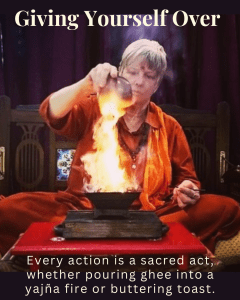
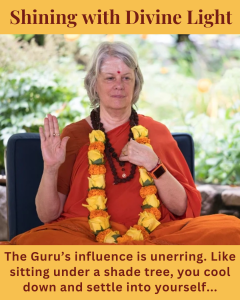
Swami Nirmalananda is a teacher of the highest integrity since 1976. In 2009 she was honored with initiation into the ancient order of Saraswati monks. Now wearing the traditional orange, she has openly dedicated her life to serving others. Usually called Gurudevi, she makes the highest teachings easily accessible, guiding seekers to the knowledge and experience of their own Divine Essence.
This is a key point in tantra. It comes from the recognition that Shiva is being all. Everything in the world and even everything in your mind is Shiva in disguise. So, what part of the world should you reject? What part of you should you reject? Certainly, your mind needs some conditioning, like a runner preparing for a marathon. Your mind needs…
— Gurudevi Nirmalananda
From Gurudevi’s full discourse “Celebrating Spiritual Greatness“
Words are important. The radar screen of your mind is filled with what you say and with what others say to you. The unsaid words are on that screen as well. You’re always tracking the moving blips.
You may want others to use specific words to make you happy. Usually they don’t follow your script, not even if you give it to them. Bottom line, consider what are you looking to get from them. If your happiness depends on them saying the right things, they can upset your apple cart just a few minutes later. Your sense of self must come from a deeper inner center for you to be happy and to have successful relationships.
If words can shut you down, are there words that can open you up? Yes! The enlivened mantra is sacred words, words of power. They invoke the upwelling of Consciousness within you. This inner arising transforms you completely, bringing a whole new level of aliveness and enthusiasm into your life. You see the world differently. You see you differently.
It is your mind that needs this transformation. Your own Self doesn’t need to be uplifted, for it is already Divine. But your mind keeps you from seeing your inner radiance. Your own Self is Shiva: all encompassing, pervading all, being all. Your mind is puny by comparison. Yet your mind blocks your knowing of Self like you can use your thumb to block the sun.
Transforming your mind is accomplished through words. This is because your mind is churning out words all the time, day and night. When you change the words you use, you get different results. Research on affirmations shows measurable improvements in education, health and relationship outcomes.[1] Using different words on yourself makes a difference
The Shiva Sutras says this works in your spiritual development as well. The second chapter of the text focuses on transforming your mind. These practices are called shaktopaya, the upaya (path) of shakti (energy). Your mind is made of energy, as is everything. And the enlivened mantra is full of Divine Energy. Together they uplift your mind and empower you to transcend it.
Chittam mantrah. — Shiva Sutras 2.1
By intensive awareness of the Divine in the mantra, you become what it names.
The two Sanskrit words name two things: the power of your mind and the power in the mantra. Chittam means mind, literally a contracted form of Chit (Consciousness). Mantra means a set of words that enshrine God within them. These are Divine words, meaning they are God in the form of words. God can take on any form, even the form of words.
Your mind reflects whatever you present to it. If you present garbage, your mind becomes filled with garbage. If you present Divine words, your mind becomes filled with Divine light. What kind of mind do you want to have?
Every religion and meditative tradition uses mantra in some way. In tantra, you get an enlivened mantra from a Shaktipat Guru. It is plugged in. With a lamp that won’t turn on, first you check the light bulb, then notice the cord is unplugged. When you plug it in, you get light. You want a mantra that lights you up. Receiving it is called…
If you don’t desire something specific to happen in the future, then you won’t be anxious about it. Freedom from desire also frees you from anger. The only time you experience anger is when you desire something but…
No one’s working on attaining equanimity. Well, that’s not precisely true. You probably have tried to get a little peace by withdrawing from news, from the politicians, from the musicians, the social media influencers, and even your family and friends. But you bring your mind with you, even when you isolate yourself or numb out.
— Gurudevi Nirmalananda
From Gurudevi’s full discourse “Equanimity — Peace of Mind“
When you hear these teachings, you are fed at the deepest level of your own being. The words and the energy turn your mind inward, while the words name your own Divine Essence. So you experience Self again and again. This is why I give discourses, to pour this stream of Grace-infused teachings into your head, and heart, and deeper. Again and again.
How do you meditate on your own Self when you don’t know your own Self? In one way, it’s kind of like you lived in a cave your whole life and I tried to teach you to meditate on the sun or the moon. You wouldn’t know what they are. This is why the mantra names your own Self..
— Gurudevi Nirmalananda
From Gurudevi’s full discourse “Meditating on Your Own Self“
You lie on your back in yoga’s relaxation pose, Shavasana. Or you may prefer to lean back in a recliner.
You drift into a quasi-meditative state without going all the way to sleep — this is yogic sleep, yoga nidra.
It is a state of deep rest but without the heaviness of sleep. In a short time, you arise refreshed, perhaps even more so than after a full night of sleep. Three hours of yoga nidra can substitute for a full night of sleep. I have taken advantage of this on many overnight flights. It is a lifesaver when my day’s activities overflow into late night hours, especially since I don’t want to give up my early morning yoga practices.
As a yoga teacher, I learned how to lead yoga nidra as part of a yoga class. We called it a “Guided Relaxation” even though it’s not really about relaxing. It is an awareness practice, where you extend your awareness into the inner spaces of your body and being. Thus I changed the name of it to “Guided Awareness,” which we still include in every Svaroopa®yoga class. Twice. At the beginning and at the end. This is how important it is.
Its roots lie deep in the yogic tradition, with references in several ancient Sanskrit texts. Yoga nidra was brought to the West by students of Swami Sivananda of Rishikesh. In recent years, it has been used as a healing therapy for veterans and others with PTSD.
Most people are simply looking for an easy way to meditate. The value of following a Guided Awareness for yoga nidra is that it reins in your mind, bringing it back to where you are physically located. As you become more present in your body, you are becoming more present. It is your presence that matters.
We include yoga nidra in Ashram programs in several ways:
Svaroopa® yoga classes — every class begins and ends with yoga nidra. Online and On-Site classes are available around the world. Click for our Global Class Calendar.
Guided Meditation Series — this online series uses yoga nidra as a stepping stone to seated meditation, which offers you deeper and more powerful experiences. Find the next class series on our Programs Calendar.
Audio Recording — I have recorded the classic Guided Awareness for you on my album, “Experience Shavasana.” It can help you get to sleep, recover from stress or anxiety, or prepare for a deeper meditation.
Yoga nidra can be a little tricky. As you begin to settle more deeply within, you may want to roll over into your favorite sleeping position. Or your head may lean over toward one side. These are ways of going unconscious, into a sweet deep sleep, but not yogic sleep.
Yoga nidra is a light meditative state, yet not sleep but not wakefulness. Your mind is restful but not unconscious. Someone is still home inside. Who is that someone? That is you. This is the whole point, that you find the deeper dimensionality within. This is what yoga is all about.
While you may wish for bliss in every meditation, it’s actually the busy meditations that are moving you toward enlightenment faster. Just like a car speeding along the highway passes more scenery, when you’re really zipping along…
— Gurudevi Nirmalananda
From Gurudevi’s full discourse “Growing into Self“
Sometimes you can tell what’s going on inside a person by the way they look. Their silly grin or their wrinkled brow tells you what they are thinking and feeling.
Yet someone can be smiling while thinking negative or harmful thoughts. In poker and in politics, the pathway to success is to hide your true feelings. This can sometimes be true in close relationships as well.
Can you look at someone and see that they are enlightened? This is important because you want to study with the best. They can help you make rapid progress toward your own enlightenment. What is enlightenment like, both inside and outside? Fortunately, Arjuna asked this question for us:
Arjuna uvacha, sthita-prajnasya ka bhasha samadhi-sthasya keshava
sthita-dhih kim prabhasheta kim asita vrajeta kim. — Bhagavadgita 2.54
Arjuna asked, “What is the inner experience of an enlightened being? In worldly activities, how do they talk? How do they sit? How do they walk?”
The next eighteen verses are Krishna’s answer. He describes the process of becoming enlightened as well as how the enlightened being lives.
By divine Grace, all his sorrows are destroyed. With a peaceful mind, he abides in a Divine state of inner steadiness. — Bhagavadgita 2.65
Your understanding of this description begins from your own experiences of a peaceful mind. But what is “a Divine state?” These experiences are pivot points in your life.
I remember being a teenager at summer camp in the mountains. I often sat in a sacred grove that had a view of the valley. It was reserved as a silent lookout point. In the beginning, the view transported me. I felt like I could almost fly across the vast terrain. I felt free.
My experience changed as I returned again, sometimes multiple times daily. It became an inner vastness that was much greater than the view. At the same time, I felt…
So, at the end of your meditation, when you leap up and you get moving, physically or maybe it’s just your mind, you’re blocking your ability to see the Divine in the mundane. You’ve gone back to measuring, analyzing, counting…