Author Archives: Swami Nirmalananda

Unknown's avatar

About Swami Nirmalananda

Swami Nirmalananda is a teacher of the highest integrity since 1976. In 2009 she was honored with initiation into the ancient order of Saraswati monks. Now wearing the traditional orange, she has openly dedicated her life to serving others. Usually called Gurudevi, she makes the highest teachings easily accessible, guiding seekers to the knowledge and experience of their own Divine Essence.

See the Divine, Find Your Self

By Gurudevi Nirmalananda

Yoga warns about living in the pairs of opposites, and offers you another way to live — see God in everyone and everything. 

You go through stages as you become able to see what is already in front of you, the Divine fully present within the mundane. Your process speeds along when you cooperate with it, and even more smoothly when you understand it.

Begin by considering that others have good reasons for doing what they do, thinking the way they think and living the way they live.  While you don’t have to agree with them, you feel better within yourself when you allow them to have their perspectives. 

When you invest your mental and emotional energy in seeing others as wrong, or in seeing yourself as wrong, you are the one who is churning over it.  You are the one listening to your negative thoughts. You are the one who has to live with your mind.

The condition of your mind is of the greatest importance, yoga says. It is not your own Self that you need to worry about. Your svaroopa, your innermost essence, is already Divine.  You don’t have to uplift your own Self.  

Yoga is about finding your Self, not perfecting your Self.  Yoga’s practices give you the experience of your own inherent divinity.

– Excerpt from A Yogic Lifestyle, page 7

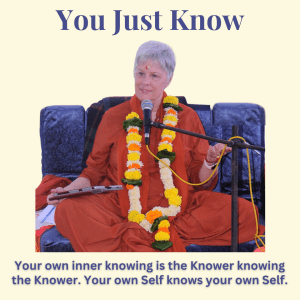
You Just Know

By Gurudevi Nirmalananda

Your own inner knowing is yoga’s goal. This is a knowing beyond thought, beyond logic, beyond explanation or causation. You just know.

Yoga’s inner knowing is different than the intuitive feeling that most people seek. Yoga’s knowing is not about externals, not about problems or other people. It is the Knower knowing the Knower. Your own Self knows your own Self.

The astonishing thing about this is that it is so easy. Even more amazing, you actually already know. It’s only your mind that tells you something different. Thus, all of yoga’s practices are for your mind.

But the practices are not so you can convince your mind of anything. Yoga’s practices pacify your mind, so it gets out of the way.  Your mind becomes peaceful and happy. It is like a dog laying down and rolling over for a belly rub. Your mind loves the experience of your own Self.

Since your mind doesn’t know how to get there on its own, it needs help. The mantra and other practices are not enough on their own. You need an intervention. One who knows can give you the knowing. This is Shaktipat.  It is the greatest gift of all.

I have just summarized the first few sutras of the Shiva Sutras. They assert you are Consciousness, the Self-Knowing Essence of Beingness that is being all while being you. But you don’t know.  And you want to know. So you look for someone who can awaken your own knowing of your own Self.  That’s why you’re here now.

I’ll go through these sutras in Sanskrit as well, thus beginning my theme for the year — Insight into Sutras. These ancient aphorisms explain how life works as well as how to make spiritual progress. Additionally I describe them more fully in my twice-weekly meditation programs. Here we begin with the first sutra…

Change Your Mood

When you experience love, you feel fulfilled. This is an important part of life, the experience of loving. Your loving of someone does touch the other person, yes.  But in yoga, the point is, that it affects you. So, yoga teaches the yogi to take responsibility for their own mood. To grow up, to get over your childish reactivity, or perhaps your.. 

—  Gurudevi Nirmalananda

From Gurudevi’s full discourse “Loving God

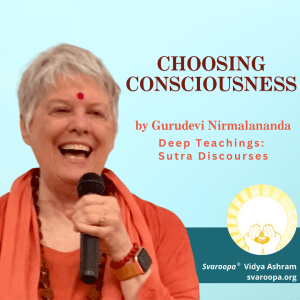
Choosing Consciousness 

By Gurudevi Nirmalananda 

Happy New Year! It’s a new start. It’s like the sunrise in the morning, radiant and glorious with colors of light blazing across the sky. May your new year bring you this light — inside.

Your own inner light is the light of Consciousness. I’ll compare you to a snowflake, different from all the other snowflakes, unique and individual. A mass of clouds are blown into place. The water forms into ice crystals and falls from the sky. From the one source and substance, you come into being as an individual.

Yet all the snowflakes ultimately melt back into water – merging into the whole again. In this way, you are a unique form of Consciousness, fascinating, intricate, beautiful, even mesmerizing. Yet your goal is to become water again, to live in the fluidity and flow that is inherent to your being.

For this, you look to your own essence – the essence of a snowflake is water, and the essence of a human being is Beingness. Why is this important?  

Because you’re not yet actualizing the Beingness that you are – you’re not living in the flow of Divine Consciousness and Bliss. You are made of Beingness, and when Beingness experiences Beingness, the experience is bliss – Divine unending constant inner bliss that feeds and nourishes you on all levels. Your goal is the bliss of Consciousness, oh Shiva. To find, to feel, to see and to know your own Self as the one Self being an individual while being the whole.

So here we are at the beginning of a new year, blossoming forth with all possibilities, all potentialities, arising from within, from the source of the universe – your own source, oh Shiva.

You get to choose. The creative power of Consciousness lies intact within you. You can sculpt time into whatever shape you’d like it to be. You can be up before the sunrise, doing yoga and meditation so the inner sun comes up with the outer sun.  

You can bring that light into every corner of your life, basing your decisions and actions in the inner illumination that flows forth as love and creativity. You will easily find compassionate and intelligent solutions, exciting and promising plans and ways to get more as well as ways to give more. 

And if you choose the same-old, same-old, you’ll get the same-old, same-old. Yes, I’m talking about New Year’s resolutions – again.  Some of you have heard…

Holy Days

By Gurudevi Nirmalananda

Christmas celebrates Divine Light in the person of Jesus of Nazareth. While most call him the “son of God,” he called himself the “son of man.” As a yogi, I can describe him as an incarnation of Consciousness, a light unto the world.

Driving down the streets, I am delighted by all the lights on the buildings and in the yards. In the Northern Hemisphere, these year-end holy days come in the shortest days of the year, shining light through the dark.

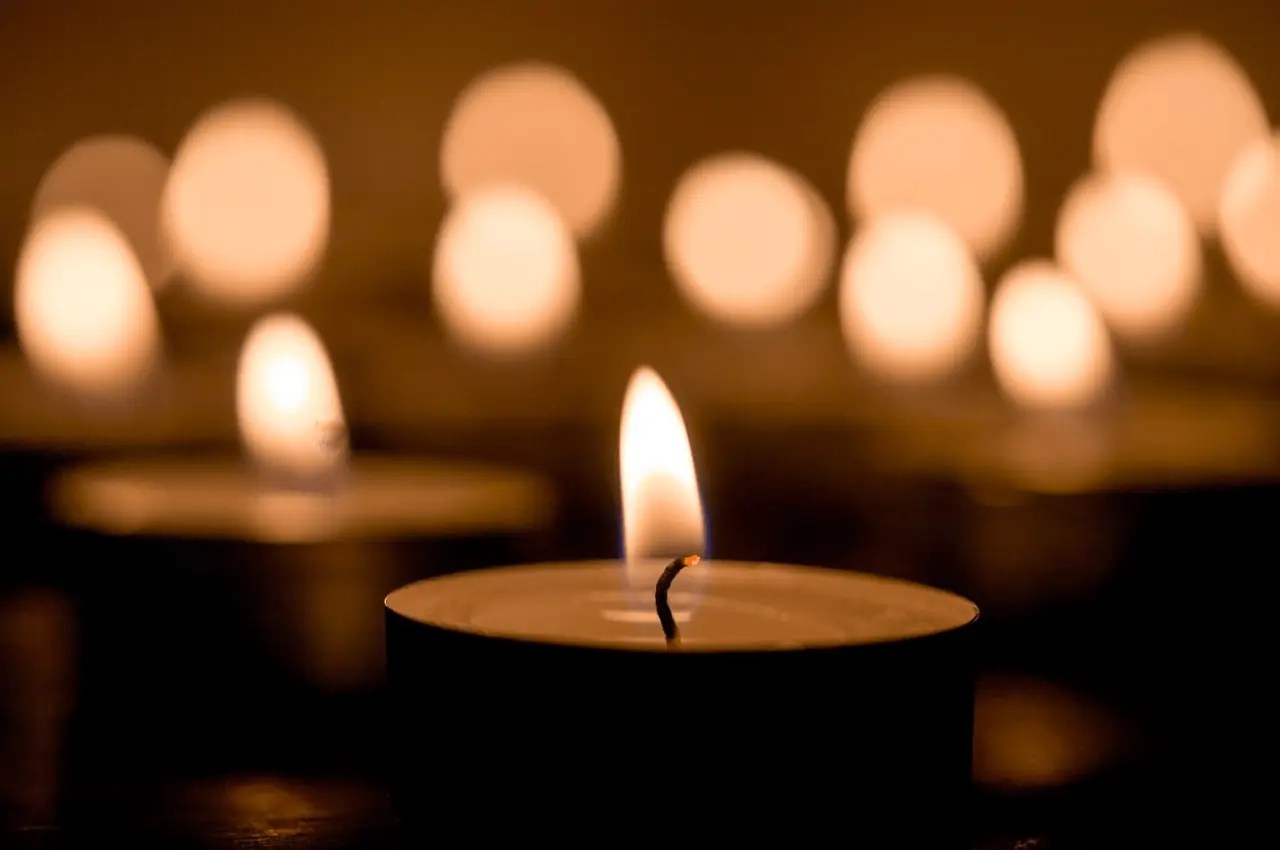
Hanukkah comprises eight nights of candle lighting, commemorating the miracle of the oil lamps in the rededicated Temple in Jerusalem. As a yogi, I light candles on my altar daily, to honor the Divine outside and inside.

Kwanzaa has the lighting of candles on seven nights, paying tribute to worthy principles that underlie African-American culture. These are unity, self-determination, collective work and responsibility, cooperative economics, purpose, creativity and faith. As a yogi, I see these as principles of Consciousness that lie at the foundation of our practice and our lives.

Solstice celebrations date as far back as the Neolithic period, 10,000 BCE. They are found in the history of many places including Rome, Egypt, China, Persia, Peru, Native Americans and more. Stonehenge is built for the winter solstice. As a yogi, I love the light that shines through the dark, especially shining through your inner darkness so that you become an agent of Divine Light.

Each of these beautiful traditions invoke light in their own way. While the principles and stories behind each of these celebrations are inspiring, the participants’ focus is usually more mundane. Family gatherings, gift giving and feasting are important communal activities, but they rarely mention the holiness of the event. When they do light candle or attend a religious service, it is a small percentage of the time that they spend together. Their focus is on each other.

As a yogi, I found that looking outward left me unfulfilled. I tried. I focused on the people. I focused on the candle flame. I focused on the memory of Jesus. I focused on the highest principles of life and the idea of light shining through the dark. And I still felt empty.

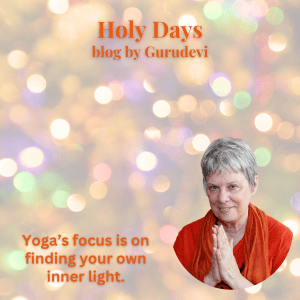
All of these celebrations look outward. Yoga’s focus is on finding your own inner light. Thus I confess that I lost interest in these beautiful festivals long ago. My joy is daily. My bliss is continuing. My experience of the Divine is internal, the bedrock of Beingness that supports my existence as well as yours.

Yet I delight in gathering with others – not so that they will fill me up, but so I can see their inner light shining through their eyes. To me, you all glow with the light of Consciousness all the time. This is why I bow. Again and again I bow.
The Svaroopa® Yoga Difference

By Gurudevi Nirmalananda

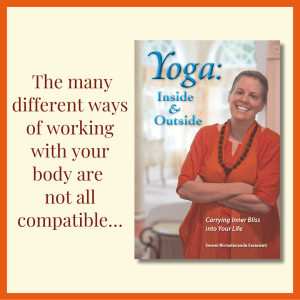
There are so many different ways of working with your body. They are not all compatible. 

The physical conditioning that produces an Olympic gymnast does not produce a good football player. The physical changes that you get when you begin snowboarding, perform as a dancer or do Pilates don’t help with sciatica or with childbirth. A furniture mover is not conditioned for playing tennis. 

Similarly, different systems of hatha yoga (physical yoga practices) are not all compatible. One system emphasizes strength and stamina, another emphasizes constant movement and yet another emphasizes attaining a photo-perfect pose.  

All of these activities are based on contraction. You contract certain muscles to accomplish certain types of movements, and along the way (knowingly or unknowingly) you compress your spine. Svaroopa® yoga decompresses your spine. It is a completely different process, for a different purpose. Process and purpose: exercise uses the process of contraction for the purpose of accomplishing a specific type of activity.

In Svaroopa® yoga, in contrast to exercise or other styles of yoga, we release contraction. Every class is carefully choreographed to release tensions in the muscles connected to your spine, from your tailbone progressively all the way to the top. The reasons for this are multilayered and exquisitely complex, the most important of which is that your body is made of atoms…

— Excerpt from Yoga: Inside & Outside — Carrying Inner Bliss into your Life,  pages 35–36

A Sweet Surrender

Gratitude and devotion are not the same thing.  Gratitude is always for something, it’s transactional.  You get x, so you feel grateful for it.  You say, “Thank you.”  You even know how to say thank you whether you’re grateful or not.  But hopefully you get to enjoy being grateful. Still, it’s a transaction.  Devotion is unfounded, even unbounded.  When you experience devotion, it’s…  

—  Gurudevi Nirmalananda

From Gurudevi’s full discourse “An Attitude of Gratitude

What Kind of Yoga?

By Gurudevi Nirmalananda

What’s up with all the names?

Bottom line, all yoga is good yoga — even when they are all different. It’s like lunch. No matter what you eat midday, it’s still called lunch.

Hot Yoga is done in a hot room (98°), making it easier for your muscles to lengthen. It is also called Bikram Yoga, honoring the yogi who brought it to America from India.

Yin Yoga is about cooling down and slowing down. You lean into cushions and blocks to make your muscles able to lengthen more easily.

Why this emphasis on muscle lengthening? When your muscles lengthen, your nervous system tells your brain to stand down from red alert. This helps your mind become more peaceful. When your mind is peaceful, you can see deeper within. Yoga is all about looking inward to discover your own essence and beingness.

Ashtanga Vinyasa gets you moving fast and breathing fast, like aerobics. The dance-like sequences are repeated again and again. Power Yoga and Jivanmukti Yoga are variations on this theme. Viniyoga slows it down, still keeping you moving with a methodology focused on the healing sequencing of the poses.

Kundalini Yoga gives you lots of fast breathing, coordinated with repetitive physical movements. You might experience inner heat from the energy moving through your spine, which is its purpose.

Moving and breathing are good for your body. They are good for your mind as well as for your emotions.

Yet beyond mere exercise, yoga is about your discovery of the deeper dimensionality within you. In these fast-moving yoga systems, what matters most is the inner stillness that you experience when you stop pumping your breath and body.

The classical yoga systems focus more on the inner stillness. While you do poses and yogic breathing, there is usually a pause between the poses, specifically for the refinement of your awareness.

Hatha Yoga is the classical system, meaning a yoga that you “hatha,” you apply yourself to — using will power, time and effort. The Sanskrit texts clearly describe that you are working on getting enlightened by beginning with your body and breath. The focus is on awakening Kundalini, the energy of the cosmos which lies hidden in your spine.

Variations on the classical system include Sivananda Yoga, Integral Yoga and Indra Devi Yoga, which was the first Yoga Teacher Training that I took. Their emphasis on yogic relaxation has expanded to a modern system of its own, Yoga Nidra. Kripalu Yoga is also related, emphasizing that you simply do what you can and don’t worry about perfecting the pose.

Iyengar Yoga comes from hatha yoga, an eponymous approach featuring many innovations by its founder. You move into a position and stay there while finessing your technique, a sophisticated form of isometrics. Then you do another pose, followed by another. Anusara Yoga and Restorative Yoga are variations on this approach.

These systems have their roots in a classical methodology that spans millennia. While the modern focus is on limber, lithe and lean, yoga’s poses come from the tantric yogis in the Himalayas. Tantra means loom, where the interweaving of warp and woof threads happens. Among the tantrics’ many secrets were poses, yogic breathing, mantra and the inner awakening by a great master.

I was graced by this inner awakening almost 50 years ago, which fired up my transformational process. The fuel propelling my rocket ship through the inner stratosphere was Cosmic Consciousness climbing my spine — Kundalini. She taught me how the poses are supposed to work, from the inside out. This is why I teach:

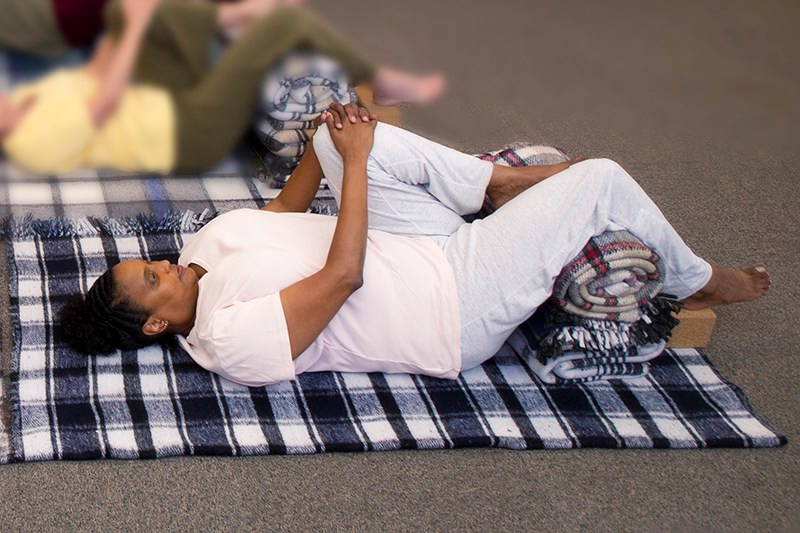
Svaroopa® yoga is a spine-centric yoga. It is a slower-paced yoga. Every pose targets your spine, to decompress it and restore it to full health and resiliency. “You are as young as your spine,” the saying goes. It is true.

Yet there is more going on in your spine, a mystical center for the blossoming forth of Consciousness from within. We use alignments, yoga props and careful pose adjustments by your teacher to dissolve your deepest spinal tensions. Not only does it keep you young, it opens up the flow of life energy within.

With time and practice, this opening leads to the inner awakening, as described in the classical hatha yoga texts. Easier still, the inner awakening is available in a weekend workshop, the Shaktipat Retreat.

While Svaroopa® yoga is based in Consciousness, it utilizes many of the tools you find in other yogic systems. Our yogic breathing is a slower type than you find in a Kundalini Yoga class, but deeply effective for energizing and enlivening your whole body-mind-soul system.

When we have you reach your arm up in the air, it’s not about how far you can go. Instead, we use the angle of your arm as a way to access your spine, like a laser beam shining from your hand, through your arm, through your shoulder and into your spine.

We repeat certain pose sequences, similar to Viniyoga, for their ease and effectiveness. We enjoy a slower paced class, similar to Yin Yoga, and we use yoga props like in Iyengar Yoga.

You get hot in Svaroopa® yoga, but it is inner heat, the most delicious and powerful kind. It dissolves muscular tensions while it untangles your limiting thoughts and beliefs. It’s all for the purpose of setting you free. Yoga is about liberation!

The Sword of Mantra

In the fourth century BCE, Alexander the Great arrived in Phrygia, a kingdom in what is now Turkey. There, outside the castle, an oxcart was parked tied to a post with a complex knot called the Gordion knot.  An oracle had declared that any man who could unravel the knot was destined to become the ruler of all of Asia.  Alexander the Great took a look at that. And he reasoned his way through it, thinking that it…  

—  Gurudevi Nirmalananda

From Gurudevi’s full discourse “Mind, Heart and Soul