You see, when you have an amazing experience, and how important that is, the fact that it is amazing means it’s different from your everyday experience. And then you go back to everyday. Your expanded experience might last a minute, a day, a month, or longer. But you go back to everyday. The point is to…
— Gurudevi Nirmalananda
From Gurudevi’s full discourse “The Moment of Enlightenment“
This is a key point in tantra. It comes from the recognition that Shiva is being all. Everything in the world and even everything in your mind is Shiva in disguise. So, what part of the world should you reject? What part of you should you reject? Certainly, your mind needs some conditioning, like a runner preparing for a marathon. Your mind needs…
— Gurudevi Nirmalananda
From Gurudevi’s full discourse “Celebrating Spiritual Greatness“
Words are important. The radar screen of your mind is filled with what you say and with what others say to you. The unsaid words are on that screen as well. You’re always tracking the moving blips.
You may want others to use specific words to make you happy. Usually they don’t follow your script, not even if you give it to them. Bottom line, consider what are you looking to get from them. If your happiness depends on them saying the right things, they can upset your apple cart just a few minutes later. Your sense of self must come from a deeper inner center for you to be happy and to have successful relationships.
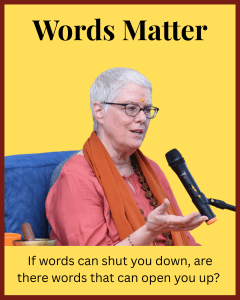
If words can shut you down, are there words that can open you up? Yes! The enlivened mantra is sacred words, words of power. They invoke the upwelling of Consciousness within you. This inner arising transforms you completely, bringing a whole new level of aliveness and enthusiasm into your life. You see the world differently. You see you differently.
It is your mind that needs this transformation. Your own Self doesn’t need to be uplifted, for it is already Divine. But your mind keeps you from seeing your inner radiance. Your own Self is Shiva: all encompassing, pervading all, being all. Your mind is puny by comparison. Yet your mind blocks your knowing of Self like you can use your thumb to block the sun.
Transforming your mind is accomplished through words. This is because your mind is churning out words all the time, day and night. When you change the words you use, you get different results. Research on affirmations shows measurable improvements in education, health and relationship outcomes.[1] Using different words on yourself makes a difference
The Shiva Sutras says this works in your spiritual development as well. The second chapter of the text focuses on transforming your mind. These practices are called shaktopaya, the upaya (path) of shakti (energy). Your mind is made of energy, as is everything. And the enlivened mantra is full of Divine Energy. Together they uplift your mind and empower you to transcend it.
Chittam mantrah. — Shiva Sutras 2.1
By intensive awareness of the Divine in the mantra, you become what it names.
The two Sanskrit words name two things: the power of your mind and the power in the mantra. Chittam means mind, literally a contracted form of Chit (Consciousness). Mantra means a set of words that enshrine God within them. These are Divine words, meaning they are God in the form of words. God can take on any form, even the form of words.
Your mind reflects whatever you present to it. If you present garbage, your mind becomes filled with garbage. If you present Divine words, your mind becomes filled with Divine light. What kind of mind do you want to have?
Every religion and meditative tradition uses mantra in some way. In tantra, you get an enlivened mantra from a Shaktipat Guru. It is plugged in. With a lamp that won’t turn on, first you check the light bulb, then notice the cord is unplugged. When you plug it in, you get light. You want a mantra that lights you up. Receiving it is called…
If you don’t desire something specific to happen in the future, then you won’t be anxious about it. Freedom from desire also frees you from anger. The only time you experience anger is when you desire something but…
No one’s working on attaining equanimity. Well, that’s not precisely true. You probably have tried to get a little peace by withdrawing from news, from the politicians, from the musicians, the social media influencers, and even your family and friends. But you bring your mind with you, even when you isolate yourself or numb out.
— Gurudevi Nirmalananda
From Gurudevi’s full discourse “Equanimity — Peace of Mind“
It is my pleasure to introduce Svaroopa® Vidya Ashram’s fundraiser “Doorways to Your Self.”
There are many ways to experience your Self, your Divine Essence. One of them is dakshina (selfless financial giving). Join me in giving to Svaroopa® Vidya Ashram. Bring yoga into your heart and wallet.
Gurudevi says:
If you do this yoga, you will come to know who you really are. It begins as brief glimpses, subtle knowings, inner impulses, flashes of insight and currents of bliss. They grow on you; they grow in you.
It is wonderful that there is not just one doorway to your own Self. You can access it many ways — Shaktipat, chanting, studying the sutras, mantra, asana (yoga), meditation and more. I had the experience of Self in my first asana class, yet I could not put words to it. I felt different, like I was coming from a deeper place. Perhaps you have experienced it as well. A dip into consciousness that left you feeling refreshed, joyful, deeper, more aware or embodied.
Recently, I have been experiencing my Self in the pause. Particularly the pause when doing mantra repetition. Between each mantra ( said out loud or silently), I pause. I have found everything in the pause — joy, peace, contentment and more.
The feeling that arises when I think of all that Gurudevi has helped me uncover is gratitude. Gratitude for her patient repetition of teachings, for creating Svaroopa® Yoga, for helping me uncover what was already there by showing me the many doorways to my Self.
If you have benefited from Svaroopa® Yoga, please join me in supporting Gurudevi and Svaroopa® Vidya Ashram. Open the Dakshina Doorway to your own Self. Please donate today.
You can call us at (610) 644-7555. Or you can send your check to Svaroopa Vidya Ashram, 116 E. Lancaster Ave., Downingtown, PA 19335. Thank you again and again!
Yoga blankets are now on sale! These blankets have supported students in Ashram classes and trainings. Now, they are ready to support your home practice.
The right propping makes all the difference in your yoga. It allows you to release more deeply into the poses. This is the perfect opportunity to purchase blankets at a discount. Pick some up the next time you come to class at DYMC.
Or stop by for a free program like Swami Sunday, and take blankets home then. Gift yourself the support you need. Release into new depths in your yoga practice.
When you hear these teachings, you are fed at the deepest level of your own being. The words and the energy turn your mind inward, while the words name your own Divine Essence. So you experience Self again and again. This is why I give discourses, to pour this stream of Grace-infused teachings into your head, and heart, and deeper. Again and again.
Shaktipat accelerates your spiritual progress. With Shaktipat initiation from Satguru Swami Nirmalananda (Gurudevi), your spiritual momentum is greatly enhanced.
During the weekend Shaktipat Retreat, you gain new levels of access to the deeper dimensions of your own Beingness.
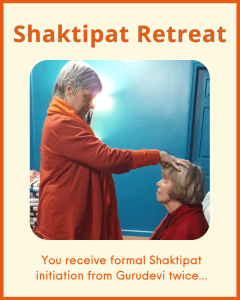
You receive formal Shaktipat initiation from Gurudevi twice. As a Kundalini Master, she is authorized to transmit this powerful initiation. She explains the process and purpose as well as how you cooperate with the inner light arising within you, in-light-ening you day by day.
Discover a whole new dimension to your own being. Recognize and revel in your own spiritual essence. And learn tools that help you bring that into your life.
At the beginning of the Shaktipat retreat, my mind and body had a little resistance. “Oh,” I thought, “we’re chanting again??!” But I went with it. After Gurudevi’s first touch, I felt pulled up from my base and realigned. I could see a roadmap that Kundalini had implanted inside me. During my meditations, the kriyas were much stronger. I experienced a physical cleansing, a burning off.
How do you meditate on your own Self when you don’t know your own Self? In one way, it’s kind of like you lived in a cave your whole life and I tried to teach you to meditate on the sun or the moon. You wouldn’t know what they are. This is why the mantra names your own Self..
— Gurudevi Nirmalananda
From Gurudevi’s full discourse “Meditating on Your Own Self“












 SVA Blog