Category Archives: Ashram News

Just Do It!

By Gurudevi Nirmalananda 

This is not only good advice, it’s a famous advertising slogan — Just Do It. It captured the zeitgeist of the time, a great sense of possibilities. It’s a perfect slogan for a tantric yogi, one who brings their spirituality into the world.

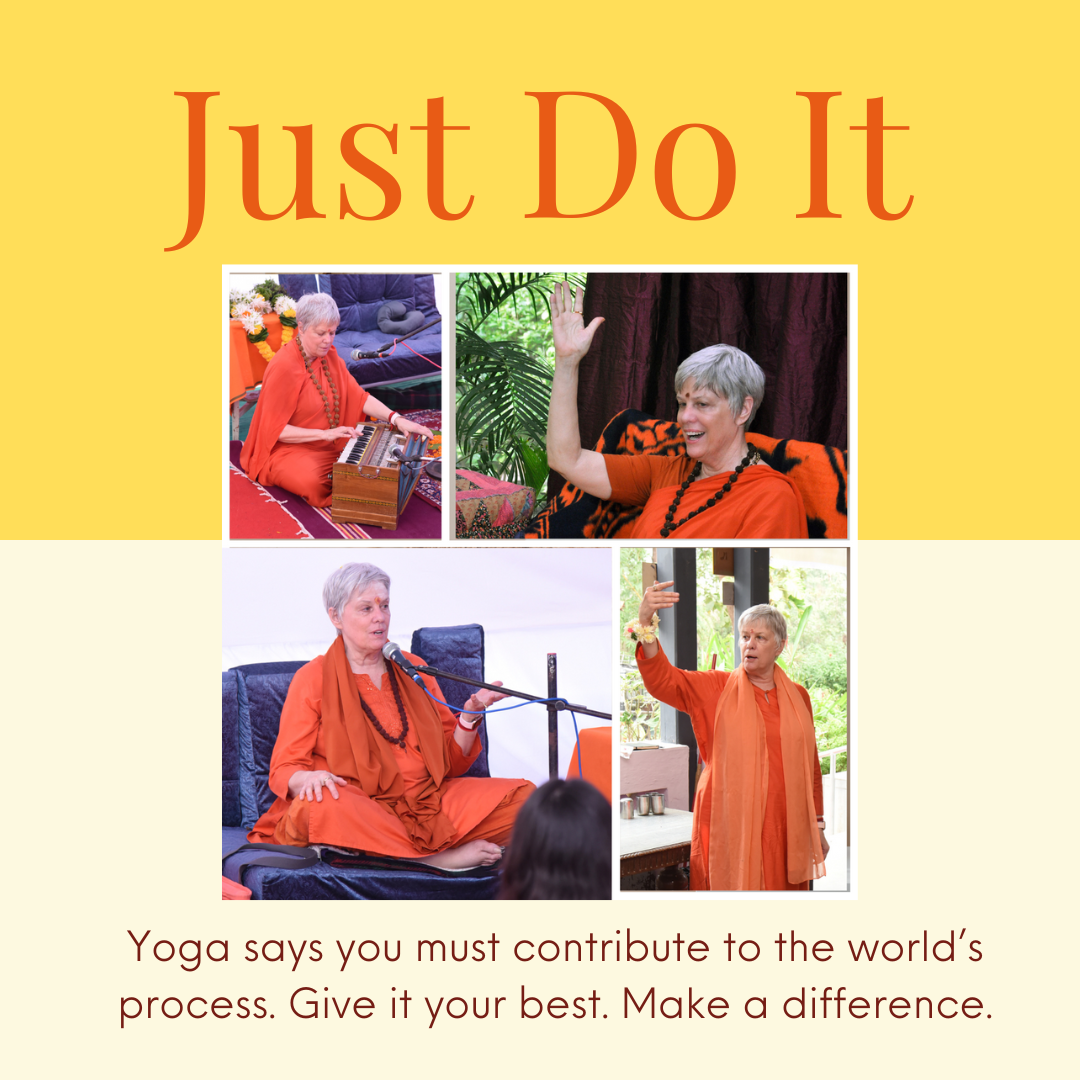
The Bhagavadgita defined this yogic approach to the world. Krishna says you must contribute to the world’s process. Give it your best. Make a difference.

Buddhi-yukto jahaatiiha ubhe suk.rita-du.sk.rite,

tasmaad yogaaya yujyasva yoga.h karmasu kau”salam.

— Bhagavadgita 2.50

Established in clarity, shed selfish motivations that create

pleasurable and painful karmas.

Devote yourself to yoga. Skillful action is yoga.

Yogis of yore withdrew from mainstream society to live in nearby forests. Similarly, in Egypt the desert hermits lived in remote caves. Hearing of these spiritual extremists, you might think that you should leave the world, to try to get enlightened by yourself. However, those living in the Indian forests and Egyptian deserts were not solo seekers. They lived together in small groups under the guidance of experienced teachers. They were not into DIY spirituality. 
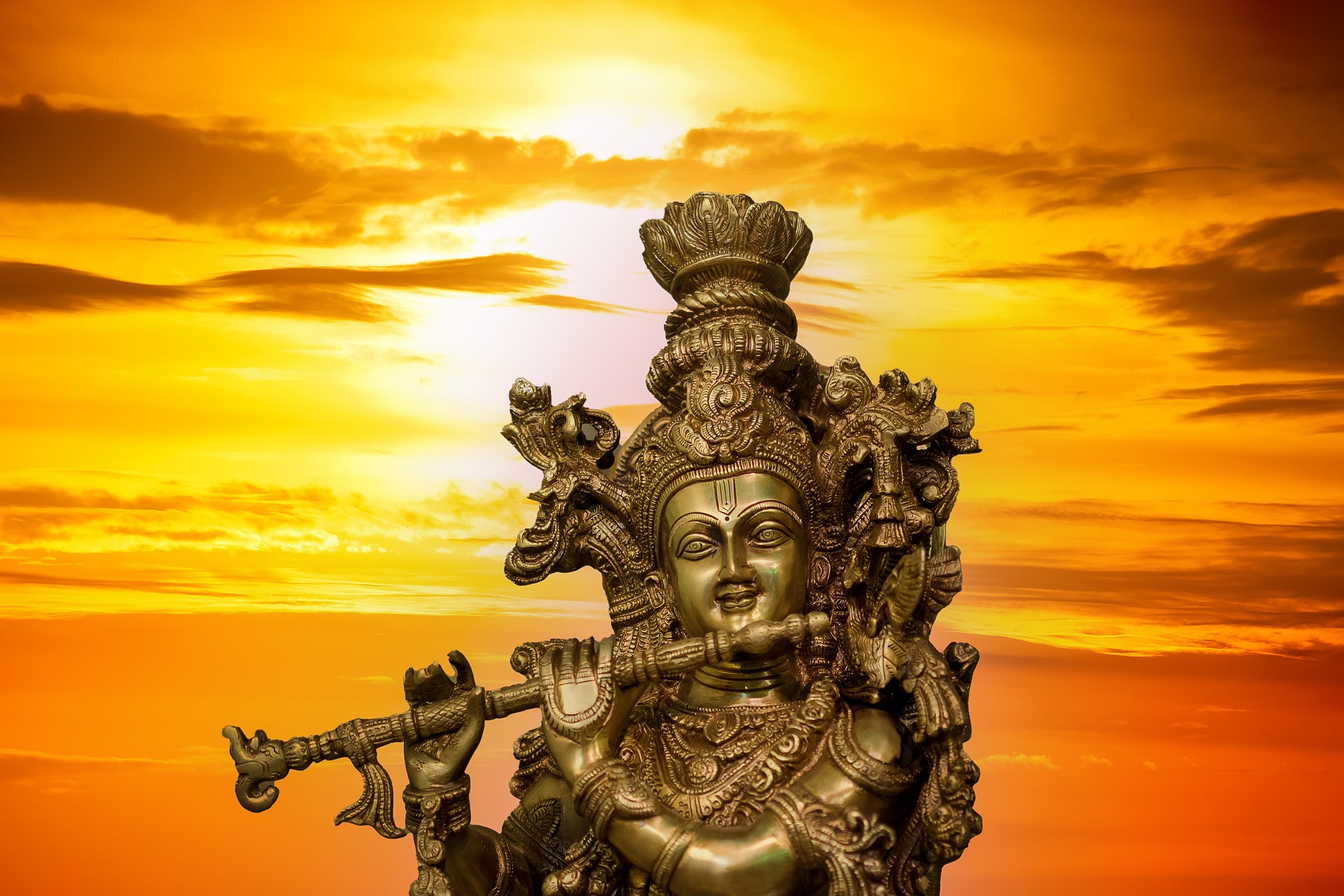
Krishna’s teaching was a radical revamp of the tradition. He said, “Get out there and make a difference in the world.” Why such a change? It was because the world had changed. He lived on the cusp of Kali Yuga, our modern age, predicted to be a time of increasing darkness. Krishna said the world needs the yogis. You must bring your light into the world. Get up and get going. Just do it.

His teaching was revolutionary in another way. While you choose to act in the world, doing your absolute best, a yogi’s motivation is different than that of worldly-minded people. You’re not doing things so you can get a karmic payoff. While people will work hard to get a promotion, their improved status and salary are karmic payoff for their efforts. Doing something nice for others, so they appreciate you, means you’re looking for the karmic payoff. Krishna says, “See what needs to be done and do it. No payoff needed.”

Proactive. Professional. Proficient. And not looking for the results to make you feel good about yourself. Instead you analyze the results of your efforts as a way to…

Yogic Nutrition with Gurudevi

Online beginning November 7

What does a yogi eat?  To achieve health as well as pleasure and (most importantly) spiritual development, yogis feed themselves consciously.  

Drawing on yoga, Ayurveda and scientific nutritional guidelines, Gurudevi gives you easy ways to improve your nutritional profile.  

As these principles begin working for you, you’ll notice a change in your digestion, assimilation and elimination. 

Taste is also important, especially as it contributes to your nutrition as well as your quality of life.  Each class includes a tasting session with discussion.

Enrollment is limited, so everyone can participate in the discussions as well as get personalized support and recommendations from Gurudevi.

Diagonal Leg Deliciousness!

Carolyn (Karuna) Beaver, Yogaratna

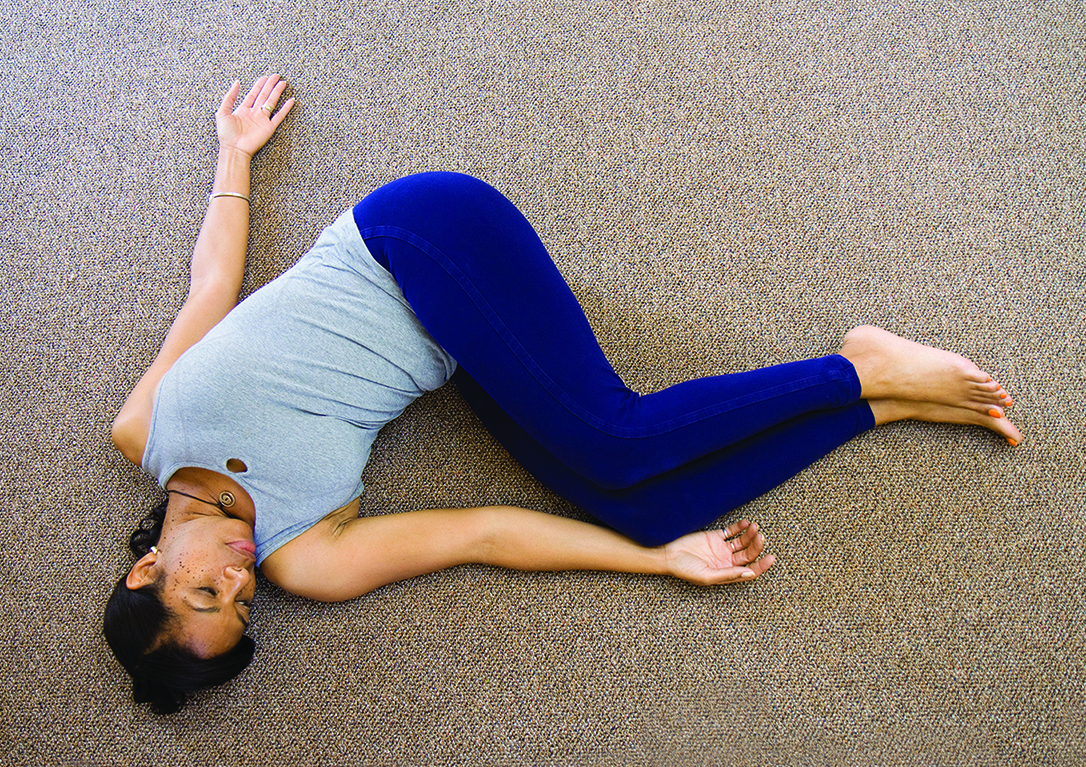
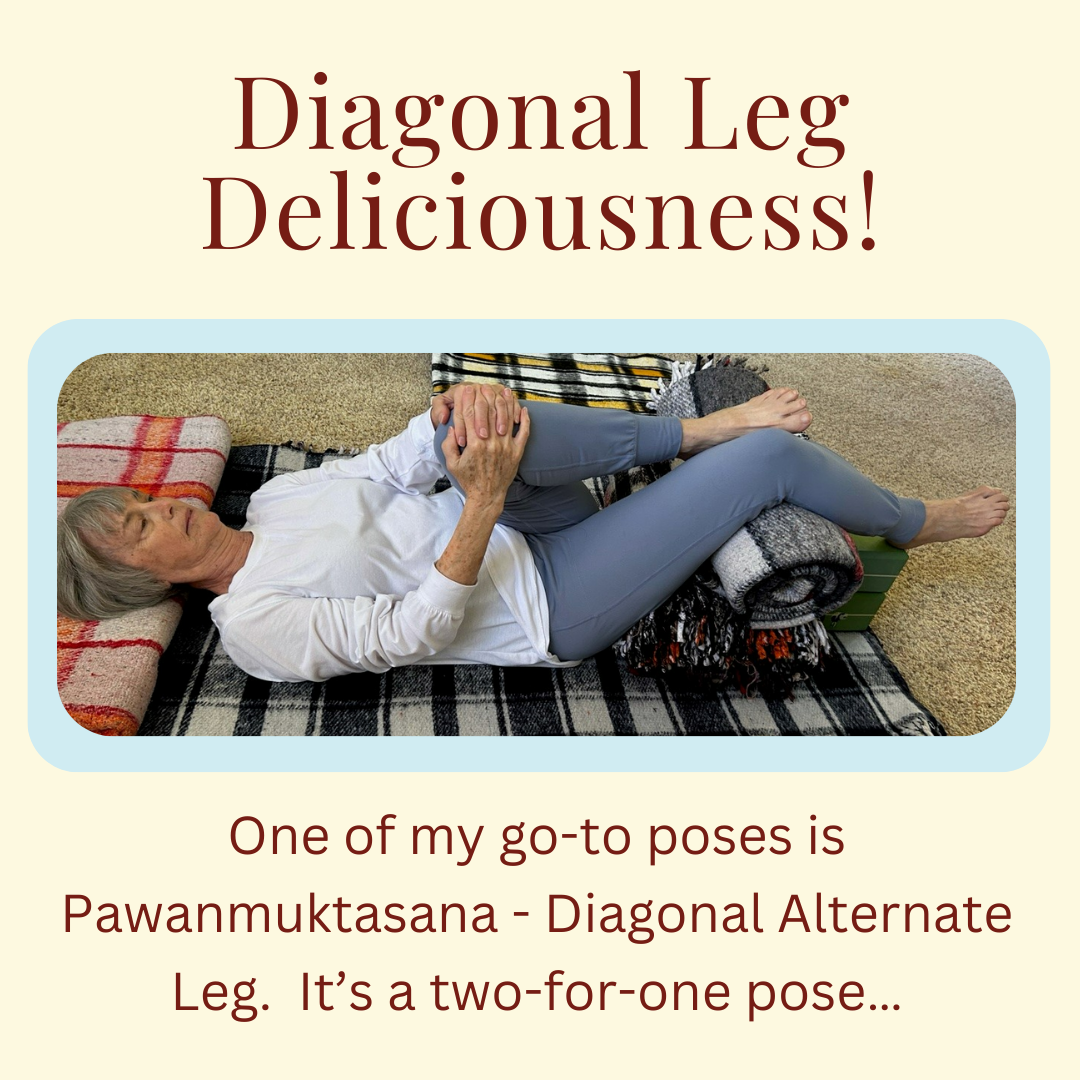
One of my go-to poses is Diagonal Alternate Leg.  It has a wonderful way of resetting my unstable hip joints.  Lately, however, I have been slowing it W-A-Y down.  Then I get all the juice I can from it.  It feels like my own self-administered Cure All Knee Press.

It’s a two-for-one pose.  You start in the regular angle of Alternate Leg.  I linger just a little, first with my knee in towards my chest.  Then, I move my leg into an advanced and deeper angle, thus I can feel my tailbone release in both angles. Ahh…

I take my time moving my leg across my body into the diagonal angle.  I go slow, and then pause.  When I coax my knee in towards my chest, I might even feel into a tight spot.  Some softening breaths, and I can feel those muscles let go.  It’s the “Cure All” effect!

My favorite part of all?  Allowing my leg to lean in towards my chest slowly and naturally, as I ease it back to its starting point.  I can feel my thigh bone pivoting and settling into my hip socket in a different and deeper way.  And even better than all this?  I get to do it all on the other side!

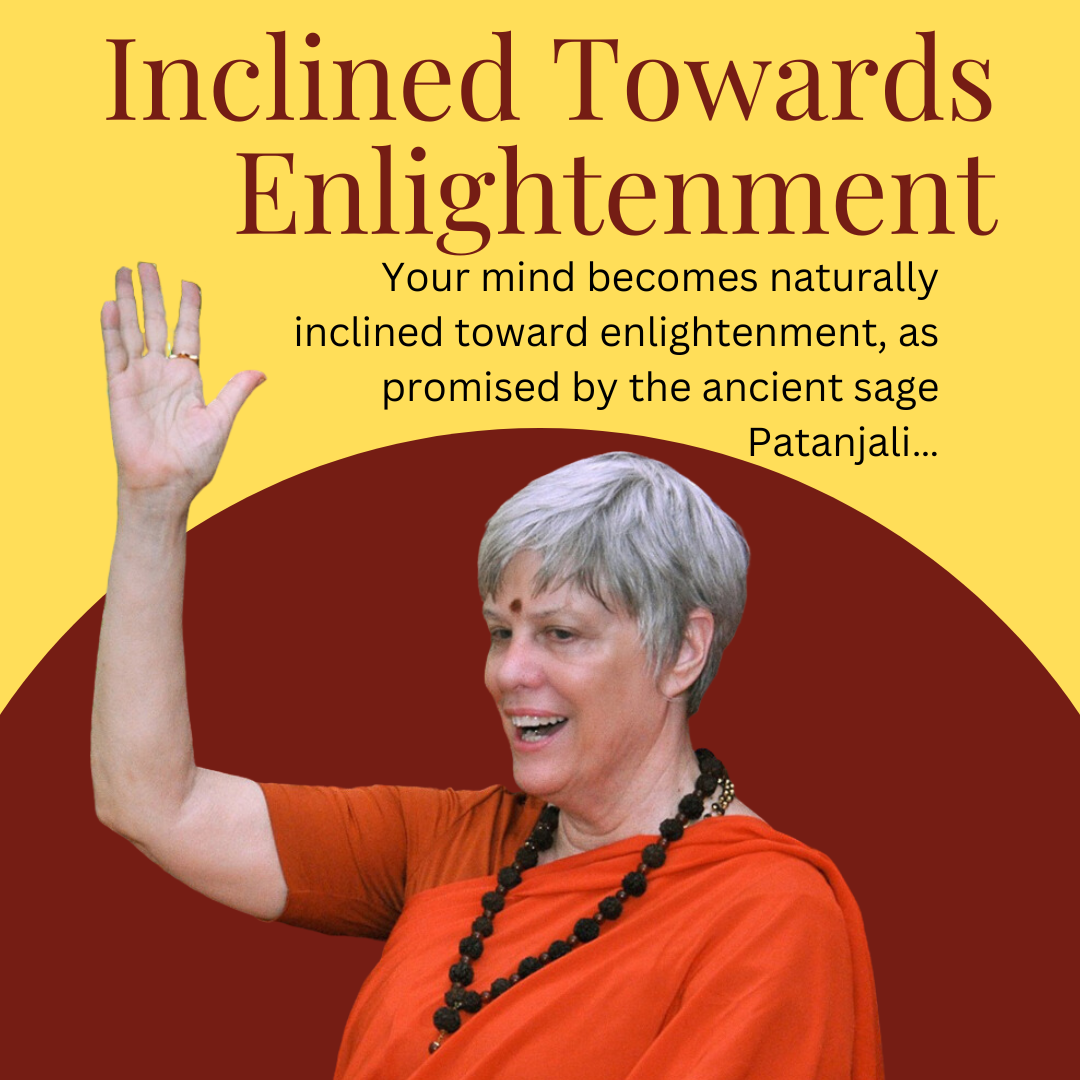
Inclined Towards Enlightenment

By Gurudevi Nirmalananda 

Then your mind is inclined

towards discernment and

 is heading toward liberation.

Tadaa viveka-nimna.m kaivalya-

praagbhaara.m cittam.   

— Yoga Sutras 4.26

This sutra is near the end of his text, meaning you’ve done the deep spiritual work he describes.  Then, having trained your mind for a while, it becomes inclined towards two things:  discernment and liberation.  Discernment means you easily distinguish between what uplifts you compared to what tears you down, and that you make intelligent choices. Liberation means you become free from the cycle of reincarnation, thus this is your last lifetime.

There’s a hitch.  First you have to train your mind for a while.  How long?  Well, just like training your dog to sit, it depends on how much time you put into it every day.  If you make a stab at it once a week for 10 minutes, it will take much longer than if you spend an hour on it daily.  You choose, basing your choice on what’s important to you.  If you want to get enlightened, you like to put time and energy into it, just like with anything else for which you might aspire.

A research study proves that Patanjali’s promise is valid.  When you put some time and energy into upliftment, you get uplifted.  

Burton & King1 asked participants to write about IPEs (intensely positive experiences) for 20 minutes daily for three days.  The members of their control group wrote about different topics.

They were all evaluated for mood and health at the beginning and three months later.  Those who wrote about IPEs for 3 days had enhanced positive mood scores compared to the control group. They also had significantly fewer medical visits for illness in the three months.

Do you want to improve your mood and be healthier?  Write about the happiest moments of your life for three days, 20 minutes a day.  Amazingly easy!  And the effects will last at least three months.  If you want them to last longer, you may have to continue your writing assignment or redo it.

Do you want to get enlightened?  It will take more than three days.  But it’s worth it because enlightenment is so much greater than mere mood management. Enlightenment is about shining with the light of your own Beingness all the time.

This light is already there within you, but covered over by things that weigh you down and tear you up.  Yoga’s meditative practices lighten your load and reweave the fragmented parts of your being back into wholeness.

In ancient India, yoga was not an athletic endeavor.  In the 1900s, one yoga teacher mixed British calisthenics into his classes.  He became famous, starting a trend that continues today, with athletic yoga, aerobic yoga and even gymnastic and aerial yoga.  But for thousands of years prior to that, yoga was always a meditative process. 

I call it “slow yoga.” That’s what we do – slow you down so you can go through three reliable stages:

1, Healing – both body and mind need some TLC.  Slow yoga gives you the recovery time and deep reconditioning you need.

2. Transformation – the upliftment of your mind brings your emotions along.  It starts with inner peace, gradually expanding into happiness, generosity and bliss.

3. Illumination – enlightenment is within your reach as your mind becomes naturally inclined toward discernment and liberation, just as the sage describes.  He calls it “svaroopa,” which names your own Divine Essence.  That’s why our yoga is named Svaroopa® yoga.

However, you don’t actually “reach” for enlightenment.  You settle into it.  That’s because Divine Light, as in the word en-lighten-ment, is already within.  You are an incarnation of Divine Light. You merely need to look within in order to find it.  That’s called meditation. 

  1. https://www.sciencedirect.com/science/article/abs/pii/S0092656603000588?via%3Dihub ↩︎

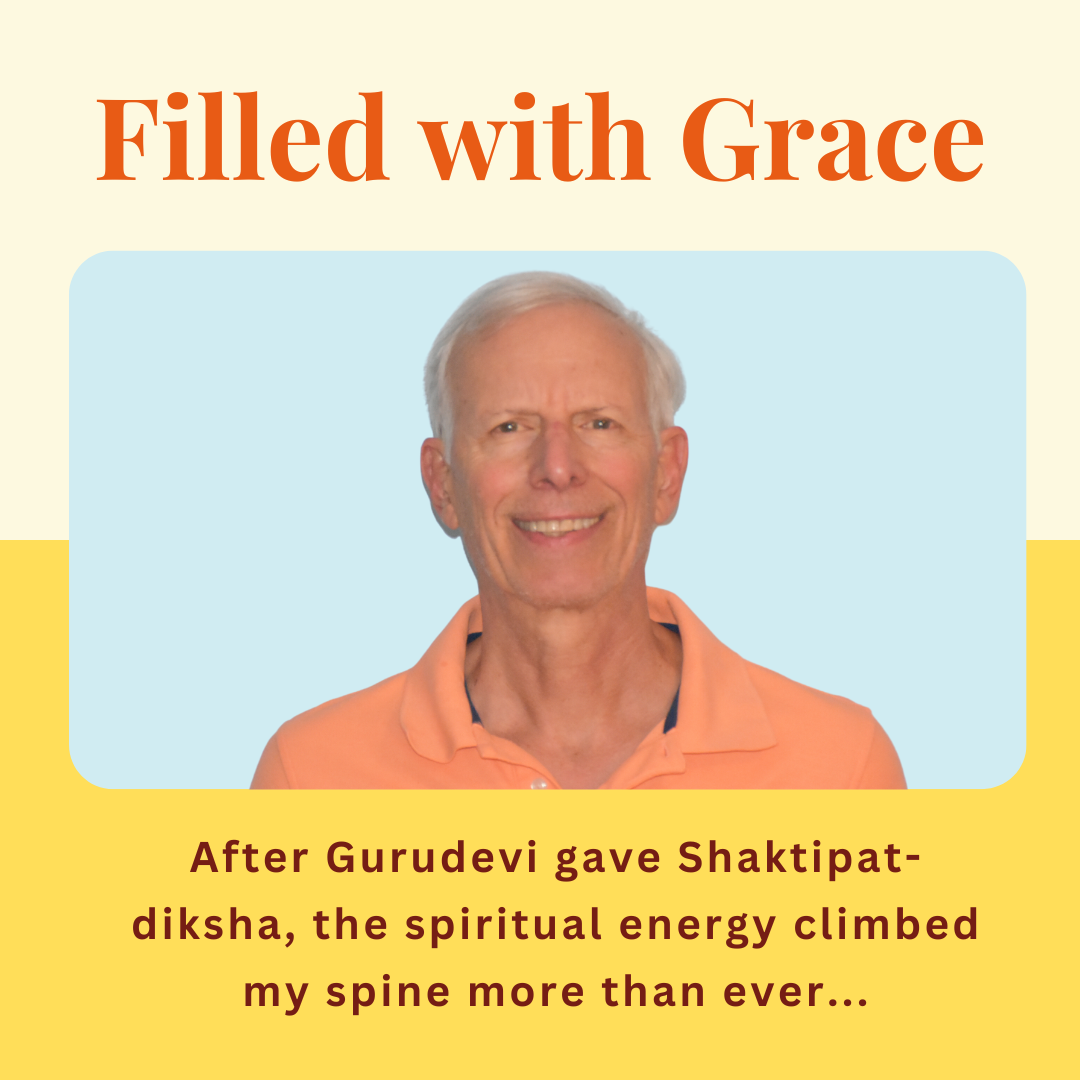
Filled with Grace

By Lloyd (Dharma) Apirian

Interviewed by Lissa (Yogyananda) Fountain

By attending Swami Sundays with Gurudevi, I’d already made profound inner shifts.  Yet I was looking for something even deeper.  Feeling a little down and flat, I wanted renewal: a deeper knowing of my own Self.  

An immersion with my Guru guarantees this!  I also know Shaktipat is a powerful way to boost my personal growth and transformation.  So I signed up for my first online Shaktipat Retreat.  

Doing a Shaktipat Retreat weekend at home has its advantages.  I was in my yoga room and everything was so familiar.  Yet I went just as deep in meditation as when I am in Gurudevi’s presence.  After Gurudevi gave Shaktipat-diksha, the spiritual energy climbed my spine more than ever.  It was freeing, opening and releasing.  I was surrendering to the Self. 

During a longer meditation, I experienced an auditory kriya.  I heard OM Namah Shivaya singing in my left ear!  In a short time, the sinus congestion I’d been feeling cleared away.  This was all Grace, pure Grace.  The Shakti moving through the Guru transcends limitations of space, time and energy.

To keep the Grace flowing, it’s recommended you increase your meditation time and be consistent.  After the retreat, I did notice the effects were fading.  I hadn’t been doing enough meditation.  Before my next Shaktipat, I’m signing up for Meditation Club!  To support carrying these effects into my life, I need the structure.

The Shaktipat experiences that Gurudevi describes with her Guru, Baba Muktananda, inspire me.  They once seemed unattainable and remote.  Now I know they are possible for me.  Shaktipat is a life changing opportunity to experience the Truth of my own Beingness.  I am forever grateful.

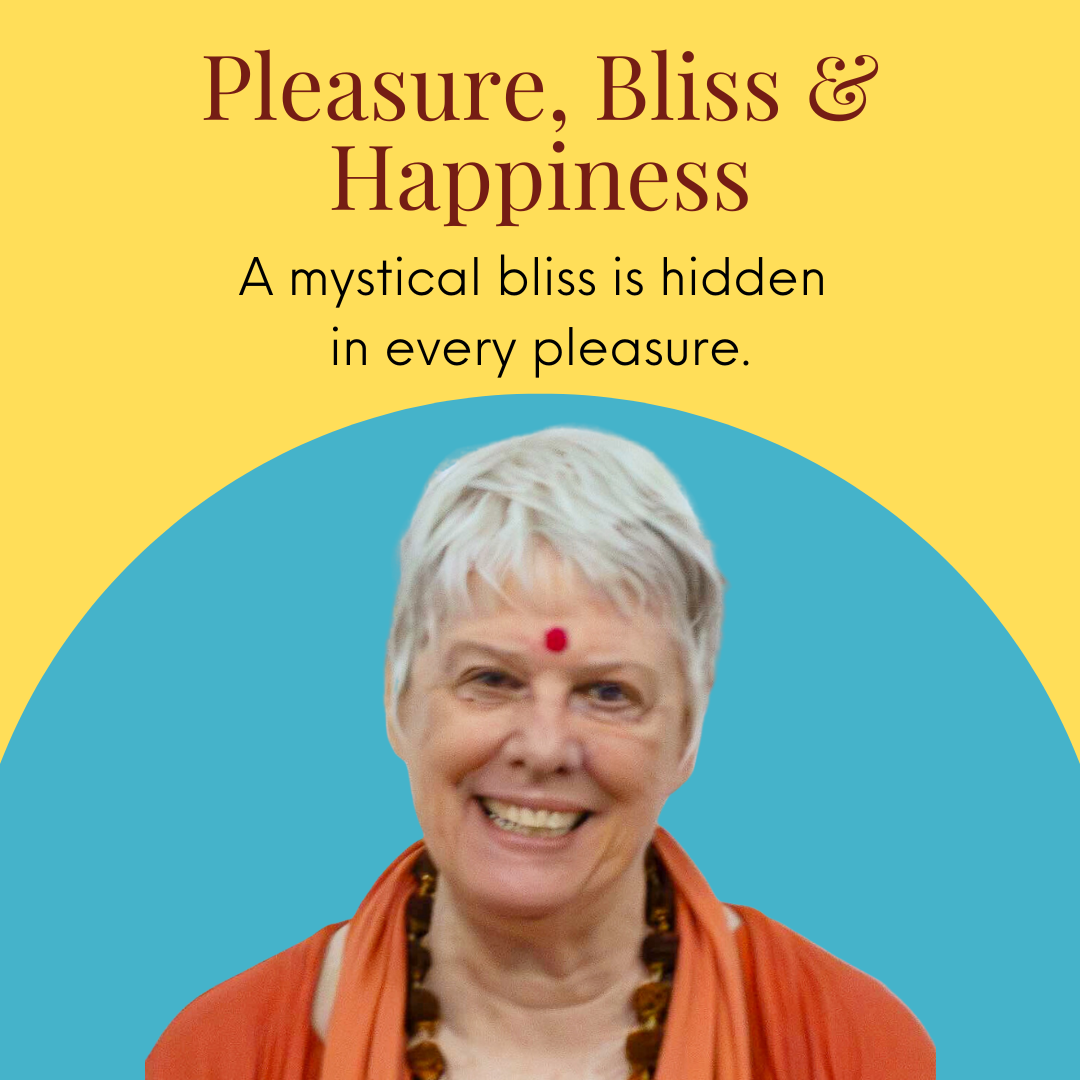
Pleasure, Happiness & Bliss

By Gurudevi Nirmalananda

At the end of a busy day, you look for something pleasurable to do. You may even have sought out pleasure during your day. Your choice of foods and drinks, maybe going for a walk or taking a nap, filling your ears with music or your eyes with beauty – pleasure seeking is a dominant theme in most people’s lives. Why?

To find out why, simply refrain from pleasure when you feel the need. Notice how you feel without a sensory indulgence, including any discomfort in your body as well as your emotional state. You may also find that your mind is crazy-busy. No wonder you want something to distract you!

Pleasure is a pathway to happiness. When you do something pleasurable, you get happy for a short while. When the happiness ends, you need another indulgence to trigger a few more moments of happiness. Like a frog, you hop from one thing to another, seeking brief moments of happiness. Bliss is better.  It lasts longer than happiness.

Mystical bliss is hidden in every pleasure… (read more)

Standing in Presence

By Rosemary (Rudrani) Nogue, Yogaratna

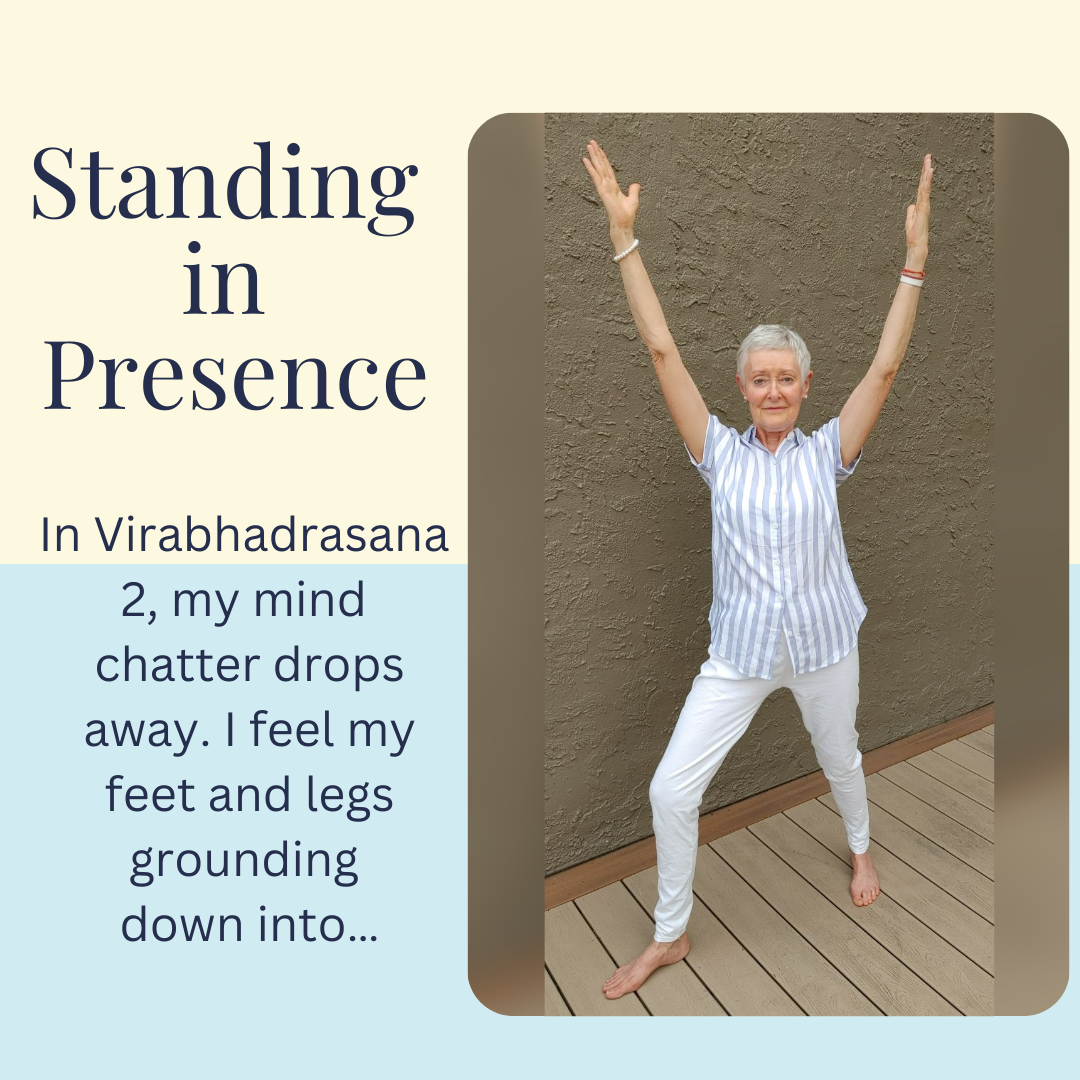
The standing pose Virabhadrasana 2 (Warrior 2) is one of my favorites.  Moving in, I become absorbed in its physical angles and alignments.  Any mind chatter drops away.  I feel my feet and legs grounding down into the support of the earth.  Engaging my abs and raising arms skyward, I feel solid and uplifted at the same time.

I become aware of the interconnectedness between my body and mind.  I settle into equal balance between my feet, and my mind feels balanced too.  It feels circular.  My physical balance creates mental balance, and mental balance creates physical balance. 

My spine is freed to soften and lengthen.  With the crown of my head over my tailbone — Voila! — I am even deeper inside.  There is only quiet. 

Staying in the pose uncovers my stamina.  The pose feels powerful while being challenging.  I feel clear, strong, resilient and elated.  I experience standing in total presence, right here, right now, being the Beingness I am. Moving out of the first side, I am more than ready for the second side.

Continuing in Virabhadrasana 2, a sense of inner presence arises.  It unwraps an experience of my inner warrior.  As my heart expands, I feel strong and powerful yet kind, loving and open at the same time.  This pose prepares me to move into my day.  It gives me Me!  No wonder Virabhadrasana 2 is one of my favourite poses.

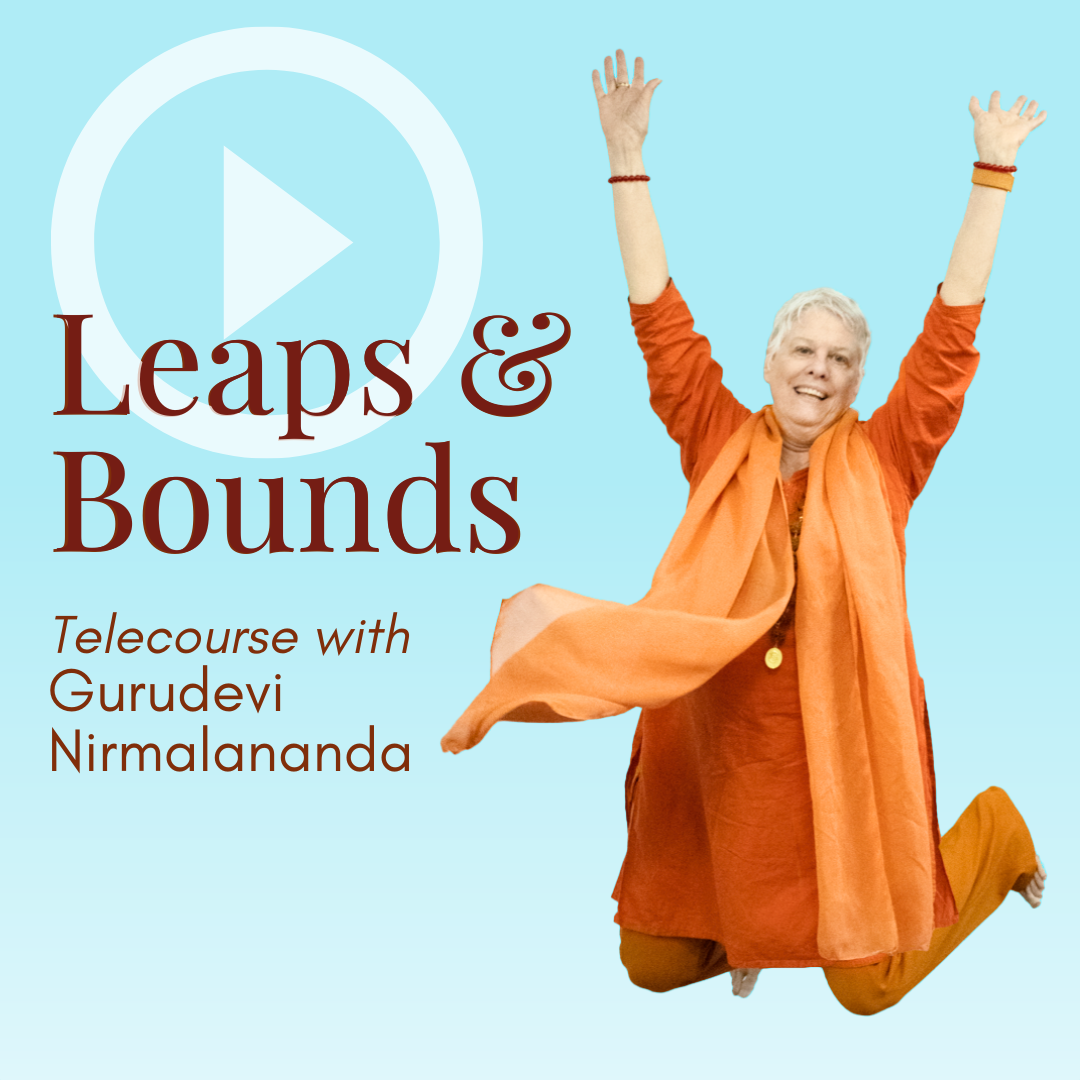
Telecourse: Leaps & Bounds 

Learn and grow in this multi-media course. This course draws out the meaning of Shaktipat:  what it is and how it works, as well as how you maximize the blessings it brings.  Be filled up by classical teaching stories as well as verses from Sanskrit texts. 

Go at your own pace in this multimedia course, comprised of substantive articles and teaching videos,.  Your password is current for three months after you enroll.  

Enroll in any of the three modules or sign up for all of them:

Module 1:  Growth Spurts — Leaping forward, bounding into Consciousness, making fast progress easily 

Module 2:  Living Spirituality — Riding on the shoulders of spiritual giants, how do you incorporate their great gifts into your everyday life?

Module 3:  Ordinary Monks & Mystics — Outgrowing your past & shaping your future. The loom of tantra: interweaving spirituality through life.

Bonus Video:  Resting on Your Laurels (free when you enroll in all 3 modules).

Gurudevi taught this course in 2019 as her Year-Long Programme.  New videos and updated Teachings Articles make it fresh and totally relevant to your needs today — that is, if you’re not enlightened yet

Leaps & Bounds

By Gurudevi Nirmalananda

Breakthroughs are not dependent on receiving Shaktipat.  Grace is not so limited.  Grace is part of life, always available. 

You’ve been lifted out of your small-s self so many times by Divine Grace.  Shaktipat is the form of Grace that awakens your inner meditative energy, so the upliftment keeps coming, again and again, every time you meditate.  It arises within.

While Svaroopa® yoga specializes in Shaktipat, you were uplifted and sheltered by Grace before yoga.  Your life has had many moments of Grace.  Like a child sitting on daddy’s shoulders, Grace shows you what you could not see.  Yet you still have to come down to earth and go through the process of growing into your own future. 

It’s easier to navigate to your future when you’ve seen where you’re going, and even easier when you have a GPS.  Yoga’s teachings provide both:  the description of your goal as well as how you get there.  They describe levels and stages that can help you understand where you’re at, and give you practices that help you make the next leap forward. 

That’s what I’m presenting in this Telecourse – the levels and stages of your upliftment.  It tends to happen in leaps and bounds.

Sutra on Pain Avoidance

By Gurudevi Nirmalananda

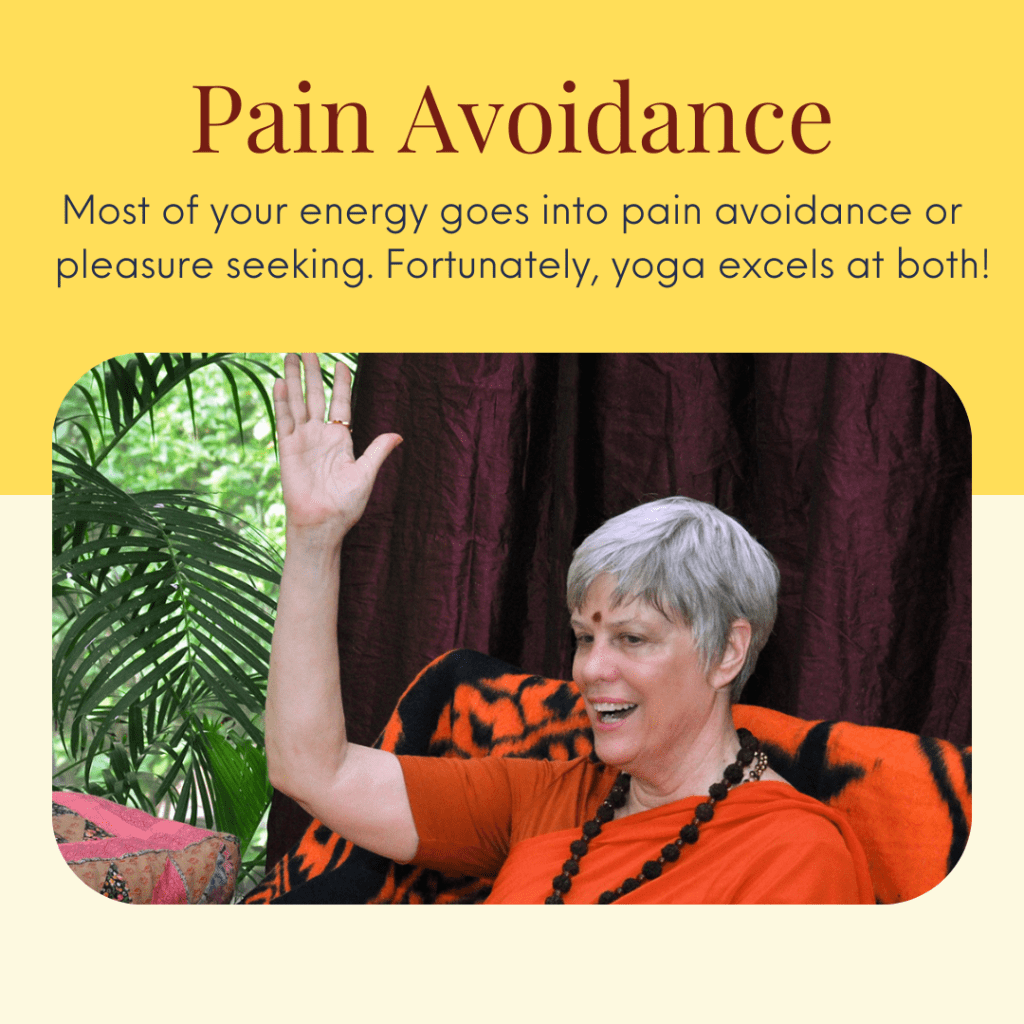
Pain is part of life.  This is why most of your energy goes into pain avoidance or pleasure seeking.  Fortunately, yoga excels at both!   

The physical practices of yoga are incredibly pleasurable, though you may go through a learning curve before you discover this. 

Especially when you are in-person classes, your teacher can adapt the pose to your body’s readiness as well as give you a prop or adjustment that melts through your accumulated tensions.  Svaroopa® yoga excels at this.  Regular practice of yogic breathing and the poses protects you from future pain in a magical way. 

Yoga’s meditative practices focus on getting you past your mental and emotional pains.  Using the enlivened mantra of this tradition cuts through your inner turbulence and carries you deeply within.  You find your deeper essence, what yoga calls “your own Self.”  Once you’ve experienced the inner infinity of your own Self, you have a different perspective on life and its events.  It’s easy to agree with the book title, that it’s all small stuff. 

That’s the gist of this sutra, a concise teaching with a great promise: 

Future pain can and should be avoided. 

Heyam duhkham anaagatam. 

— Yoga Sutras 2.16 

My elders expected to be in pain as they aged.  When I tried to give them a few yogic tricks that would diminish or relieve their pain, they said, “No thanks, honey.  I’m old.  I’m supposed to hurt.”  The sage Patanjali disagrees.  He not only promises that you can avoid pain, but that you should.  Good news! 

How do you avoid pain?  While yoga poses and breathing practices help you with your body, meditation is the key.  This is Patanjali’s focus, getting you past your mind so you experience the greater reality within.  All the yogic sages throughout time have focused on meditation as well as how to bring your own Self with you into life. 

Instead, our sense of self gets locked into worldly definitions. When I was in my twenties, my parents said it was time for me to get my boxes out of their garage.  I had completely forgotten about those old possessions, childhood treasures. One box was full of stuffed animals.  As I unpacked them, I was shocked to see how meaningless they were.  Yet they had meant everything to me when I was 12.  What happened?  I outgrew them. 

So many things have come and gone in your life.  You’ve already learned how to move on.  Patanjali says you can use this ability now, right in the midst of whatever you are currently going through.  Recognize that the ticking clock is moving on.  It’s time to outgrow your old needs and dependencies.  It’s time to grow into a new you. 

It’s meditation that makes this easy because you experience the greatness of your own essence.  When you tune into your own Self, the profound depth of pure Beingness supports you from the inside.  Now, whatever is happening on the outside, you take it in stride. 

You are more than these events seem to make of you.  You are more than others understand you to be.  You are so much more.