
By Swami Nirmalananda

Yoga’s goddesses are not just the beauties on magazine covers and in videos. The Indian roots of yoga gift us with a mythic reality, incredibly rich and fulfilling, to explain everyday as well as extraordinary events.
Lakshmi and Saraswati are among the best-known Goddesses, each of whom is the Ultimate Reality in a feminine, creative, fertile, productive and powerful form.  Most Goddesses sit on lotuses, rooted in the mud of the earth yet blooming in pristine beauty.
Sunday October 30 is Diwali, Lakshmi’s annual festival. As a harvest festival, it celebrates the bounty of Mother Earth (Bhudevi), as well as expresses gratitude. Yet Diwali is not merely about material abundance, nor was Thanksgiving Day meant to be. In 1789, President George Washington issued the first Thanksgiving Proclamation, establishing it as a day of “public thanksgiving and prayer” devoted to “the service of that great and glorious Being who is the beneficent Author of all the good that was, that is, or that will be.”
Diwali is a public holiday in India, with celebrations featuring the fireworks of our Fourth of July, the feast of our Thanksgiving, the gift-giving of our Christmas & Hannukah, and the loud and boisterous parties of our New Year’s Eve. Everyone gets new clothes and dresses in their finest, with family and public events filling the day, even spanning 2 or 5 days in some regions!
It’s a great celebration. Yet it’s about the “beneficent Author of all…” Its roots lie in ancient times, the honoring of life itself as well as the way nature’s bounty sustains us. Lakshmi is the name given to this Divine Energy of beneficence, the generosity that supports and nourishes all, that which makes us thrive. It seems unfamiliar to the Western mind because we don’t have a name for something that happens every day.
 A seed sprouts, sends roots into the earth and reaches up for the light. What makes it sprout? What makes it grow, flower and fruit?
There is an energy, a power hidden within the seed, something that propels an inert little speck to blossom into a living plant — a plant that gives us the food that we harvest and eat.
This Divine energy produces more than enough seeds, not only to feed us, along with a myriad of insects and other creatures, but to provide for its future generations (and ours). How many seeds does a pomegranate have? How incredibly prolific!
The sages of India gave a name to this Divine Energy: Lakshmi. They honored all the different energies as Divine Energies, describing this world as a Divine Playground, and gave us mystical practices and teachings that promise us the same seeing.
 Religion honors the Divine as though it is found outside of you, being in relationship with you, blessing or testing you. Thus Lakshmi is found in Hinduism, honoring the Divine Nature of the food we eat and all the blessings we receive. Yet yogis look deeper. Yogis look for the Divine within. Thus it is, on Diwali, that yogis look for that same beneficence within themselves, that same blossoming forth in a spirit of generosity, nurturance and blessings.
When you celebrate the bounty that will feed us through the winter, you naturally prepare a holiday feast and enjoy the company of your nearest and dearest. You also shop the season’s sales, so you can grab more of the bounty for yourself and your loved ones. This is how the celebration of bounty turns into institutionalized greed, not only at the dinner table but for weeks afterward, all the way to Christmas or through your whole life.
Yet when you celebrate the Divine source of that bounty, paying attention to something you usually take for granted, you stop to honor the sanctity of life and the holy gift of the Goddess. Then you truly give thanks, not only to the sun and earth, but to the Divine source. Opening your heart in gratitude is a Divine experience, hopefully one you can share with others who share your acknowledgement of that Divine presence in all.
As a yogi, you go a step further. You look for the Divine source inside, not only to experience but to act on, just as Lakshmi does, by sharing your bounty with others. Thus, for yogis, Diwali is a time for giving gifts, a time to support those they care about the most. It’s not about receiving; it’s about being the ever-flowing font of blessings. Diwali is a day to honor the Divine within you, as well as the Divine outside of you and all around. It’s a time to thank Her for Her great blessings — on a day dedicated to Lakshmi. Diwali.
 And you could even dress up as a Goddess for the day! Not as a sex-goddess, not for the purpose of attracting attention, but as a scintillating form of Divinity. It’s a day to honor the Divine blessings that give us life for yet another year, as well as to honor the Divinity in yourself, that is your Self.
OM svaroopa svasvabhava namo nama.h

image credits (from top to bottom):
- Lakshmi: www.ifairer.com
- Saraswati: http://www.rudraksha-ratna.com
- Seed Sprouting: www.the-science-mom.com
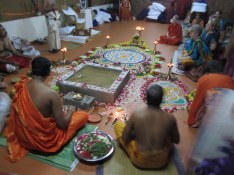
- Lakshmi yaj~na (fire ceremony): Ashram photo from Kerala event
- Dressing as Lakshmi: www.qz.com
- Swami Nirmalananda’s hands: Ashram collection (on the cover of Namah CD)
 by Matrika Gast
 Small world, so amazingly miraculous and beautiful.
 By Mati Sandy Gilbert
 My personal high was when Swami presented me with a beautiful crystal from her own puja. I remember reveling in her praise. Afterwards, others told me I beamed. How could I not?
 Ishvari (Terry) Gardner agrees that Swami Nirmalananda’s visit was a great experience for all. She recalls, “I couldn’t help watching the attendees’ rapt attention to Swami’s discourse. She deftly wove the question of ‘How much is enough’ through life itself as well as elements of yoga. She encouraged us to become aware of our own Yoga Score and how it can affect our life. Following her discourse, we all chanted the mantra of our lineage: ‘Om Namah Shivaya.’ Then we settled into a very still, silent, deep meditation. Afterwards, there was a lighthearted joy in the room as individuals went up to kneel at her feet and share a few private words with her. Each received prasad, an orange cord bracelet, tied on by other yogis. The group chatted together about their experience. I believe everyone left a little — or a lot — changed. I am certain that all were inspired to ‘do more yoga.’ I am profoundly grateful to have Swamiji inspire all of us in so many, many ways.”
 By Matrika Gast
 While one set of WIIFMs got me to Svaroopa® yoga, in the process I discovered that deeper motivation to know my Divinity experientially. The paradox is that both WIIFM goals have been fulfilled again and again. And even more keeps coming. An endless stream of Grace reveals the Divine woven into all things.
 By Yogeshwari Fountain
 In “Being a Role Model,” she points out the “Truth” that I am “perfect and divine,” always, no matter how I feel, or what my mind says, no exceptions. To live this, I need all the practices of Svaroopa® yoga to keep re-aligning myself to the Self intentionally. But to know I AM Living Truth itself is an inner shift that develops over time. While I have blissful experiences of it, clearly I am not established there. But the Guru is, and because of this, she is the ultimate role model, manifesting the revelatory power of Grace.
 The glory of this tantric path is that you must then turn outward, and shine your light back into the world. While Swamiji continues to model this for all of us, she exhorts every Svaroopi to do the same for others. I’m often asked, “How many hours of yoga do you do each day?” If only they really knew! Still, being a role model is humbling, as I’ve never felt “better than” anyone. I’m simply grateful to be on this path of discipleship. I trust that if I cooperate with the process, and watch my motives for any given action, I will become progressively more uplifted. I will understand what I am truly becoming, not in a worldly sense, but as embodied Consciousness, Living Truth.
 SVA Blog