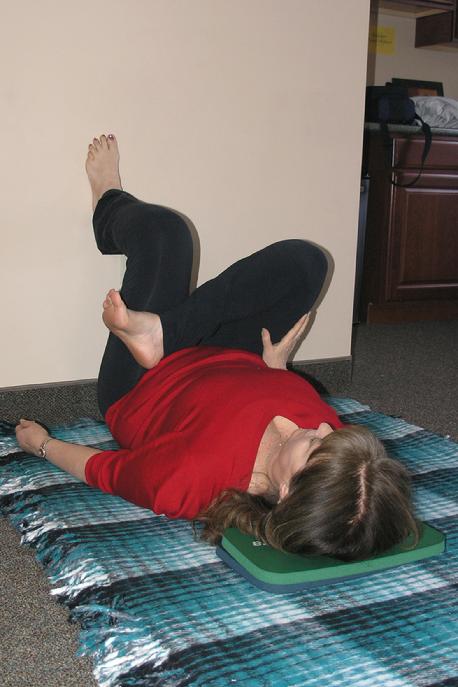
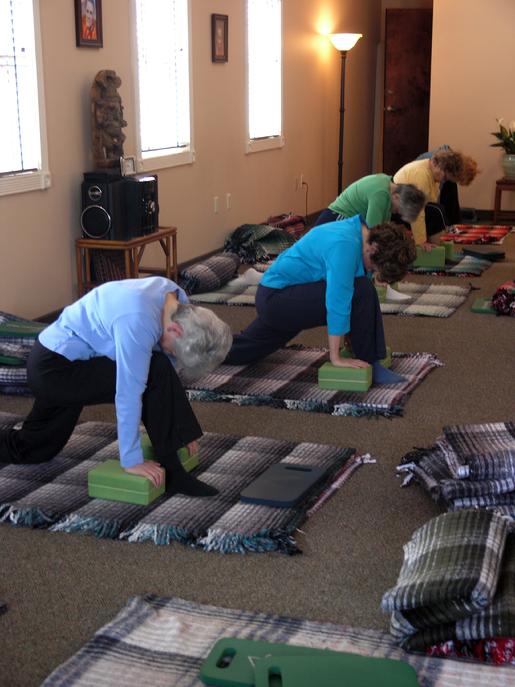
When I first started doing Svaroopa® yoga poses, I hated Lunge. Now it’s my cure-all for life. I use it for every ache and ailment. I do Lunge when I’m not feeling well and when
I’m grouchy.
I actually began Svaroopa® yoga with individual Embodyment® sessions and vichara (guided self-inquiry). Later, for a home practice, I relied on recorded guidance to do Four on the Floor. I avoided Lunge — the third pose in the sequence — I just lay in Shavasana instead. When I attended an asana class, naturally, I would have to do a Lunge. It did get easier with repeated classes. Then I took the Foundations of Svaroopa® Yoga course, and everything changed. I found a love for Lunge.
Because Foundations is a five-day introductory teacher
training, you learn to teach the primary poses to others. Thus, you stay in poses longer and learn more
about alignments and propping. That’s
when Lunge became my favorite pose. With
extra support to meet my personal needs, I was able to relax into the
pose. Then I could feel its benefits
profoundly. My legs and spine
expanded. And expansion spread into my
heart and mind.
While I did not take Foundations in order to teach, the
program was hugely beneficial to me. I
experienced profound opening. I learned
to prop myself in my home practice more effectively. My feelings for Lunge morphed into love.
Overall, I experienced more deeply the
transformative effects of releasing spinal tension. And I learned more about the importance of
precise alignment and customized propping to meet my individual tensions. Lunge as well as other poses in my home
practice are delightful now. It’s
amazing to have such reliable tools for living life to the fullest.
l consider
myself the queen of self-care. I can’t
remember the last time I needed to take a sick day. Doing my practices keeps my immune system
strong, my spine flexible. My spirits stay
uplifted and steady. Ujjayi Pranayama,
meditation, chanting and asana start my morning. I offer seva, repeat mantra and try to
remember my Guru throughout each day.
Still, I
am capable of throwing myself off a deep end, forgetting how to swim! Swami Nirmalananda’s Teachings article, Assess
Your Condition, could not have come at a better time. Swamiji points out, “While yoga’s tools work
better than anything else, you need to pay attention to how you’re feeling and
what you need.”
A lot is going
on in my life. My husband is retiring,
and we are putting our house on the market. I’m teaching my classes, travelling and
teaching for the Ashram. I am seeing
clients, leading satsangs, writing blogs, etc. Endings, beginnings and maintenance — it’s all
Shiva dancing through form and beyond form. Yet it is so easy to give into my distracted mind’s
demands. I’m in hurry. I forget that all is Shiva, being me. I find myself doing my “wonder woman yogi”
routine. Then it’s time to stop and
assess the condition of my body and mind.
I am
noticing the four symptoms of a mind distracted from Self. Rendering Patanjali Yoga Sutras 1.31,
Swamiji lists them: pain, despair, nervousness and interrupted breathing. She reveals that “in addition to the four
symptoms, there’s a mystical secret hidden in this sutra. Patanjali explains their common cause: vik.sepa
(vik-SHAY-paw) — distracted mind. He
means your mind is distracted from your deeper essence.”
I find I am
most susceptible to interrupted breathing (shvasa-prashvasah). My mind is fragmented with endless details and
plans. In this busy time, I need a
moment-to-moment infusion of Divine Essence. I need to settle down, and tap in. Swamiji’s February “quick fix” makes this
accessible: “do a few Ujjayi breaths, anywhere and anytime.”
Just
today, a yoga buddy could hear the anxiety in my voice. So, together, we stopped everything and took a
few slow, long, easy Ujjayi breaths. The
space between us filled in with Self.
The sound of my breath got me out of my head and into my body. The space within me filled with my essence and
expanded. It opened me to the still
center within. Shiva!
Swamiji describes
that “you hold your breath so you won’t feel the feelings that are surfacing or
are just below the surface.” Until I
read this, I had no idea it could be happening to me. The truth is, I am experiencing a major life
transition. I am trying to dial down the
accompanying emotions and dramas. There
are, however, some big feelings to feel, not to repress!
Doing a minute of
Ujjayi breathing re-centers me. Divine Essence
fills me. Nothing outside is so urgent. Perspective returns. It was just the mind, after all. When I feel thrown into the deep end, I don’t
have to flail my arms. I don’t even have
to swim. I can breathe, listen to my
breath’s sweet sound and soften. Then I
float in Guru’s Grace.
By Ellan (Shanti) Catacchio Interviewed by Marlene (Matrika) Gast
I confused seva with volunteering. I know now, however, that seva is yoga because it puts me in my stuff. That inner experience triggers spiritual growth. In volunteering, I just focused on getting the job done. In offering seva, I look at the effects of the process on me. I used to say I work better under pressure. Then I realized I only worked under pressure. Seva has helped me change that.
My first seva involved updating contact information. The three-part process included calling, emailing and finally sending snail mail. I learned a bit about how to navigate an online communications system. All the while, I had to push myself through resistance and a deeply engrained habit of procrastination. I kept telling myself it was seva. You just do it. Humbly. In my case, grumbly.
dailydot.com
Liberation came in the form of my next seva: transcribing Swamiji’s recorded talks. Heaven. I actually asked Swamiji if it was still seva if I enjoyed it. Thus, I was treated to one of her wholehearted laughs. I was confusing seva with tapas. I loved that this new seva took information from my ears to my fingers and then to my eyes to review what I had transcribed. It required a lot of going back and listening again and again. How sweet that was. But nothing lasts. We transcribers were far ahead of the editors. So, then, I was asked to do editing.
I confessed up front that editing was not my best skill set. Yet I stuck it out for a time. I got books for help but was not effectively contributing to the final product. Still, this seva was full of the Grace of revelation. It threw me into some very old stuff from school days. I recognized that gap couldn’t be closed and other sevites had that skill. I was able to release the editing seva without my small-s self being devastated.
My current sevas include labeling and organizing our photos in an online app. I also send letters to non-cash donors, providing documentation for tax purposes, and I send notes to honorees who have been named in cash donations. Through seva I’ve learned to recognize old identities and bad habits I need to shed. I’ve learned humility in doing what I am told when I don’t want to. I’ve learned to trust in a process I don’t fully understand. I have cultivated willingness to learn new things and the capacity to step out of my comfort zone. Doing seva is doing more yoga; doing more yoga reveals our true Divinity. In the meantime, it gets stuff done. How great is that!
By Evy (Kalyani) Zavolas, Interviewed by Margie (Maitreyi) Wilsman
“The
best part of the Yoga Therapy Intensive Retreat
is that I do not feel rushed,” declares Evy (Kalyani) Zavolas. “Delicious downtime and rest allow my body
and mind to integrate the therapeutic benefits.
I experience inner renewal.” Since
it was first offered, Kalyani has taken this healing retreat four times.
Early
morning includes chanting with Swami Nirmalananda or a yoga class before meditation
. After a leisurely breakfast, you
receive Yoga Therapy or a vichara (guided self-inquiry) session. The Ashram yoga therapists customize your sessions
to your particular needs. Afternoons
feature talks about the yogic healing process along with another private
therapy session, and you chant and meditate before bed.
Kalyani
describes, “At home again, information from the talks supports me when I have
pain. I stay calm, take care of myself
and apply my yoga practices. I remember that
80% of pain is determined by how you handle it, depending on your mind-set. Studies show that there are cultural
differences. Some will feel pain and
have an incredibly strong emotion. Others
handle pain differently, so the intensity is less. I also value the talk on spontaneous healing.
While it has been poo-pooed in the past,
textbooks now report examples of spontaneous healing.”
Kalyani also appreciates that the retreat has no prerequisites for enrollment. It’s open to everyone, whether experienced yogi or non-practitioner. Kalyani has been doing Svaroopa® yoga and teaching for 19 years.
William, her husband, attends a class occasionally or rests in Shavasana when possible. Even so, William accompanied Kalyani to the retreat in 2016. She shares, “He had just finished law school and was dealing with his father’s impending death. Yoga therapy and rest helped William recover, center himself, and deal with loss. Swamiji’s talk on the history of medicine’s approach to pain was illuminating. He found it interesting that prayer was once a significant part of medicine. Studies are now showing that how a doctor treats the patient really does matter. The spiritual aspect is being returned in some cases.”
As a teacher, Kalyani knows the power of Svaroopa® yoga handle pain. She emphasizes, “The Yoga Therapy Intensive Retreat is a user-friendly five days. You don’t have to be someone who does Svaroopa® yoga daily to benefit. For everyone it’s a great way to heal and renew. As with any Svaroopa® yoga program, when I return home, I am ready to deepen my physical practices. Spiritually, I am uplifted and revel in easier access inward to Self. I can use all the help I can get!”
I
used to feel I needed to keep my distance from the world. I thought that my life would be easier, that
everything would go more smoothly. This
way, I thought, I could live more fully in the Self. I thought this was enlightenment.
However, our 2018 Year-Long Programme, Enlightenment in the Midst of Life, showed me otherwise. Sadguru Swami Nirmalananda’s took us through powerful monthly teachings. She showed us that withdrawing from the world won’t free us from petty thoughts and desires. Nor will withdrawing make life smoother or easier. Articles, audio discourses, conference calls and the final in-person retreat opened me to a different understanding. Enlightenment will not change the events and conditions of my life. When I am enlightened, I will be a different person experiencing them.
Through Swamiji’s teachings about enlightenment, I have deeper access to my own Self — the One Self Being All. Swamiji’s teachings reach into my own life in the world. As a Self-Realized Master, she knows firsthand the journey as well as the landscape of enlightenment. This past year her teachings propelled me to deeper practice. She explained that if you’re not working on being enlightened, life will push you toward it anyway. However, when you’re working consciously, you can manage your process.
Attaining enlightenment is not about leaving the world. It’s about being in the world and doing the same things you would be doing. Yet your actions are coming from a different perspective. You make different decisions and the effects are different. Enlightenment will not make your life easier; it won’t change what happens to you. Your life is different because who you are is different.
There
were so many eye-openers over this past year. Swamiji’s teachings showed me where I’ve been
and where I am. They showed me the
promise of where I am going. Swamiji
assured us, “Every situation in our lives is designed to push us into
transformation.” When a situation is
difficult, will I retreat and feel sorry for myself? Or will I accept the difficulty, step forward
and learn the lesson?
I’ve
come to see that the things we grumble about just push us forward. Every situation, especially the ones that we
resist and complain about, is designed to push our buttons. Then I know, “Oh, I have more growth to do,
and this situation is showing me what it is.”
With this understanding, I am less resistant to what happens in my life. I am more present.
Swamiji emphasizes mantra and seva as most important for enlightenment in the midst of life. Now mantra repetition often starts up in the background of my mind spontaneously. It’s very comforting, very quieting, continuing underneath everything. It reminds me that Kundalini is running things. She realigns my body. She wakes me up at 3 am to meditate. She tells me when I need to stop my activity. She says, “You have to do Ujjayi now or you won’t be good for anything.” And I love seva. I find that whenever I am involved in seva it aligns me with Self.
In
2010, I took The Shiva Course, Swamiji’s first Year-Long Programme. I have enrolled in every one since. The conference calls as well as the in-person
retreats have been very important. These
deep experiences have propelled me forward faster than any other experience. Swamiji begins the group’s closing retreat at
a much deeper level than any other retreat. She says she can do this because of our shared
learning throughout the year.
Sharing my experiences with others shows me when and how I am holding myself back. At this last retreat, I noticed I was reluctant to give up an old anger. I saw clearly that I was unwilling to release this pain. Then I knew it was ridiculous. The resulting re-direction to Self was delicious. Ultimately, I learned that I am happier and more effective when I let Self take charge. I tell my mind what I have heard before from Swamiji. She quotes Baba Muktananda: “Be a servant to the Self; don’t try to be the boss.” I am looking forward to February 24. That’s the date for the Free Intro Phone Call for the 2019 Year-Long Programme. Give yourself a treat, and register for this call, too.
Ujjayi
breaths, a Lunge or a few repetitions of mantra always help me hit my reset
button. These DIY (do it yourself)
practices never fail. In her January Teachings, Sadguru Nirmalananda offers
us another. It’s the first DIY “quick
fix” in a year-long series.
The
practice she offers is called “level up,” like reaching a higher level in a
video game. I was excited to see this
one. It’s something I already do in
meditation. Shortly after I settle into
my seat, I often notice that I am leaning more weight into my right side than
my left. When I even out my weight, it
automatically sends me deeper into my seat.
When that happens, I don’t feel as if I’m holding myself up. My spine is weightless, strong and
lengthened. It provides the “up vibe”
that our Sadguru describes. It propels
me deeper into meditation.
In a
New Year’s half-day Svaroopa®
yoga workshop, I tried this out while standing.
We did the Tadasana variation of leaning weight first into one foot and
leg, then the other. Then we allowed our weight to be even through the bones of
both legs and feet. As I stood evenly in
my bones, I felt their solid support. I then
noticed the support offered to my spine.
Like the seated quick fix, my spine felt energized and elongated. I’d reached a higher level, in the pose and
in my Self.
This
is DIY yoga. More importantly, it’s
“deepen it yourself” yoga. For years,
Sadguru Nirmalananda has encouraged us to practice yoga’s many ways of
deepening into who and what we really are, the One Self, Consciousness-Itself. The familiar phrase “do more yoga” rings in
my ears. To ring in the new year, she’s
also encouraging us to do “less” yoga, simply more often.
A
quick fix can change everything. It can
hit your reset button, bringing you back to who you really are: Shiva. Sadguru Nirmalananda says, “It’s easier to
get back to your Self if you haven’t gone too far away.” That’s what makes doing less yoga more often
so effective.
Quick
fixes do make you feel better. And, of
course you want to feel better, but it’s only because you don’t already
feel better! When you go chasing after
worldly things, you’ll get worldly satisfaction, sometimes not even
consistently. The only place to find
true fulfilment is inside, not outside.
What
if your steady state was a higher state, based in your own inherent bliss and
joy? It can be. Swamiji lives from this state
consistently. She learned to find it
inside from her Guru, Baba Muktananda.
And we are learning it from Her.
You’ll find the bliss of your own Being, svaroopa, by looking inward,
over and over and over again. Do less
yoga, more often, until over and over again becomes forever.
By Rose Koerner, Interviewed by Phil (Krishna) Milgrom
“It
was such a special experience being in Lokananda,” shares Rose Koerner. “But when you move away from that, it’s hard
to keep up the intensity of the opening.” So, after Foundations in June 2018, Rose
practiced Ujjayi and meditation daily as her Teacher Trainers had recommended. She also attended yoga classes yet still felt herself
slowly slipping downhill. “Being away from Swami and all,” she recounts, “the
intensity of the opening eventually began to dim a little. I knew I had to do
more.”
To
stay inwardly open, Rose turned to the audio recordings available on the Ashram website. That was and continues to be her saving grace.
“Now when I listen to the recordings, they remind me of how I felt in the Foundations
training,” she explains. “That helps me
stay strong and consistent in my living practice. The more opportunities I have
to remember the wisdom in which the practices are rooted, the greater the
connection I have with the practices as I go about my daily life.”
Rose
appreciates the chronological organization of audio recordings on the website. She could easily find Swamiji’s talk from the Swami
Sunday during Rose’s June Foundations. “Listening
to the same talk that I heard at Lokananda especially helped revive the
connection,” Rose says. “Since I’d heard
it live, there was more sensory information locked into it. Now I can remember
more of my profound experience more easily. It seems even more powerful now. Listening to the audio at home is a good way
to remind myself of what I learned in Foundations.”
loveheadphones.shop
Even
before Foundations, Rose listened to Swamiji’s recordings while commuting. She drives 30 minutes to and from the school
where she teaches 6th graders. Listening to the recordings was an excellent
way to continue learning more from Swami. She also found it a good way to deal with the
stress of the commute. “It helped me
feel more stable while driving,” Rose describes. “I can listen to something much more enriching
than the daily news, which could stress me out, and more enriching than
whatever music pops up on the radio.
Then, when I listen at home, I have a notepad in front of me and jot
down things that stand out. Sometimes I
draw a picture to interact with the talk a little more.”
Whether in her car or at home, listening to the audio recordings keeps
Rose’s Lokananda Foundations experience fresh and alive. It keeps her closer to
Swami. Listening to those recordings
also keeps her rooted in the teachings that she cherishes as nourishment for her
spiritual life.
“Seva is expanding at the Ashram. While we are welcoming new sevites, many longtime sevites are taking on new sevas as well as giving more time to their original seva. For more of us Svaroopis, seva has become established as an important part of life,” states Denise (Devapriyaa) Hills, Seva Coordinator. Our website describes seva:
…“selfless service,” work performed without any thought of reward or repayment. In India, seva is one of the ways to propel your spiritual growth while simultaneously contributing to the community.
Devapriyaa continues, “Swami Nirmalananda personally picks
the seva for each yogi. There’s thus a
lot of power and Grace when you receive your seva.
“Everyone has different reasons for offering seva. Nearly a decade ago, when Swamiji founded the
Ashram, Many yogis took on seva because they wanted to volunteer — to give back,
engaging in the practice of karma yoga.
Now many more yogis choose to offer seva as an expression of devotion to
Swamiji. This devotional piece is bhakti
yoga, another whole layer of practice that adds depth and sweetness to your
life. Seva is a sure-fire way to deepen
your state, and stay in it, no matter your motivation.
“A couple of times a year, Assistant Seva Coordinator Bhadraa
(Betsy) Archer and I phone sevites to hear how their seva is going. Consistently, we hear ‘seva changed my life.
Being able to give to Swami opens me to the abundant flow of Grace.’ Recently, a sevite told me ‘I get so much
from this. I feel Guru’s Grace flowing through me all day now.’ Of course, as with any work, taking on a new
seva can present difficulties or challenges. But even this experience tends to be full of
Grace. One longtime sevite quoted from Swamiji’s 2018
December Teachings to describe her experience: ‘Every challenging situation
is designed to shine light in your blind spots.’”
Devapriyaa feels that the expansion of seva in our Ashram
community is due to “more people making a commitment to the path of the Svaroopa® Sciences founded by
Sadguru Swami Nirmalananda Saraswati. Devotion
to Swamiji is a strong factor. It arises
from the depth of her profound teachings, which are growing and expanding. On this path you feel ‘The More.’ Feeling that draws many to seva, while seva
opens you to the flow of Guru’s Grace more and more deeply.”
Sevites include yogis residing in and near Downingtown as
well as yogis living at a distance throughout North America and Australia. Recently, local sevites as well as those
traveling to Downingtown have supported Swamiji in community outreach programs.
These special free events serve the community
surrounding us, weaving us into it as well.
This past fall, Swamiji taught a free Introduction to Meditation for
Caregivers, and spearheaded Lokananda’s participation in Halloween Trick or
Treat as well as a Christmas Cookie Crawl (for which sevites baked). This was especially festive because our holiday-decorated
store front windows took first place in the Downingtown Holiday Decorations
contest.”
Interested in seva? Devapriyaa shares that there are now 40
different categories of seva. Swamiji is
known to be creative if finding the perfect seva for you! If you want Svaroopa® yoga to become even a deeper way of life on
your chosen spiritual path, take on seva for our Guru and Ashram. Starting at the beginning of a new year is
auspicious. For answers to questions,
email Devapriyaa at seva@svaroopayoga.org. Or if you’re
ready to apply, click
here for the seva survey. There’s
something for everybody.
Your mastery of the poses depends more on your mind than
your body. When you’re upset, your yoga
poses imperfect, even harder to do. When
you can’t focus, you’re more likely to injure yourself while practicing. If you think mastery is about your body,
you’re missing the point. Yoga’s
practices are all for your mind, not merely to change the content of your mind
but to get you beyond your mind.
You know what it’s like to get beyond your mind. When you walk out of class and your mind is
clear, light and open, you’re experiencing an inner spaciousness without
boundaries. You can get the same feeling
by standing at a lookout point and gazing at a beautiful view. It’s because you get free from your mind,
even if only for a few moments.
Baba Muktananda
What would it be like to live in that clear inner space all
the time? That’s the goal, as described
by yoga’s great masters throughout the ages.
That’s why I went to live and study with my Baba, because he clearly
lived in that depth, openness and ease.
It was easy to see in him, plus he explained it all. Most valuable, it was completely
contagious. His inner bliss radiated off
him, which is why I loved to sit with him.
I found my own Self when I sat with him; I knew who I was and why I’m
here.
Your own Self is who you really are, beyond who you think you are. Your busy thoughts construct a superficial sense of self, but there is more to you than that. You have proven this by changing friends, jobs or even partners, moving on from who you used to be — to find out who you are now. That inner resiliency and sense of continuity arise from a deeper inner level. The source is your own Self.
Meditation masters propel you into the experience of your
own Self. They don’t just tell you about
it, they give you the experience. They
don’t merely share techniques, their deep presence opens you up to a new level
within. They don’t try to fix you or
improve you. They recognize and revel in
your inherent Divinity, which makes you able to do so too. I know because I sat with one who gave me all
of that and more. I serve him by serving
you.
By
Annette (Annapurna) Zucco, Interviewed by Lissa (Yogeshwari) Fountain
“Teaching
Svaroopa® yoga is my path
to the Self. How I teach now may be
different from a year ago. I’m always
evolving, changing and going deeper,” shares Annapurna Zucco. She has been teaching Svaroopa® yoga in MA for 10 years.
Like so many teachers, Annapurna began as a yoga student in another hatha yoga style. However, she felt that her experience was incomplete: “I was not able to do any spinal twists, because the pain between my shoulder blades was so intense.” A mother of two young boys, her full-time job required she change her schedule. So she tried Marjorie Crockett’s Svaroopa® yoga class at a local Parks & Recreation. Annapurna recalls, “The marker pose was JP (Rotated Stomach Pose)! Right at the start I was in that painful spot again. Yet, by the end of class, I relaxed into this reclining twist, completely pain-free. It was a magic moment. I was hooked!”
marlboroughyoga.com
Taking
regular classes with Varadananda King since 2004, Annapurna says, “For me it
was an organic process. From the moment
I lay on the floor, I was able to track what was happening in my body. I could follow what was unraveling, maybe
because of my background in physiology and anatomy.” Although Annapurna felt she was “too shy” to
actually teach, her curiosity got the best of her, and she took Foundations in
2007. “This training propelled me into
the depths of my Self, and I gained confidence as the other participants were
encouraging me to teach. It set the
groundwork for where I wanted to go.” Even
while she was still raising her family and working, she was able to complete
YTT by 2011, and has been teaching ever since.
“Asana
spoke to me. I worked at a greenhouse,
which is physically demanding; you’re moving all the time. And I process my experiences
through my body. So I continued to take one
to two classes per week.” She feels this
has given her a unique perspective. “Attending
class has focused me on my path. Learning and getting support from other
teachers kept me centered and more aware of what was happening within: the flow
of Grace and unfolding of Kundalini. Because
I was still a student myself, I could then understand what was happening for my
students as well. I am more sensitive to
them and respectful of their needs.”
marlboroughyoga.com
“When
I teach, and I’m well prepared and present to my students, it all flows from a
place of Grace. It comes from my heart. There’s an ease to it. I teach because it is who I am.” Part of Annapurna’s preparation is to re-read
the pink sheets, write clear lesson plans, practice the poses and do her own
daily practice. She says, “It’s all
coming from Swamiji — every word in the pink sheets is imbued with her Grace. Annapurna also meditates and studies with
Swamiji’s Year-Long Programme: “I need all these different pieces to reach
inside myself; this is my way to The Self. The Grace is always there, but you
do have to put yourself into it.”
After
Marjorie Crockett’s death and Varadananda King’s relocation to Downingtown, Annapurna’s
classes are an interesting blend of her own students with theirs. “Today, it feels like coming full circle when
I can serve my own teachers’ students,” reflects Annapurna.
Because
she wants to be able to give her classes more, Annapurna has signed up for her
first ATT course in March 2019: “Heart Openers.” She wants to keep personally evolving and
growing and enhancing her classes. “Students
teach me so much. I love supporting
them. I am so blessed that this is how I
can be in the world.”













 SVA Blog