
Amazing ROI on Your Investment

matrikaBy Matrika Gast, SVA Board Member

I am becoming familiar with the realities of Return on Investment (ROI).  Emotionally and spiritually invested in teaching yoga, I used to call my technical writing profession my “day job.” I am grateful that the energy I invested in that profession produced useful ROI.  One return is the skills that support my communications seva to our Ashram.  Another is an IRA bank account, which has helped me in opening a yoga studio.

Yet an IRA is not as good as yoga and meditation, as they keep on giving.  With IRAs, once you retire, your nest egg shrinks and the ROI is progressively diminished.  When you invest in the yoga you cherish, your ROI expands exponentially.  The more you give of your training and experience to your students, the more your “yogic wealth” expands.  It’s truly amazing.

foundations-adjustment.jpg

Most yoga teachers are not pursuing gigantic financial goals, yet we are enriched nevertheless.  Teaching Svaroopa® yoga supplies immeasurable spiritual income, rooted in the ancient teachings and Grace-full lineage of our Master Teacher and Founder Swami Nirmalananda.  Inevitably, through her, we are saturated in that flow of Grace.  In this way, our Ashram IN-vests knowledge, skill — and Grace — in us.  As we channel this IN-vestment into our teaching, our ROI expands beyond anything we could have imagined.  The more we give it out, the more we are filled.

When you experience this mind-blowing fullness, you yearn to pay it forward.  You have so many opportunities to do so.  In addition to doing or teaching yoga, you have the yogic practice of dakshina, offering financial support for the source of the teachings.  Your Ashram is that source.  Our Ashram Mission Statement makes clear that the Ashram stands as a conduit of Grace in an ancient yogic lineage.  In addition to providing teacher training, our Ashram is committed to serving seekers of Self-Realization.

Invest-in-Your-Ashram-logo_v2.1Throughout May, when you donate to support the source of the teachings that have so filled and empowered you, you double your investment in the Ashram.  Because we SVA Board Members have committed to $22,000 in matching pledges, you double the power of your dakshina.  For every $1 you donate, the Ashram receives $2.  When you thus double your investment, what amazing ROI will you receive?

As you help Swami Nirmalananda spread the ancient teachings to so many others, you can count on exponential returns beyond your personal IN-vestment.  Challenge yourself to grow even more.  Yearning to pay forward what you have received, challenge yourself to open your wallet.  Let it reflect the openness of your heart.  And then challenge yourself to be aware of how your support, your investment, comes back to you.

Click here to read more about Investing in Your Ashram.

Click here to get your donation doubled.

The Gift of Giving

gayatri.jpgBy Gayatri Barbara Hess
SVA Board Member

Chatting with friends, the topic of charitable giving came up.  One person said he focused on the Mission Statement of the organization he gave to.  If the mission was in tune with his values, then he gave freely.  He did not get trapped in previous mind chatter: “How will they use my money? What’s in it for me?”

I reflected on where I freely give, and the Ashram came quickly to mind.  To see whether it passed my friend’s test, I looked up Our Mission:

We provide yoga and meditation programs and services,
teacher training and a vowed order.
As a conduit of Grace in an ancient yogic lineage,
we serve seekers of Self-Realization.

What a mission to give to — I’m in 100%!

Then I took a few minutes to check “tag lines” at the bottom of the SVA homepage.  I read, “Experience how easy it can be to explore the inner depths of your own Beingness.”  Opposite this I saw, “Meditate with a Master.” WOW!

The Ashram is available for anyone who is a seeker, no matter their entry point or experience level.  Swamiji often talks about the multiplicity of ourselves.  With a multiplicity of online Freebies, Lokananda programs, “on the road” programs and more, the Ashram offers so much for any seeker.

By contributing to the Ashram financially, I am not only supporting the organization that opens access to my own Self.  I am also giving back to that organization as it supports all seekers.  There is no better way for me to give.  When I give to our Ashram, wholly devoted to Self-Realization, I support everything I hold dear.

Invest-in-Your-Ashram-logo_v2.1We Svaroopa® Vidya Ashram Board members feel passionately about Our Mission.  Together we have pledged to give $22,000 in matching funds.  Yes, for every dollar you give, your Board will match it dollar for dollar.  I still have a habit of getting excited about “More Bang for Your Buck”!  By giving in this April fundraiser, you send your “money energy” to support a mission replete with Grace.  You also double the gift through the Board’s matching fund.

I am blessed to give to this Mission and to our community.  Thank you for also supporting the Ashram that gives so much.

Click here to read more about Investing in Your Ashram.  Click here to get your donation doubled.

Investing in Your Ashram

amala-photo

By Gurupremananda (Lynn) Cattafi, SVA Board President

Acquiring material things won’t buy you happiness.  Yet when you invest your money into something with a higher purpose, the return on your investment is priceless.  When you give from your heart, your generosity does come back to you.  The joy and peace that arise from within is indescribable.  You are in that energetic flow.

Vidyadevi Stillman and Rukmini Abbruzzi describe the yogic science of investing your money:

Watering-Your-Money-Garden

answersaboutwealth.com

“Money is a placeholder that holds energy, making you able to utilize that energy or share it with others.  Being in the energetic flow that we call ‘money’ is an important part of life.  You can’t even grow a garden without putting some money into it.  It’s almost like you dig some holes and put some money into them.” (Wealth: Abundance and More, February 2015)

Ashram Board Members know this, which is why have created a matching funds campaign.  For every $1 you donate, the Ashram receives $2.  Leading the way in our “Investing in Your Ashram” campaign, we have committed to matching your donations up to $22,000.

Investing our energy by pledging matching funds enhances Svaroopa® Vidya Ashram’s capacity to serve you.  This investment grows programs, essential support staff and improvements to Lokananda.  This invigorated infrastructure is ready to spread more of Swami Nirmalananda’s teachings to you as well as more seekers.  In other words, we are investing in YOU!

We also understand that, as donors, we further our own spiritual development.  Following the impulse toward generosity by making a financial contribution is the ancient yogic practice of dakshina.  It is a way to support your teacher and the teachings.  Like all of your Svaroopa® Sciences practices, what you gain is your own Self.

Invest-in-Your-Ashram-logo_v2.1You’ve heard that money can’t buy you happiness.  In this case, I heartily disagree.  By investing money in an organization dedicated to you knowing your own Self, you gain something valuable.

Over the next few weeks, you will read some very personal accounts from your Board members on what investing in the Ashram means to them, and what it does for them.  We have challenged ourselves to create the matching funds donation.  Now we challenge you, the Svaroopa® community, to equal our generosity.  Invest in your Ashram, thus invest in your Self.  Remember, for every $1 you donate, the Ashram receives $2.

Click here to read more about Investing in Your Ashram.  Click here to get your donation doubled.

OM svaroopa svasvabhava namo nama.h

The Nooks & Crannies of my Mind

karunaBy Karuna Beaver

Through my yoga practices, I’ve uncovered layers of physical, mental and emotional trappings that had held me back for years.  I’ve been able to feel and begin to heal.  This is what Swami Nirmalananda and Rukmini Abbruzzi wrote about in this month’s Teachings Article, Making Spiritual Progress in Life:

Svaroopa® yoga’s specialty is to begin with healing what ails you, then to reveal your inner potential to you.”

In the article’s words, I wish I could say that I’ve completely stopped “dragging myself down.”  Still, I am making progress! Patanjali’s yamas (lifestyle practices) do now “blossom spontaneously” for me.  I don’t have to practice as many mental reminders to refrain from negativity.  I am organically less greedy, grabby and needy in my interactions with others, and more importantly, in my own inner actions and reactions.

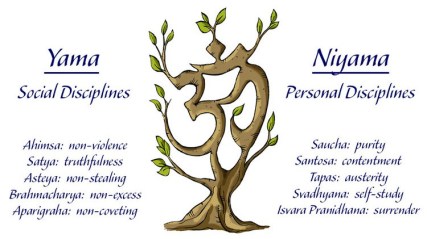
Yamas Niyamas

somelikeithot.yoga

I also find myself more and more drawn to the niyamas, which focus on resolve, not restraint.  The niyamas include shaucha, purity; santosha, contentment; tapas, tenacity; svadhyaaya, chanting/studying yoga’s ancient texts; and ishvara-pranidhana, surrender to God.

In April, my practice of shaucha has included cleaning closets, cupboards and car, inside and out.  All the while, I repeated mantra out loud, speaking or chanting it.  This practice gives “whistle while you work” a whole new dimension.  To borrow a phrase from Meditation Teacher Training, mantra is scrubby bubbles for my mind.  Not only did I scour closets and car, I cleaned out my mind’s nooks and crannies.  The contemplation article underscores this benefit, calling mantra repetition “the most powerful way to cultivate mental purity.”

Japa

amyelandry.com/

I repeat mantra silently at various points daily.  Yet, my mind needs more work.  With many layers to clear, out loud mantra repetition (japa) is just the ticket.  I was reminded of this recently.  I’d slipped into churning about things either beyond my control or not worth worrying about.  Two reliable sources advised japa periods of an hour or more.  It worked, and sent me into another niyama — tapas.

I’m “buckling down to do the hard stuff,” as the article says about tapas.  For me it means doing more japa.  Having cleaned out my actual closets, I’m trying to clean out more mental and emotional closets.  By doing so, I’m trusting in the blossoming forth of more niyamas.  I’m looking forward to deep contentment, and filling more of my life with study, song and surrender.  In any season, deep cleaning lets in more light.  Do more japa!

Why I Teach

Deepa Maria MazziBy Deepa-Maria Mazzi

Witnessing the transformation of students through Svaroopa® yoga has motivated my teaching for over 20 years.  I now teach seniors who have been with me for over a decade.  Their dedication inspires me.  Mostly, I teach for selfish reasons.  Svaroopa® yoga changed my life.  It taught me to be in charge of myself in a new way.  Now I teach to share this with those open to receiving it.

1803 Local MandaliIn private sessions and yoga therapy as well as in classes, my focus is on self-empowerment tools.  Thus, Ujjayi breathing is usually the foundational practice for students and clients.  When they begin to use Ujjayi every day, they often have tears of gratitude.  I assure them, I’ve been there, I’ve done that.  I know you can be helped.  I make sure they know that it’s the yoga dissolving the pain, in mind and body, not me.  I’m just doing my job.

When people are in pain, friends and family usually don’t understand that they are burning up inside.  This was my experience in my mid-thirties, living with excruciating pain.  I felt helpless and so needy.  Lying in bed, breathing, even wearing clothing — all caused pain.  The common catchall diagnosis is fibromyalgia.

From my mother and grandmother, I heard it’s “just aging.  You learn to live with it.  That’s what we all do.” Yet after my first “accidental” Svaroopa® yoga class, I was pain free for three days.  So I began taking weekly classes.  Even from the first, I knew I wanted to teach.

As a teacher, I aim to convey that you get to choose, you get to make yourself a priority.  As students allow healing from the yoga, they stop bending over backwards for friends and family.  They no longer need to prove they are worthy of getting love.  When they take charge of their own lives, they find the love they have been seeking outside is actually within.

tattoed meditator pinterest

pinterest.com

For many, especially those in pain, they first see yoga as an escape.  When they notice they are living more pain free, I talk straightforwardly about taking their yoga more into active, day-to-day living.  Teaching them Tadasana, I guide them to stand in the Truth of who you are, with eyes open and a soft gaze.  This is how to take blissful steadiness into the world.

As students begin to find the inner source of love and bring it into their lives, their relationships improve.  Connections with family and friends become mutually loving.  In the end, I teach because of this wonderful domino effect.  It’s my way of contributing to the world.

This spring, I took all three of the Half Day Programs offered by Vidyadevi Stillman when she was teaching in San Diego.  With super-challenging poses she nudged us beyond where we thought we could go.  This experience got me excited about the possibility of expanding my teaching to younger students.

I see that younger folks are living in so much tension.  Striving constantly to be connected through smart phones to the “outside,” they lose touch with themselves inside.  I can foresee potential service to a younger generation, helping them take a deep, healing dive inward.  As Swami Nirmalananda says, “Do more yoga.”

DIY Weekends

jyoti-judith-kenney.jpgBy Jyoti Kenney

I still look at DIY and think home projects, even after taking three Ashram DIYs in 2017.  I am currently putting together DIY bookshelves with doors and think back to all my home “do it yourself” projects.  Some I viewed as an adventure; others were a struggle.  My new IKEA bookshelves are supposed to be easy.  In some ways they are, with clear directions and the promise of improving my living space.  Yet I’m struggling to complete this project.  What makes it such a struggle?  The absence of Grace comes to mind.  I am working on this project and thinking “chore.”

idea bookshelf assemblyAshram “Deepen It Yourself” weekends are DIY with Grace.  It occurs to me that were I to begin approaching my current bookshelf project from a place of “capital-S Self” rather than “small-s self,” the project would be easy, even with challenging individual steps.
empty bookshelf

Blogging now about my Ashram DIY experience is a blessing, as it reminds me how I forget to allow Grace into my everyday life.  Simply repeating mantra instantly brings me into Self.  Then the chore of bookshelf assembly becomes filled with Grace.


My experiences in the DIYs were filled with community, collaboration, connection and a deepening commitment to my own yoga practice.  I learned from my own experience as well as from observing the experience of others in the group.

Lunge YogaI still remember and use a tweak Swamiji suggested for Lunge that profoundly changed the pose for me.  And I particularly appreciate the take home set of poses we were given.  Each of my three DIY programs gave me an ease-filled way to continue deep experiences in my personal practice.

Perhaps best of all, DIY was fun!  The schedule, while full, was relaxed in a way that Teacher Trainings are not.  There was an ease to the group and its way of being.  Moment-by-moment, my retreat experience was filled with Grace and transformation.  Whatever your current approach to DIY projects, do yourself/Self a favor and experience our Ashram DIY Weekends – to deepen it yourself.  This year I will be there again and look forward to seeing you too.

Foundational Favorites

matrikaReported by Matrika (Marlene) Gast

“Alternate Leg, using the ‘plain vanilla’ alignments, is my favorite,” says Betsy Ayers, CYST. “I learned it nearly 20 years ago when I first became a Svaroopa® yoga student. Getting its full benefits has been a slow progression. But after years of practice I do now feel a shift in my tailbone, moving and aligning on its own. It’s simple, with no effort on my part. I had to have trust, and I had good teachers.

kemm-alt-leg

“Feeling my tailbone release tension and lengthen has been so rewarding. My hips level and I enjoy the stability in my low back. Even though with years of Advanced Teacher Training, I still like standard Alternate Leg best. In classes, I notice beginners think they have to pull, when all you do is support your leg in an easy angle. Although they don’t get the full experience for a while, I know from their eyes they’ve still gotten a profound change.”

“I don’t really have a favorite pose,” shares Margaret Hofacker, a new Foundations Grad. “For me, the best was the Foundations immersion experience, being part of a such loving community for all those days. I especially enjoyed understanding and learning to apply the detailed information about alignments and props for all the poses. And I am very thankful for the ‘moving in’ and ‘moving out’ words for each pose.”

Vicky Osborn describes, “My favorite is , Digestion Pose.  It gives me a feeling of easy stability, where I just sit for myself. Sitting in it is sustainable. It doesn’t aggravate my sciatica.  I digest my thought processes as well as my food. More than any other seated pose, Vajrasana feels like coming home. Sitting in Vajrasana for meditation is much more ‘native’ to me.  I feel stronger in my Self.”

shavasana

These three Boise ID Svaroopis just completed the Foundations of Svaroopa® Yoga course. It was my second Foundations as a student, though I’ve also assisted in a few.

My favorite pose was Shavasana, with Swami Nirmalananda’s long Guided Awareness. I savor the memory of my journey inward to ever deeper dimensions. After that experience, the world clearly shone with the Light of Consciousness.

Learning to Practice the Yamas

Janaki

By Janaki Murray

Aparigraha, non-greediness, is the most challenging yama for Westerners. I find that it infiltrates all areas of my life in some way, bringing up “subterranean mental and emotional stuff.”

Monopoly Greed

clipart-library.com/

I live in a society that has so much and constantly attempts to cultivate desire for more and more — and yet more. There sometimes seems no end to greed. I see my mind grasping for things I don’t need. I already know I won’t be satisfied when I have them. I’ll just move on to the next thing.  It is made even clearer to me when I leave the city and live out in the countryside for periods of time. Life becomes simpler and my desires and accompanying greediness plummet to zero (well, almost). Aparigraha is so much easier there. I am truly affected by location.

When I read Transcendent Morality, I realize I really need to work on this yama.  And I am grateful for the reminder to cultivate the opposite when my mind is grasping and churning. Swamiji and Vidyadevi recommend this practice as described by Patanjali’s Yoga Sutras 2.33: “When your mind is disturbed by improper thoughts, remedy it by cultivating the opposite.”

So how did it go for me? Unsurprisingly, it worked – really well and easier than I expected.

Firstly, I realized I am not as greedy as I thought. I had a long held, irrational belief that went something like: “I have a lot; therefore I must be greedy.” It was important for me to recognize that I am not necessarily exercising greed. I realized that I usually don’t act greedily even given many opportunities. I seldom overeat. I have a modest wardrobe and very little jewelry. I rarely go shopping. I have an ordinary ten year old car. I realized I am having many greedy impulses that I am not acting on. I realize I have been applying myself to this yama for a long time, and I am being too hard on myself. In Just Don’t, the February Teachings article, Swamiji and Rukmini caution us not to be too hard on ourselves while learning to practice the yamas.

Piglet and Pooh Gratitude

lifeskillsresourcegroup.com/

I recognize that guilt is the “subterranean mental and emotional stuff” that aparigraha stirs up in me. I feel guilt because I have so much and others do not. It was, and is, easy for me to cultivate the opposite to my feelings of greed and guilt, as advised by Patanjali. I decided their opposites are respectively contentment and gratitude. The effect is instant and complete; calming and quieting my mind and bringing me back to my own Self. As I have grappled with aparigraha, I’ve found much peace in this simple formula. I have gained in capacity to apply this yama in the way the Great Vow intends: with everyone, everywhere, any time and in every situation.

Yet I also have to remember to not be too hard on myself!

Shaktipat Experiences

vibhuti-2Reported by Varadananda King

“Things begin to change from the moment I have the intention, ‘I think I will go to Shaktipat,’” reports Devananda (David) King.  “Swami Nirmalananda begins her work in me. Next, I sign up and make travel plans, and things really start to heat up. I feel more aware of the presence of Grace in my life. With my recent Shaktipat Retreat, I began to feel a slow inner heat as the date approached.

Devananda 4“At the opening session Friday night, I felt great anticipation as our weekend schedule was laid out. By mid-morning Saturday, we were in full swing with arati, chanting, the first Shaktipat and the anticipation of an Ashram lunch. I felt myself lighten, my eyes widened, everything looked clearer and brighter, and we were just getting started.”

Natesh (Nick) Vassiliadis traveled with Devananda to attend the February Shaktipat Retreat.  “Walking into the retreat I was nervous, unsure, afraid, and full of questions. This was my first time ever doing any meditation practice. Mostly everyone else there were veterans. I felt like I was walking into the Amazon rain forest without any gear.

Nirmalananda in India (3)“Pushing my anxiety aside, I made friends and talked with a lot of the other yogis. Everyone was very nice, so I began to feel that nothing could go wrong. I expected that if I had an issue I would be smothered in help and support. Seeing Swami Nirmalananda was amazing. Her demeanor was captivating, her voice laced with wisdom and profundity. I wanted to ask her about my personal problems, but had little chance to do so.”

Devananda continues, “The weekend was artfully crafted to give yogis of all experience levels entry into Divine introspection and Self-awareness.  We had live performances on harmonium and drum, and chanted Sri Guru Gita each morning. Swamiji gave us the teachings of our lineage as only she can deliver, with lots of love, laughter and peacock feathers.

“How the science of awakening manifested in each of us was most important. The flow of events masterfully primed everyone and maximized their capacity to receive. I could see that the new people were visibly changed. The regulars deepened and became more established and composed. I personally felt a new avenue of relationship open up with Swamiji and the world around me. Anything can happen at the feet of the Guru. That is why I am forever grateful for what she has given me and all she has to offer our community.”

shaktipat-retreat.jpg“The Shaktipats were crazy!” exclaims Natesh. “The first one was simple. Although I didn’t feel much, my meditation was very peaceful. The second one was way better. I had a profound realization while meditating. That night I felt lifted up to a higher awareness, closer to Consciousness than ever before. The last Shaktipat was the craziest of them all. The energy was intense. During that meditation I felt expanded, and I felt Oneness. Toward the end, I realized all the questions I had on the first night had been answered — by my Self. I felt complete, at the end of a maze. There was no looking back. It was truly one of the best weekends of my life.”

Ayurveda Practices for Spring

binduBy Bindu Shortt

Aaahhh, spring — bulbs push through the thawing soil, trees and bushes bud, and the sun shines longer each day. Seeking to refresh and renew, all of nature is awakening from winter’s hibernation. In Ayurveda, spring season is called “kapha.” It derives from two Sanskrit words that mean “water” and “flourish” or “nourish.” Qualities of water increase, both in nature outside us and in nature inside us, to nourish new growth.

Our yoga-buddies in the southern hemisphere are enjoying the beginning of fall, explained in a recent blog.   In the northern hemisphere, we are coming out of winter, which is vata season. Inside, we have accumulated vata energies of dryness, cold or feeling vapid-and spacey. In reaction to these excesses, your body may be producing more mucous, in the form of colds, flu or allergies now. You may be holding extra weight from the winter or find that your digestion is really sluggish. As we switch to kapha season, your body-mind wants to clear out the excess qualities from winter to be able to live harmoniously with those of spring. This means a nurturing time of renewed energy, vitality and cleansing.

Ayurveda offers some ways to clean and nourish in springtime. These simple lifestyle practices support your body’s innate capabilities to do both. First, eat your biggest meal midday. At this time the fire of digestion burns hottest. It will also maximize cleansing at a cellular level. Keep breakfast and dinner lighter. For example, eat cooked fruits and grains for breakfast, and soups and light breads for dinner.  Favor the bitter, pungent and astringent tastes. Americans are more familiar with the other three tastes — sweet, sour and salty — which pacify vata during winter. In spring, however, we need the other tastes for cleansing.

All leafy greens are bitter, and are best cooked. Asparagus, beets and fennel are also considered bitter. For herbs and spices, bitter turmeric, cumin, and fenugreek all help the body to cleanse from within. Pungent includes the tastes of onions and garlic as well as black pepper, cloves, mustard seeds, and ginger. Along with these pungent ingredients, include the astringent taste. It is found in pomegranates, lentils and beans, quinoa, spinach, apples and pears, avocadoes, and sesame seeds as well as the spices fennel, coriander, and parsley. These foods help to dry up excessive mucous. Throughout spring, use these foods liberally, still keeping most of your meals cooked (not raw).

Begin to rise earlier, just as the sun is doing. Being up by 6 am will help you ride the 6 to 10 am kapha waves of energy, rather than sink into them, accumulating sluggishness and lethargy. Resist the temptation to nap during the day. If you do need to nap, do so sitting propped up, which will keep your body from going into a false sense of nighttime cleansing. Lying down to nap during the day will only leave you more toxic when you wake up.

Keep your daily self-massage going. Even add a second layer to it. Do dry massage first, to deeply stimulate your lymph system to move toxins on through. You can buy a pair of dry massage gloves at the pharmacy. Then you will be ready for the oil massage.

In Ayurveda wisdom, spring is a season of both cleansing and nourishing. Spring Asparagus Kitchari will give you both, helping to release any spring fluid buildup in your tissues and joints.  It’s nice with papadum or homemade chapatti, and serves 4:

Ingredients:

1 pound fresh asparagus, rinsed and cut into ½ inch pieces

½ cup rice

½ cup split mung dal

Pinch of saffron

½ teaspoon cumin seeds

½ teaspoon fenugreek seeds

½ teaspoon ground cumin

2 tablespoons ghee

Directions:

Rinse together the ½ cup rice and the ½ cup split mung dal, soak for at least 30 minutes and then drain.

Dry-roast a good pinch of saffron.

To the roasted saffron, add ½ teaspoon cumin seeds, 1½ teaspoon fenugreek seeds, ½ teaspoon ground cumin, and 2 tablespoons of ghee. Sauté until the cumin gives off an aroma.

Add 1/4 cup chopped onion to the spices and ghee, and sauté until soft.

Add the soaked, drained rice and dal plus 6 cups of water or vegetable broth. Bring to a boil. Then lower the heat to medium, and cook for about 45 minutes.

Add 1 pound of rinsed fresh asparagus, cut into ½ inch pieces. Stir gently. Cook another 15 minutes.