
Reported by Vibhuti King & Matrika Gast
 “These have been my deepest Svaroopa® yoga experiences yet,” says Dharma (Lloyd) Apirian. He took all three DIYs last summer and has just completed June’s DIY: Healing which focused on deeper variations on our Magic 4 sequence.
Especially powerful for Dharma was the training in Lunge. “First,” he describes, “my legs were aligned too close, as though on a tightrope, and I was lifting my ribs in the wrong direction. I was able to remedy these misalignments. Even more remarkable was an adjustment from another student. She placed one hand on my sacrum and the other behind my heart. I felt her hands grow hotter and hotter. I was no longer in the realm of time. Suddenly I realized someone was talking to me. Though I still felt her hands on my back, she was actually sitting in front of me. This was my first ever experience of a comfortable and easy yet well-aligned pose. It brought to life Patanjali’s sutra “Sthira sukham asanam” (the pose is steady and easy). In my home practice now, Lunge feels brand new.
“During each DIY, Swamiji gives us a Q&A session. I asked whether I am starting to access the Self, and explained how I am easing into That. She helped me go deeper and verified my experience, reducing my self-doubt. She clarified that this is what I was experiencing, while I thought it was fear. Receiving such profound guidance is one of the great benefits of have an accessible living Guru.”
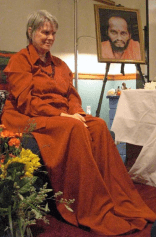 The day after the program, Dharma says he “eased into my Self” just before entering his workplace. He shares, “The receptionist is a ‘difficult’ person for me, and has been for more than a decade. As I approached her desk, I saw her with a deep love — love that I have never experienced before. Love without attachment or desire. My love for my wife has deepened. And it’s the same with everyone I see, when I am in that place of Self, my home. This is a transformative path. I have been searching since my teens for a path that would truly change me and Svaroopa® yoga is it. I am deeply grateful for my Guru, Swami Nirmalananda, and for my Teacher Trainers. I am also profoundly grateful for my fellow students. They supported and encouraged me. I hope I supported them too.”
 Also a longtime practitioner of Svaroopa® yoga, Saguna Goss is the Ashram Business Manager as well. She says, “Since the opening of the Ashram, I’ve been prioritizing the meditation retreats and sutra courses. In the DIY weekend, I had the opportunity to focus on the asanas. It was a real treat! Having the opportunity to dive into a sequence of poses and do them again and again provided a beautiful support for my body. That experience has helped my meditation practice. It was a gift to be reminded about the importance of supporting your body during this process of inner opening that comes from meditation. The beautifully deep Q&A session with Swami, followed by a Swami Sunday, completed a weekend full of Bliss!”
 SVA Board President Amala Cattafi says, “The DIY retreat reconnected me to the importance of making my yoga practice ‘full-spectrum.’ I have always favored meditation and seva over working on my body. Yet they are all connected. The DIY retreat not only reminded me of that, but gave me an easy home program that does not take any more time than my usual morning practice!”
DIY is for anyone interested in yoga and meditation. There are no prerequisites. Meticulous pose instructions are included as well as pose handouts for your personal practice. Chanting, meditation and group sessions with Swami Nirmalananda take you deeper and deeper into Consciousness. Everyone experiences amazing transformation in body, mind and heart. Our next one is August’s DIY: Connection followed by October’s DIY: Fulfillment.
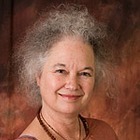 By Aanandi (Annie) Ross

 By Maureen Shortt

 By Janet Neff
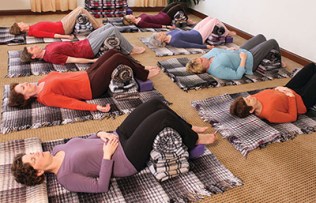 Now when I do the poses in my own practice, I hear the voices of my Foundations Teachers and Yogeshwari Fountain, my local teacher, too! I know more about what is behind it all. My experience in my local class as well as my personal practice is enriched because this thorough learning is taught by knowledgeable and experienced yogis. I also experienced deep physical, mental and emotional openings. I felt that our meditation and chanting sessions helped to solidify our learning and focus our mind and energy.
 By Karuna Beaver, SVA Board Member
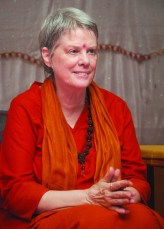 Swami Nirmalananda says yoga teachers are unique “because they are not teaching you how to manage the world, or to succeed in worldly ambitions. Yoga teachers teach you how to be in your own skin. They teach you how to find the wholeness in your own being and bring that into your day-to-day, breath-to-breath, relationship-to-relationship world.” To me, this is the “real world.” It’s the world in which you discover you are more than your mind, your accomplishments and your relationships. Yoga opens your door to this “More.”
 As a yoga organization, an Ashram, we rely on those who care about the world being uplifted and inspired by this kind of teaching. We rely on you. Our spring fundraiser’s theme is “Inspiring the Next Generation.” A good number of our teachers, myself included, are reaching retirement age. Now is the time to make a concerted effort to ensure that the Svaroopa® Sciences reach the next generation. Your generous donation to either the
  By Dhananjaya King
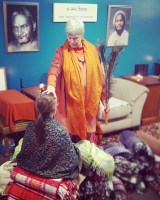 Over the centuries people who were called would sell all their belongings. They would leave their home and family to pursue what Guruji and the Svaroopa® Vidya Ashram programs offer us. As her devotee and disciple, I consider it a privilege and obligation to preserve the lineage through practice, scholarship and support. As a yogi or yogini, you are reading this now because one or more teachers or spiritual advisors pointed you in the right direction.
 Ultimately, the changes in body and mind were fueled by the Grace of Swami Muktananda and Bhagawan Nityananda. They were delivered by Guruji through my teacher to me. I am learning to allow “Doing” in the world to arise from “Being” in my Self. I want to be self-realized, and I am committed to helping anyone else who is pursuing that same goal. If that goal compels you, too, there are three ways in which you can support it.
 Or you may want to donate to Swami Support. That donation goes toward freeing Guruji for more teaching, more writing, more of what uplifts each of us in this community and reaches into the wider world. A third option for your donation is to the General Fund, which supports the Ashram infrastructure of staff, utilities, information technology, facility maintenance, etc. etc.
 ollected by the SVA Communications Team
 Chiti Aion
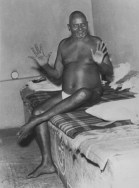 My hands stretched straight in front of me and my fingers extended and froze for a moment. My mind said, “Should I be scared that my hands will stay paralyzed?” I decided not to be scared. I felt so safe.
 In Supported Fish, a bonfire raged in my low back. I was given a folded blanket to support my hips. Less fire, more confusion. “I’m a yoga teacher. Why am I the only one in this room of 20 students who needs extra propping?” Of course, the physical reason was a super-tight spine. But looking back, I see that fire as Kundalini, fueled by Swamiji’s Presence. I am thankful to say that conflagration began clearing the way. It led me onto the Svaroopa® Vidya path. It continues to burn through “stuff” on my way to Self.
 By Rama Brooke, SVA Board Member
 Where would I be without the many teachers who have inspired me along this yoga path? I can think of many for whom I am so grateful. They include my dear friend who gave me her copy of the Primary Practice video tape 12 years ago. They include as well my local Svaroopa® teacher, my Teacher Trainers and DTS mentors. Also included are the many “Guru siblings” from whom I learn so much as we cross these oceans together.
 Or contribute to the
  By Dhairyavati (Kristine) Freeman
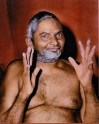 After returning from a recent Shaktipat, I added photos of Muktananda and Nityananda to my home puja. For years Swami Nirmalananda’s photo alone had been the focus of my devotion. It was as if I had compartmentalized her Grace. Then I realized that without her Guru, and her Guru’s Guru, she would not be here to serve us today. And with that I was able to expand my gratitude back through the lineage in a whole new way.
 Board Member
 My primary career is as a product development scientist. I have super-duper busy mind. I used to consider myself an intellectual, able to solve any problem. I was so wrapped up in my ability to think that it distanced me from others, and more importantly, from my Self. Like a fist, my mind used to be so tight it was useless. Because of the Svaroopa® practices and the path that Swami opened for me, my mind isn’t tight any more. I’m more creative and much more open to other people. As a scientist now, I don’t immediately make my mind up about something. I am open to possibilities I wasn’t open to before. Solutions to problems come much easier than they did before.
 In our “Inspiring the Next Generation” spring fundraiser, I will be financially supporting those who have supported me, and those who will carry the teachings to new teachers. When you open your heart to donate, you open the door to Grace. I hope you will join me by
  SVA Blog