
 By Gurupremananda Cattafi, SVA Board President
If you’re like me, you make promises every day, both to the people you’re in relationship with as well as to yourself. Maybe you have made a yoga promise, to support yourself through your daily practice or perhaps to offer seva. Perhaps it is a promise to dedicate your life to a higher goal — even the highest: Self-Realization. Swamiji has made the ultimate promise to us, to help us achieve the highest. She has dedicated her life to the upliftment of each and every one of us.
My favorite aunt prepared me for this great promise. Aunt Lillian taught me that when someone walks a mile for you, you walk two miles for them. This means when someone does something for you, you repay the kindness twofold. And when I think of what Swamiji does for me, I am thrilled to have an opportunity to offer something to her.
When we survey participants in Ashram programs, invariably we hear about profound life changes. These inspiring stories come from Svaroopa® yoga teachers, from their students, from retreatants who have received Shaktipat from Swamiji, and even from people using the Freebies on our website. They say they are receiving exponentially more than they could have ever imagined.
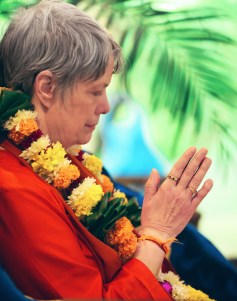 Is this true for you? Consider how these profound teachings have deepened your inner experience of your own Self. Maybe you experience a level of inner ease and peace of mind, that even affects your life decisions. Even if you want to, it’s not possible to repay this gift of dawning enlightenment. Yet we must find a way to honor and support the work of Sadguru Swami Nirmalananda, which so deeply benefits ourselves and our world.
Please consider joining the other yogis who do so by making a monthly donation. Your monthly gifts ensure practical support for the continued stream of Swamiji’s teachings. You help sustain the faculty, staff, supplies and infrastructure that make her service to us possible. Your gift supports your yogic path, not only enabling you to do more than you think you can, but also contributing to you discovering that you are more that you think you are.
When you make a monthly pledge, it’s a solemn promise. It’s a commitment, that you make and carry out, honoring and supporting the work of our Master Teacher — our Sadguru.
 Your gift has a twofold impact. It ensures that Swami Nirmalananda’s teachings reach you as well as others, extending far and wide to other seekers. It is also a profound yogic practice, whereby you invite yoga into your wallet, extending Grace into this important part of your life. Your financial gifts give you as much benefit as your daily meditation or poses, or even more.
Over the next few weeks, you will get personal stories from our Board members. They share how making the promise to support the Ashram has touched and transformed their lives. We ask you to look into your heart for guidance on making your own promise, your own pledge.
To make a one-time gift or a monthly pledge, visit www.svaroopa.org/donate
OM svaroopa svasvabhavah namo namah
 By Aanandi Ross
 Admittedly, sometimes it isn’t easy. Yet I see that my task is to stay with it. I breathe into it, softening the densities in my mind. As Swamiji has taught, I return to the vehicle of enlivened mantra. I trust the process, and mantra takes me back to my Self. Throughout life’s ebbs and flows, these practices continue to transform me. Over time, their effects settle into me more and more, anchoring into the very depths of being.
 By Bindu Shortt

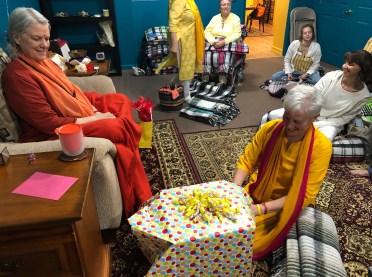 By Swami Nirmalananda
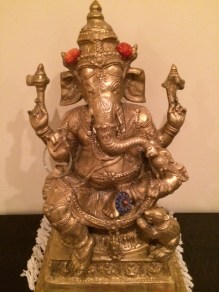 I began buying murtis, statues of the Gods and Goddesses, that I knew would be essential to holding the shakti (energy). I had gotten interested in them because I was having visions and other experiences of their very real presence and blessing in my life. The Guru Gita says:
 Baba described that they “dance attendance” on one who gives their life to knowing the Self. I only got to know them slowly, as they introduced themselves to me. I recognize the Divine and cosmic forces at play in this universe; it’s a delight to invoke and honor their presence.
 While we’ve spent years getting the buildings ready, placing the murtis, creating gardens and outdoor meditation areas – it’s the people that make this an Ashram. All the furniture could be in place but it would be a museum. It’s the living breathing forms of Shiva that keep the Grace flowing here. How fortunate am i! It’s all Baba’s Grace. And where did He get it? Nityananda.
 By Dasi Light Trautlein
 With my arms up, Hasta Padasana draws the prana up my spine, widening its flow. As I settle into the pose, I remember that asana actually means “to sit.” I feel like I’m sitting in a river; it courses up my spine to the crown of my head and out the top.
 Moonlight is so calming, so soothing, such a sweet and nurturing kind of light. Yet the moon is not a source of light, but shines with reflected light, just like your mind. When your mind is at its best, it shines with the light of your own Self, radiating from inside, outward into the world. But your mind ebbs and flows, like the stages of the moon, too often shaded with your desires and fears, clouding your mind, blocking the light.
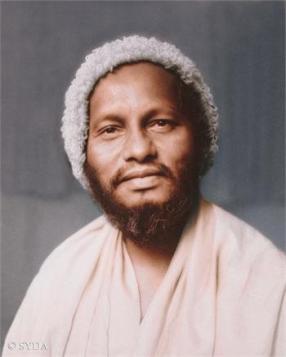 Swami Muktananda was born on the full moon. He left us on the full moon. He dedicated His life to finding the inner light of the Self and to sharing it. I was lucky enough to receive His Grace, not only showing me the light shining through Him, but the source of the light within me.
 Because He never really left. He told us that His departure would merely be the end of His physical form, but His presence would always be here. He surrounds and pervades me; He surrounds and pervades all, because He was and is Shiva. As am I and as are you.
 By Yogeshwari (Lissa) Fountain
 In
In 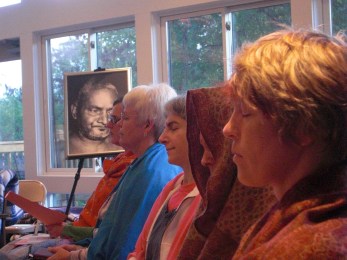 In a weekend workshop a few years ago, I progressively prepared students for the closing hour-long meditation. Our space was in a boathouse in a public park. As soon as we began, a rock band set up right outside. Playing a medley of 60’s hits, they blasted “Mustang Sally” full volume. My mind oscillated between repeating mantra and worrying about my students’ reactions. Wonderfully, at the end, all shared how the mantra helped them stay inside, despite the noise.
 By Krishna (Phil) Milgrom
 She sets up all the daily quotes on the Ashram homepage, making sure each one corresponds to the Daily E-Quote emailed to subscribers. To do so, she coordinates with Margot Garritt, whose seva is to email the quotations. The source of all is our monthly teaching article and the Contemplation Quotes Svaroopa® yoga teachers offer at the end of each class.
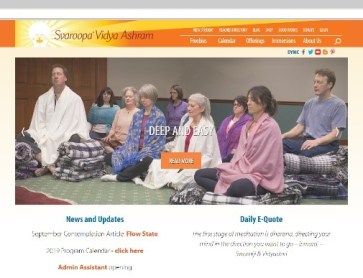 Pam wonders whether she’s getting “too much” relative to what she is giving. Yet she is comforted knowing her service is making large ripples. “This seva brings the daily quotes to a wider audience. Whoever visits
  By Swami Nirmalananda
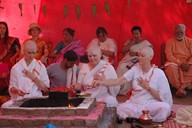 My sannyasa (swami-hood) initiation was done at a Vedic fire ceremony, yaj~na. Facing God in the fire changes you. Ever after, swamis wear orange, the color of the fire. When I became a swami, all the other priorities fell away. I am forever grateful. Only one thing remains — Consciousness.
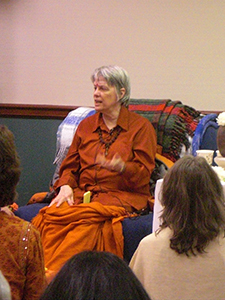 Saraswati is the Goddess of Wisdom and Creativity. I am a member of the Saraswati order, as are most of the monks that brought yoga’s root teachings to the West. The Saraswati order is a teaching order, thus I teach. Technically, I am a member of the Mahanirvani Akhara, based in Mumbai and Haridwar, India. I lead two facilities in Downingtown PA, a residential Ashram and a retreat facility, as well as one in Varanasi India, where I am in residence twice a year.
 By Chiti Aion
 To fit the yoga poses into my morning routine, I got up earlier. The effects were immediate. Even though I was getting less sleep, I had more energy throughout the entire day! Instead of dragging myself through the day, I had pep in my step. I was doing the same things I always did, but everything had changed. I knew it was because of the yoga.
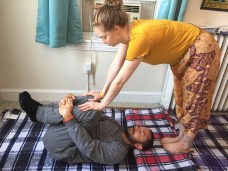 When I realized what I was getting from Svaroopa® yoga, I knew I had to share it with others. I started by creating a yoga program for fellow teachers at my elementary school. They too were amazed by feeling both calm and energized after class. The effects of one class would carry them through the week, feeling more alive, focused and refreshed.
 SVA Blog