

By Aanandi Ross
“Just Don’t,” our February Teachings from Swami Nirmalananda and Rukmini Abbruzzi, inspires me to rededicate myself to practicing yoga’s yamas — uplifting lifestyle practices. I feel the richness of these five practices. They offer huge possibilities for me; for every human being. Some have been more up front in my life at different times. Some have evolved through different stages. What shall I return to first?
Ahimsa, first on the list, means do no harm to others. I think of the many spiders I’ve encountered in my life. I’ve slipped a cup over them, slid a card underneath and carried it all out the door. It’s never really bothered me too much, except for one time when there was a very big spider, large and thick. It stopped me right in my tracks. For a moment I stood in the middle of the kitchen, before remembering to breathe.

Finding my inner warrior, I mustered up the courage to help him or her get back outside. It felt good to have helped the spider. Of course, I continue to work on my aggressive impulses when they arise. My driving habits, however, still offer me something to work on. Sometimes I still speed, which could be harmful. Maybe after publicly disclosing this, I won’t anymore.
Practicing satya requires that you speak only truth. I find speaking only truth so much easier. Have you noticed this? It is a practice, and it takes practice. Yet it is freeing as it simplifies life. The words flow out so much more easily, even when it’s challenging to tell a truth. It feels “right” in my gut.

Asteya means don’t steal. The article reminded me that I caught myself stealing a while back. At the dentist’s tea table, I had just poured myself a cup of spice tea when I saw another choice — an organic, chocolate mint tea — a flavor I had not seen before. Oh, how delightful to try later, I thought. It is not my habit to take extra free goodies. Doing so on this occasion obviously bothered me on some level because I remembered the incident. Next time I go to the dentist, I will bring a teabag to leave there. It’s in my calendar.
Regarding brahmacharya, celibacy, I recall a time in my early twenties when this practice was in the forefront of my life. I had already discovered that using the vehicle of a persona with a sexual flair was only causing pain and suffering. I cut my hair short and gained more than a few pounds. I had a yearning to know who I was beneath and beyond the needs and identities entangled in sexuality. A quote from Swamiji comes to mind, ”Work with your strengths and work on your weaknesses.”

Currently, I’m enjoying the practice of aparigraha, no more greediness. With a shift in my financial situation, I am practicing much more earnestly restraining myself from “grasping for things I don’t need.” It feels wonderful, putting things in perspective, helping me to re-organize my life.
Practicing yoga’s yamas, offers so much. They give you great ways to uplift yourself and keep your mind from pulling you out of Consciousness. In every moment there is choice. The yamas make this very clear. Practice the yamas. Just do.
 By Swami Nirmalananda
 By Matrika Gast
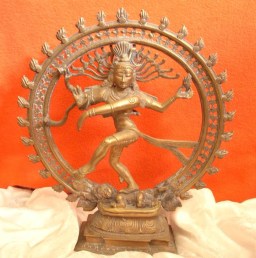
 Even with the ecstasy in the dancing, Rijumati was ultimately moved into a “state of peace and quiet”. She says, “It was an uplifting experience. Yogis aged 70 (and over) are cautioned not to stay awake all night. So I did have rest periods, including a two-hour nap. Yet I got up again at 3 am, and engaged fully in the ongoing festivities. With Swamiji’s guidance it was easy. The next day I felt pretty darn good. When I opened my eyes, I realized I could take the state of peace and calm with me, and started my day at the usual time.
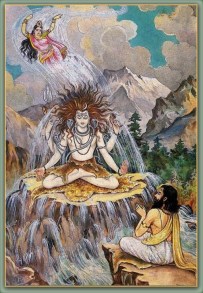 This Night of Shiva offers you the chance of a lifetime. You can become enlightened in this one night. Simply stay up all night for extended meditation practices and don’t fall asleep. It’s not too late to plan. In a cold climate, hunker down in your yoga cave; if your weather is warm, you may want to be outside. Plan for your all-night practices. Include recesses with healthy treats during the night. (If you’re 70 or over, plan naps, too.) Chant, meditate, read the ancient teaching stories about Shiva. Do poses, both to keep awake as well as to make your sitting for meditation better. Then meditate again. Repeat until sunup — or until as long as you have planned. Decide in advance and apply yourself.
 by Rudrani Nogue, CSYT
 Leola began with spinal release poses at home in the morning before starting her day. In class, she reported on her progress. After about five months, her early morning home practice included all the poses she’d learned in class. Her body — particularly her knees — and her mind were opening.
 Another Svaroopa® yoga teacher suggested Leola start Ujjayi Pranayama. Leola started waking earlier so she could do 20 minutes of Ujjayi Pranayama, as well as her meditation and poses before the kids would wake. She started noticing her days were getting easier with the kids. She has progressed to doing Ujjayi breathing for 20 minutes both morning and night. She prioritizes her weekly yoga class, going to another teacher when I am away or not teaching. Leola takes advantage of any “extras” that are available, so she is registered for our upcoming Weekend Workshop with an Ashram faculty member.

 Swami Nirmalananda shares, “When I served as the President of the San Diego yoga teachers association, I was surprised to hear a comment from a teacher of another style. She said, ‘The teachers you train know how to work together, in a classroom and outside. None of the rest of us do.’”
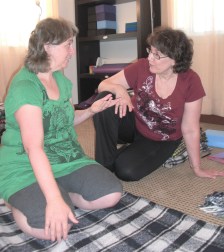 No matter the entry door, all of us community members come into relationship with Swamiji as well as with each other. We talk, formally in programs and casually anywhere, anytime. Many of us take on seva (selfless service). In serving others, and serving with others in our particular seva, we talk. We communicate about our experiences and develop enduring relationships. These connections weave the tapestry of community. It is a container in which together we deepen and expand our experiences of opening more and more to Self.
 By Deena Rotches
 I discovered that Lunge was “the one” a decade ago, returning home from a long drive to visit my mother. My total drive time was about four hours. If I went to bed without doing a Lunge, I wouldn’t get any sleep. If I did a Lunge, I was OK. I learned to release my tailbone, sacrum and spinal waist area all at once by doing Lunge very slowly.
 After my recent Shaktipat Retreat with Swamiji, another student remarked on how faithfully I adhere to daily, 4 am yoga routine. I explained to her that it prepares me for the
 By Yogeshwari Fountain
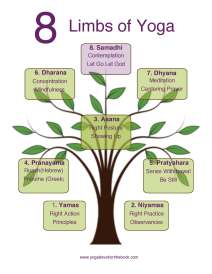 I recently re-read my 1998 notes on Sutra 2.29. It was clear that I had my work cut out for me even then. Scribbled on the page’s margin was encouragement like “Just say no!” or “You must restrain yourself from these things.” I struggled with the question “How do you live a yogic life 24 hours a day?” It all seemed beyond my grasp. My mind was so busy, I had no idea where to begin. You see, I didn’t understand Grace, the wind that has always been beneath my wings, even before I knew it.
 Guru’s Grace is the shortcut to the knowing of your Divinity, your own Self. Swami Nirmalananda awakens the arising of your own inner spiritual energy. She describes it this way, “Patanjali teaches you how to dissolve the clouds. By contrast, my Guru simply gave me the sky.” She is comparing the practices you learn from Patanjali with Guru’s Grace.
 By Raj~ni King
 When I took Meditation Teacher Training, I had to write and teach about Consciousness. This helped me to understand and more tangibly experience what I had been getting all along. The yoga process and the purpose of asana was so clear. It is spiritual upliftment, rather than just the reliable physical, mental and emotional improvement that begins the process. Knowing and more fully experiencing the purpose of practicing asana shifted my teaching profoundly. Even though I was saying the same words and teaching the same asanas, my understanding of the goal shifted.
 When I go into the studio to teach, I light a candle and do arati to the Gurus from our lineage. Then, because the space is shared, I always do a round of incense with the mantra to clear the energy. These practices help me to settle into my Self before I teach. The clearing also opens the way to the inflow of Grace from our lineage. It becomes tangible, not only for me, but my students as well. They know that they’re different when they leave. At the end of class this week, a new student exclaimed that she felt like a whole new person. She was glowing; they were all glowing.
 By Mangala Allen

 by Madelyn Jablon (interviewed by Maitreyi Wilsman)
 At first Madelyn struggled with the idea of a Guru-Disciple relationship and acknowledging Swamiji’s influence and power. Now she visualizes this spiritual relationship as a bicycle ride. Madelyn says, “I am holding one handlebar and Swamiji is holding the other. When I am uncertain of the course, I lighten my hold of the handlebars and feel Swamiji take control of the steering. If she didn’t, I would fall and crash. When I do not know where I am going, she guides me. As long as Swamiji is with me, I will not fall.” Madelyn knows that she is guided by Swamiji. She also feels Kundalini’s guidance. Madelyn says that her morning chant of the Kundalini Stotra is the most potent of her practices.
 Hospital nurses told Madelyn that they found her husband’s room calm and peaceful. They asked whether they could sit in her chair during their breaks. While other patients refused painful procedures, Madelyn meditated and played Sri Guru Gita while her husband slept through spinal taps and whole brain radiation. A doctor who had performed surgery during Sri Guru Gita asked her for a copy of the CD. The hospice staff asked questions about the puja she had set up in her husband’s room. They were curious. They could feel its transformative power in the room’s atmosphere.

