

By Janaki Murray
Aparigraha, non-greediness, is the most challenging yama for Westerners. I find that it infiltrates all areas of my life in some way, bringing up “subterranean mental and emotional stuff.”

clipart-library.com/
I live in a society that has so much and constantly attempts to cultivate desire for more and more — and yet more. There sometimes seems no end to greed. I see my mind grasping for things I don’t need. I already know I won’t be satisfied when I have them. I’ll just move on to the next thing. It is made even clearer to me when I leave the city and live out in the countryside for periods of time. Life becomes simpler and my desires and accompanying greediness plummet to zero (well, almost). Aparigraha is so much easier there. I am truly affected by location.
When I read Transcendent Morality, I realize I really need to work on this yama. And I am grateful for the reminder to cultivate the opposite when my mind is grasping and churning. Swamiji and Vidyadevi recommend this practice as described by Patanjali’s Yoga Sutras 2.33: “When your mind is disturbed by improper thoughts, remedy it by cultivating the opposite.”
So how did it go for me? Unsurprisingly, it worked – really well and easier than I expected.
Firstly, I realized I am not as greedy as I thought. I had a long held, irrational belief that went something like: “I have a lot; therefore I must be greedy.” It was important for me to recognize that I am not necessarily exercising greed. I realized that I usually don’t act greedily even given many opportunities. I seldom overeat. I have a modest wardrobe and very little jewelry. I rarely go shopping. I have an ordinary ten year old car. I realized I am having many greedy impulses that I am not acting on. I realize I have been applying myself to this yama for a long time, and I am being too hard on myself. In Just Don’t, the February Teachings article, Swamiji and Rukmini caution us not to be too hard on ourselves while learning to practice the yamas.

lifeskillsresourcegroup.com/
I recognize that guilt is the “subterranean mental and emotional stuff” that aparigraha stirs up in me. I feel guilt because I have so much and others do not. It was, and is, easy for me to cultivate the opposite to my feelings of greed and guilt, as advised by Patanjali. I decided their opposites are respectively contentment and gratitude. The effect is instant and complete; calming and quieting my mind and bringing me back to my own Self. As I have grappled with aparigraha, I’ve found much peace in this simple formula. I have gained in capacity to apply this yama in the way the Great Vow intends: with everyone, everywhere, any time and in every situation.
Yet I also have to remember to not be too hard on myself!
 Reported by Varadananda King
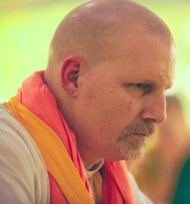 “At the opening session Friday night, I felt great anticipation as our weekend schedule was laid out. By mid-morning Saturday, we were in full swing with arati, chanting, the first Shaktipat and the anticipation of an Ashram lunch. I felt myself lighten, my eyes widened, everything looked clearer and brighter, and we were just getting started.”
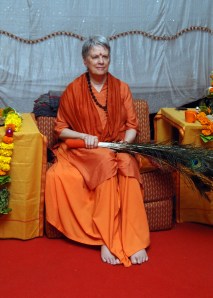 “Pushing my anxiety aside, I made friends and talked with a lot of the other yogis. Everyone was very nice, so I began to feel that nothing could go wrong. I expected that if I had an issue I would be smothered in help and support. Seeing Swami Nirmalananda was amazing. Her demeanor was captivating, her voice laced with wisdom and profundity. I wanted to ask her about my personal problems, but had little chance to do so.”
 “The Shaktipats were crazy!” exclaims Natesh. “The first one was simple. Although I didn’t feel much, my meditation was very peaceful. The second one was way better. I had a profound realization while meditating. That night I felt lifted up to a higher awareness, closer to Consciousness than ever before. The last Shaktipat was the craziest of them all. The energy was intense. During that meditation I felt expanded, and I felt Oneness. Toward the end, I realized all the questions I had on the first night had been answered — by my Self. I felt complete, at the end of a maze. There was no looking back. It was truly one of the best weekends of my life.”
 By Bindu Shortt


 By Swami Nirmalananda
 Do we give each student different poses for their different conditions? No. Of course, we have therapeutic protocols, which we can apply one-on-one to speed the healing process, but in classes we work with the basics: breath, spinal decompression and the inner immersion into Source. It’s both simple and profound at the same time.
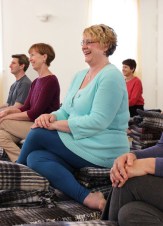 How does it change all these conditions at the same time? Simply by working on their common cause. When you decompress your spine, everything in your body, mind and heart responds — positively, quickly, powerfully. Every chiropractor and osteopath will agree and loves to help you with it. In Svaroopa® yoga classes, we teach you how to do it for yourself.
 “Because I am not able to be with Swamiji in person, the distance learning approach serves me well. I read her articles, listen to her recordings and participate in the conference call discussions with other yogis. This gives me access to the teachings that are the gift Swamiji gives of her Self. The vastness of her knowledge and the truth that she shares so freely is amazing. She opens the portal to the mysteries of life, and allows me access to my true nature. I see the bigger picture. Because she is so thoroughly knowledgeable of the ancient teachings, I don’t need to look anywhere else. She educates me and opens doors that I can easily walk through to uncover what is just a breath away.”



 By Swami Nirmalananda
 By Matrika Gast
 Even with the ecstasy in the dancing, Rijumati was ultimately moved into a “state of peace and quiet”. She says, “It was an uplifting experience. Yogis aged 70 (and over) are cautioned not to stay awake all night. So I did have rest periods, including a two-hour nap. Yet I got up again at 3 am, and engaged fully in the ongoing festivities. With Swamiji’s guidance it was easy. The next day I felt pretty darn good. When I opened my eyes, I realized I could take the state of peace and calm with me, and started my day at the usual time.
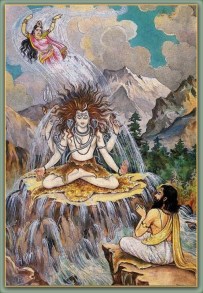 This Night of Shiva offers you the chance of a lifetime. You can become enlightened in this one night. Simply stay up all night for extended meditation practices and don’t fall asleep. It’s not too late to plan. In a cold climate, hunker down in your yoga cave; if your weather is warm, you may want to be outside. Plan for your all-night practices. Include recesses with healthy treats during the night. (If you’re 70 or over, plan naps, too.) Chant, meditate, read the ancient teaching stories about Shiva. Do poses, both to keep awake as well as to make your sitting for meditation better. Then meditate again. Repeat until sunup — or until as long as you have planned. Decide in advance and apply yourself.
 by Rudrani Nogue, CSYT
 Leola began with spinal release poses at home in the morning before starting her day. In class, she reported on her progress. After about five months, her early morning home practice included all the poses she’d learned in class. Her body — particularly her knees — and her mind were opening.
 Another Svaroopa® yoga teacher suggested Leola start Ujjayi Pranayama. Leola started waking earlier so she could do 20 minutes of Ujjayi Pranayama, as well as her meditation and poses before the kids would wake. She started noticing her days were getting easier with the kids. She has progressed to doing Ujjayi breathing for 20 minutes both morning and night. She prioritizes her weekly yoga class, going to another teacher when I am away or not teaching. Leola takes advantage of any “extras” that are available, so she is registered for our upcoming Weekend Workshop with an Ashram faculty member.
 Swami Nirmalananda shares, “When I served as the President of the San Diego yoga teachers association, I was surprised to hear a comment from a teacher of another style. She said, ‘The teachers you train know how to work together, in a classroom and outside. None of the rest of us do.’”
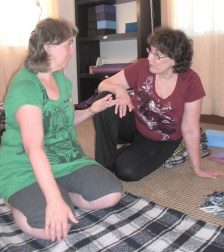 No matter the entry door, all of us community members come into relationship with Swamiji as well as with each other. We talk, formally in programs and casually anywhere, anytime. Many of us take on seva (selfless service). In serving others, and serving with others in our particular seva, we talk. We communicate about our experiences and develop enduring relationships. These connections weave the tapestry of community. It is a container in which together we deepen and expand our experiences of opening more and more to Self.
 SVA Blog