
 By Swami Nirmalananda Saraswati
I love America’s 4th of July celebration! Certainly the events are fun, but it’s the principle underlying it that is most meaningful to me — Independence Day. When the American colonies declared their independence from Britain, what were they claiming? What was their motivation? What could bring together so many leaders, who lived so far apart (based on travel times in the 1700’s) and had such different lifestyles?
Money. Their primary complaint was “taxation without representation.” There were other things they didn’t like, but money underlay most of their complaints. Is that what freedom is about, the freedom to spend your money on what you want?
The average American lifestyle seems to prove out this theory. If actions speak louder than words, what are most people doing? Shopping. Now we not only have Black Friday but Amazon Prime Day is vying with it for prominence. It’s about how much you can get, not about how much you can give. It’s about how much you own, not about how much you care. It’s about how much you depend on things for happiness, or depend on other people for your happiness. It’s about dependency — not about independence.
 Yet the philosophy underlying America’s founding documents is very elevated. The first two paragraphs of the Declaration of Independence include these phrases:
When in the course of human events…
…to assume among the powers of the earth…
…the Laws of Nature and of Nature’s God…
We hold these truths to be self-evident…
…all men are created equal…
…they are endowed by their Creator with certain unalienable Rights…
…[including] Life, Liberty…
You may have noticed that I didn’t complete the last phrase with “and the pursuit of Happiness.” That’s because the pursuit of happiness is not an elevated activity. Elevated means uplifted, and most people pursuing happiness are not pursuing uplifting things. In addition, the Founding Fathers couldn’t conceive of liberty for everyone; minorities, including women, were not meant to be included, not until constitutional amendments were enacted for each.
So their motivations were crass, they were exclusionistic and opportunistic, not to mention greedy and prejudiced, but they cited a high philosophy. Most of them were well educated, which meant they knew Greek, Latin and Hebrew, and read the classics as well as the Bible in its original language.

moksha – liberation
Their studies usually included Plato and Aristotle, as well as other philosophers, giving them elevated principles, whether or not they were able to apply them to everyone at the time. But they didn’t study Sanskrit. They had never heard that they would find freedom inside, by finding God within. They didn’t seek liberation, only independence.
As a child, I was inspired by the early settlers who immigrated so they could practice their religion, like the Pilgrims in Massachusetts. The settlers who appeared to be looking for wealth didn’t inspire me, so I paid little attention to the history of Jamestown. I loved the frontiersmen, who seemed to be seeking freedom from the tyranny of society. The Founding Fathers spoke of higher principles, the most elevated I’d found in any of my first twelve years of formal education. Yet I wanted more.
Buddha’s teaching that life is suffering was instantly understandable to me, but the path offered by Buddhism sounded just as restrictive and painful as what society offered me. Only yoga gave me a way out, which turned out to be a way in. It was Muktananda that made the difference for me, giving me Shaktipat. That gift showed me a possibility that I’d never heard of before – truly the promise of liberation. True freedom!
- Freedom from the tyranny of my own limited sense of self, to experience my own Divinity.
- Freedom from locking down my heart into conditional love, to experience Divine Love for all.
- Freedom from depending on others to give me a sense of self-worth, by experiencing the depth and vastness within.
- Freedom from being defined by others’ expectations and needs, and freedom to meet both, but for a different reason and from a deeper inner reservoir.
 Yoga promises freedom, not independence. I still pay taxes. I vote in elections. I’m a good citizen, participating in the benefits that our society offers and contributing to them. I’m not a rebel anymore, because I’ve found my Self. I don’t need to create a sense of self by matching what others do or by rebelling against that. I am me. Free.
And I still love the 4th of July! It holds the hint of the promise of freedom. For a yogi’s “pursuit of happiness” is the inner exploration of her own Divinity. Do more yoga. Discover your Self.
 “These have been my deepest Svaroopa® yoga experiences yet,” says Dharma (Lloyd) Apirian. He took all three DIYs last summer and has just completed June’s DIY: Healing which focused on deeper variations on our Magic 4 sequence.
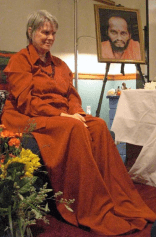 The day after the program, Dharma says he “eased into my Self” just before entering his workplace. He shares, “The receptionist is a ‘difficult’ person for me, and has been for more than a decade. As I approached her desk, I saw her with a deep love — love that I have never experienced before. Love without attachment or desire. My love for my wife has deepened. And it’s the same with everyone I see, when I am in that place of Self, my home. This is a transformative path. I have been searching since my teens for a path that would truly change me and Svaroopa® yoga is it. I am deeply grateful for my Guru, Swami Nirmalananda, and for my Teacher Trainers. I am also profoundly grateful for my fellow students. They supported and encouraged me. I hope I supported them too.”
 Also a longtime practitioner of Svaroopa® yoga, Saguna Goss is the Ashram Business Manager as well. She says, “Since the opening of the Ashram, I’ve been prioritizing the meditation retreats and sutra courses. In the DIY weekend, I had the opportunity to focus on the asanas. It was a real treat! Having the opportunity to dive into a sequence of poses and do them again and again provided a beautiful support for my body. That experience has helped my meditation practice. It was a gift to be reminded about the importance of supporting your body during this process of inner opening that comes from meditation. The beautifully deep Q&A session with Swami, followed by a Swami Sunday, completed a weekend full of Bliss!”
 SVA Board President Amala Cattafi says, “The DIY retreat reconnected me to the importance of making my yoga practice ‘full-spectrum.’ I have always favored meditation and seva over working on my body. Yet they are all connected. The DIY retreat not only reminded me of that, but gave me an easy home program that does not take any more time than my usual morning practice!”
 By Aanandi (Annie) Ross

 By Maureen Shortt

 By Janet Neff
 Now when I do the poses in my own practice, I hear the voices of my Foundations Teachers and Yogeshwari Fountain, my local teacher, too! I know more about what is behind it all. My experience in my local class as well as my personal practice is enriched because this thorough learning is taught by knowledgeable and experienced yogis. I also experienced deep physical, mental and emotional openings. I felt that our meditation and chanting sessions helped to solidify our learning and focus our mind and energy.
 By Karuna Beaver, SVA Board Member
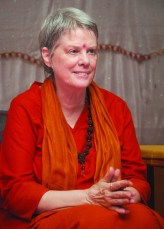 Swami Nirmalananda says yoga teachers are unique “because they are not teaching you how to manage the world, or to succeed in worldly ambitions. Yoga teachers teach you how to be in your own skin. They teach you how to find the wholeness in your own being and bring that into your day-to-day, breath-to-breath, relationship-to-relationship world.” To me, this is the “real world.” It’s the world in which you discover you are more than your mind, your accomplishments and your relationships. Yoga opens your door to this “More.”
 As a yoga organization, an Ashram, we rely on those who care about the world being uplifted and inspired by this kind of teaching. We rely on you. Our spring fundraiser’s theme is “Inspiring the Next Generation.” A good number of our teachers, myself included, are reaching retirement age. Now is the time to make a concerted effort to ensure that the Svaroopa® Sciences reach the next generation. Your generous donation to either the
  By Dhananjaya King
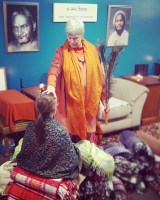 Over the centuries people who were called would sell all their belongings. They would leave their home and family to pursue what Guruji and the Svaroopa® Vidya Ashram programs offer us. As her devotee and disciple, I consider it a privilege and obligation to preserve the lineage through practice, scholarship and support. As a yogi or yogini, you are reading this now because one or more teachers or spiritual advisors pointed you in the right direction.
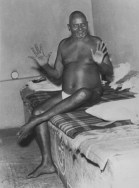
 Ultimately, the changes in body and mind were fueled by the Grace of Swami Muktananda and Bhagawan Nityananda. They were delivered by Guruji through my teacher to me. I am learning to allow “Doing” in the world to arise from “Being” in my Self. I want to be self-realized, and I am committed to helping anyone else who is pursuing that same goal. If that goal compels you, too, there are three ways in which you can support it.
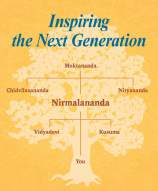 Or you may want to donate to Swami Support. That donation goes toward freeing Guruji for more teaching, more writing, more of what uplifts each of us in this community and reaches into the wider world. A third option for your donation is to the General Fund, which supports the Ashram infrastructure of staff, utilities, information technology, facility maintenance, etc. etc.
 ollected by the SVA Communications Team
 Chiti Aion
 My hands stretched straight in front of me and my fingers extended and froze for a moment. My mind said, “Should I be scared that my hands will stay paralyzed?” I decided not to be scared. I felt so safe.
 In Supported Fish, a bonfire raged in my low back. I was given a folded blanket to support my hips. Less fire, more confusion. “I’m a yoga teacher. Why am I the only one in this room of 20 students who needs extra propping?” Of course, the physical reason was a super-tight spine. But looking back, I see that fire as Kundalini, fueled by Swamiji’s Presence. I am thankful to say that conflagration began clearing the way. It led me onto the Svaroopa® Vidya path. It continues to burn through “stuff” on my way to Self.
 By Rama Brooke, SVA Board Member
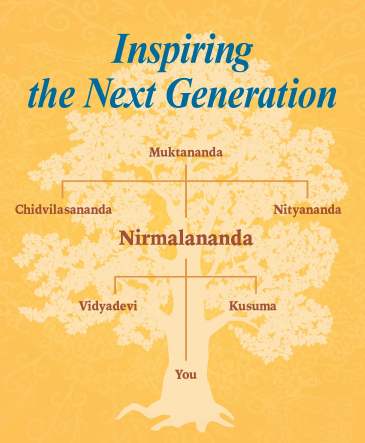 Where would I be without the many teachers who have inspired me along this yoga path? I can think of many for whom I am so grateful. They include my dear friend who gave me her copy of the Primary Practice video tape 12 years ago. They include as well my local Svaroopa® teacher, my Teacher Trainers and DTS mentors. Also included are the many “Guru siblings” from whom I learn so much as we cross these oceans together.
 Or contribute to the
  By Dhairyavati (Kristine) Freeman
 After returning from a recent Shaktipat, I added photos of Muktananda and Nityananda to my home puja. For years Swami Nirmalananda’s photo alone had been the focus of my devotion. It was as if I had compartmentalized her Grace. Then I realized that without her Guru, and her Guru’s Guru, she would not be here to serve us today. And with that I was able to expand my gratitude back through the lineage in a whole new way.

