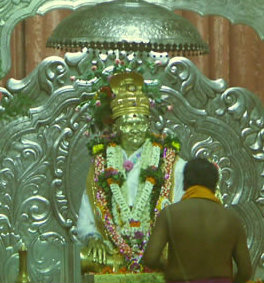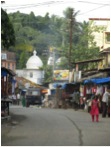
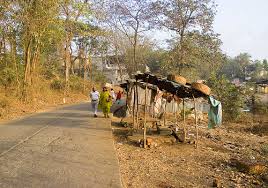
February 14 — On my way to the temple, I met a lady sweeping the dirt walkway. The interesting thing about this town is at first glance it looks rundown, chaotic, even a little backwards, but if you look closer it’s exactly the same as any town. Just place a shopping mall in the center instead of a temple. You see, this town was built around Nityananda.
“Hello,” I attempted to communicate while looking into her eyes to see if I can perceive contentment, i do and we talk. Turns out she 55, has one kid and her husband passed away 2 years ago. Her clothing and teeth show her poverty but she’s not living on the street; she’s just poor like many others around here. She says with a smile and a nod of her head, that she is doing seva for Nityananda. She’s been sweeping around the temple for 35 years. I say thank you, thinking this place wouldn’t be here without her. We talk a short time longer and I say good bye.
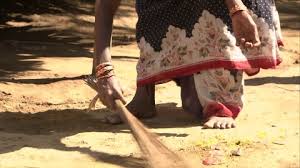 I get some chai from a vendor and sit. And think… It makes sense, sweeping the dirt walkways keeps the streets clean, which keeps the town plaza clean, the temple steps and the temple floors clean. She not the only one doing the sweeping, I just happened to talk with her. By the way, seva is not a job; they are sweeping for Nityananda.
I realize that I sweep the dirt too, but in a different way. I sweep the dirt from my body through a healthy lifestyle; I sweep my speech, trying to be kind and talk meaningfully to others; I sweep my mind by consciously trying to catch my tendencies, replacing un-serving thoughts with ones that serve my path.
It’s devotion that we have in common. The actions one undertakes are not the important part but our intention. You see, the lady sweeping is devoted to serving her Guru. This is her practice, her doorway.
The temple in and of itself is just a building. It can’t bring you anything, unless you’re willing to devote yourself to sweeping the dirt,
Where’s your doorway? You’re standing in it…
February 15 — I talkeded to the same lady this morning, but there’s not much contentment in her eyes… in fact I see none. Now I look further and see she is wearing a badge; I did not see it the other day. Then she asked me for money. I’m polite, we talk for a bit and then I walk away.
Shortly afterward, I spoke with a man walking along the river, i asked him if the ladies sweeping get paid. He said that they work for the temple and get their housing and meals taken care of. That’s not my definition of seva..
Why am I spoiling the story? Because I thought 35 years of devotion was beautiful. Because I’d like to have that. Because I’d like to be so certain and have no shadow of a doubt. And if I see it others it gives me hope that it exists.
I know it doesn’t matter what others are doing, it only matters what you’re doing. I’ll keep sweeping the dirt.
 I see a few other connections to etching and the experience I am having. It strikes me that, as with an artist creating a beautiful etched piece, it all starts with an idea. My experience of Ganeshpuri is brought to life by the teachings of Swami. She has an amazing ability to take the subtlety and beauty of the ancient teachings that we experience in Ganeshpuri and bring them to life and relevance for a North American audience. I often marvel with the fact that many solutions that seem new and revolutionary in our society were figured out and are well documented in the ancient texts that Swami brings to life for us.
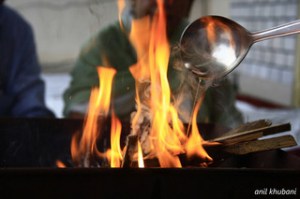 I have been immersed in the fire of yoga like never before! The main purpose of the sacred fire ceremony (yaj~na) was for the maintenance and protection of Svaroopa® Vidya Ashram. My husband Rudra (more about that later) and I had the honor of being the officiating couple, which meant we were performing the rituals on behalf of the whole group and the Ashram.

 What came to my mind were descriptions of the ceremonies and worship of the ancient Jews at the Temple in Jerusalem. Aside from the obvious difference that that the Jews were worshipping the formless and that the yogis are worshipping a form of the formless, all the other elements were present: priests dressed in special vestments were chanting an ancient language and waving flaming candles and firepans; musical instruments were playing; incense was being waved; offerings of flowers and food were made; and afterwards the blessed food (prasad) was distributed to the rapt crowd who had brought offerings as well as their supplications and prayers.