
 By Bindu Shortt
In springtime the ground thaws, the snow melts and there is a muddy aliveness. With a saturation of water, the earth germinates seeds. Flowers and trees blossom. Fields are ploughed and planted. Ayurveda observes that your body and mind undergo a similar process of clearing and revival in spring.
Ayurveda recognizes spring as the “kapha” (kap-ha) season. According to Ayurveda, yoga’s sister science, your physical body, mind and emotions are formed of three “bioenergies,” which are made up of nature’s five elements. These bioenergies are called doshas. Vata is constituted of air and space, water and fire constitute pitta, and water and earth constitute the kapha dosha.
In Sanskrit, “kapha” means to bind or hold together. Kapha governs the structure of the body, giving you stability, strength and endurance. Your capacity for love, compassion, nurturing, empathy, loyalty, patience and forgiveness stem from kapha. You exhibit these qualities when you are kapha-balanced.
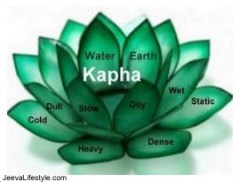 Ayurveda observes that “like increases like.” Thus, the qualities of spring on the outside increase those same qualities inside you. After winter, kapha thaws, accumulates and moves your bodily fluids. Kapha makes its home mostly in your chest, stomach, body fat, bones and lymph. So in spring you may experience colds, sinus problems, allergies or hay fever. Your kapha dosha moisturizes you with mucus, usually in response to the buildup of drying vata over the winter.
Just as the spring thaw cleanses the land, the movement of your inner fluids cleanses your body. As the earth thaws, the first plants to come up are the tender little sprouts and then some berries. Animals seek them out for their natural cleansing properties. Like the animals, you may find that you want lighter foods such as sprouts and berries. Your innate Ayurvedic wisdom knows they support your inner spring cleaning. Those heavy winter stews of potatoes, parsnips and carrots can be replaced by lighter springtime soups made with seasonal veggies such as asparagus or broccoli. Your taste for grains may run lighter to white basmati rice, quinoa or millet. You may find you want a little salad a couple of times a week as well as more cooked greens, steamed now rather than sautéed.
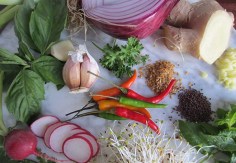
photo credit: Banyan Botanicals
To nurture yourself in sync with Ayurvedic wisdom, observe the six flavors. Favor the bitter, astringent and pungent tastes. These foods help to thin and move excess mucus. Grains are bitter; lentils and beans are astringent. For pungent, use green chilies, onions, garlic, ginger, turmeric and lots of black pepper. All strengthen your agni — your digestive fire in this cool, damp season.
Keep your veggies and fruits steamed or boiled. For fruits, favor seasonal berries and cherries. In addition to leafy greens, green veggies include peas, green beans, broccoli, asparagus, sprouts, celery, cabbage and Brussels sprouts. Minimize your dairy intake if you tend towards the spring imbalances of colds, sinus problems, allergies or hay fever.
Keep doing your daily oil massage before bathing or showering. If your individual constitution is kapha predominant, add another layer to this ritual. First give yourself a dry massage. Use either nubby exfoliating gloves from the pharmacy, or Ayurvedic silk self-massage gloves, found online. This dry massage helps to get your lymph moving, as part of your systemic spring cleaning.
 In your daily life, ride the waves of natural energy. As we have more light each day, you might find it easier to be up before 6 am. That lets you ride vata — the wave of light, pristine energy from 2 to 6 am. It will support your entry into the heavier kapha energy wave from 6 to 10 am. This practice will keep your physical and mental energy higher and clearer. Take that clarity into your day to support your natural internal cleansing.
Spring is your time to ride the waves of outer and inner renewal. Revel in it!
 By Karuna (Carolyn) Beaver
 I’m still learning this lesson, sometimes daily. I imagine you are too. Family members know you best, and they’re experts at pushing you past your limitations. Swami and Rukmini say, “They want you to be a saint and they are doing their best to help you get there.” In fact, the contemplation article says my mother was pushing me right into enlightenment. Thanks, Mom!
 By Dasi Trautlein
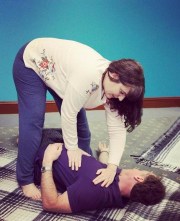 When I could offer only Embodyment® sessions, my clients would experience change, but it wouldn’t last. This outcome confused me. But the Treating Pain course taught me why and how I could really help clients maintain their openings. What I have learned has translated to all my clients and students. I have also benefitted. Using these treating pain protocols on myself, I have become a healthier, happier and more energized teacher. As I have changed, my current students are more inspired and motivated.
 By Bindu Shortt
 I can’t explain how seva works. I only know that by offering seva my capacity expands. It’s like my pot that holds Grace and Truth and Self becomes bigger. I become free-er. Free-er to do more, to give more. The flowing of giving from this free place affects me as it flows out through me, as me. If seva is “selfless service,” then there is no small ‘s’ self-involved. And the “service” is given to Self.
 By Priya Kenney
 We used Crayola candles because that was what we had in the house. The colorful river of Crayola wax reminded me that it’s all a play of consciousness. There was no fear, no need for things to be a certain way. It is all just a palette of experiences for us to play in as we remember who we are, the Self.
 By Shuchi Cilley
 propelling us so deeply inside that we were still established there days later. Dare I call it a hangover? (I am not looking for an antidote, hee hee.)
 By Yogeshwari Fountain
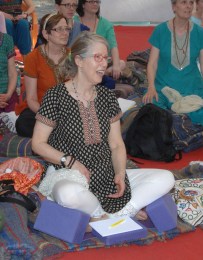 When I contemplate the involution that Consciousness takes, even before becoming my mind and senses, I can feel it expand my perspective far beyond whatever my small “s” self is experiencing in that moment. Currently, I am following the map of yoga’s ten lifestyle practices: the yamas and niyamas (see
  By Shuchi Cilley
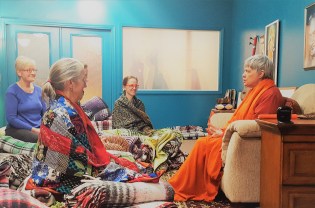 How do I describe the experience of Swamiji demonstrating and teaching us the simultaneous vibrations in OM or immersing us in the poetry of Lalleshwari? Add in vichara, repeatedly shining through the dark spots of my mind, and enclose it all within the Shakti of Lokananda. There’s more — the company of so many deep Svaroopis, new friends and old, flying in from across the continent. I savored the bedtime discussions with my dear roommates, the food at Lokananda and our Ashram lunch with Swamiji. Time and space had no meaning; past, present, and future all together, right now, right here.
 By Aanandi Ross
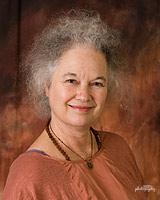
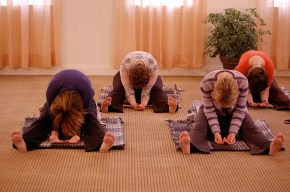 When I finally took the Deceptive Flexibility training, it explained the connection to me and answered a lot of other questions. Deceptive flexibility is a complex condition in both body and mind. It is a so deeply rooted condition that it can even be difficult to notice. I learned that my extreme angle of Kurmasana was actually overstretching my hip ligaments. Stretching them into unnatural extremes caused my spinal muscles to become very tight. I remember Vidyadevi saying, “Your body thinks your leg is going to fall right off, so your spinal muscles tighten to prevent that from happening, to protect you and hold you all together.”
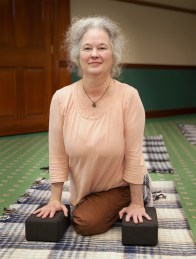 The secrets revealed to me in Deceptive Flexibility training have been life changing, and worth every modified Kurmasana, every tailbone pose and every sacrum pose. I am now genuinely more flexible, my muscles are softer and my mind more content. The poses taught in Deceptive Flexibility feel delicious. They support my body in ways that begin unraveling deep tension. My favorite pose now is Eka Pada Raja Kapotasana (Pigeon Forward Bend) with customized propping. The blankets allow the pose to reach through my hip and into my spine, releasing my sacrum muscles and even my neck.
 By Gayatri Hess
 Then the November weekend retreat baked me. Wow! I really mean baked. The glorious baker, of course, was Swami Nirmalananda, she who has traversed the terrain of this process and is fully established in her own Divinity. I deepened into Self, more clearly seeing Self in myself and Self in All.
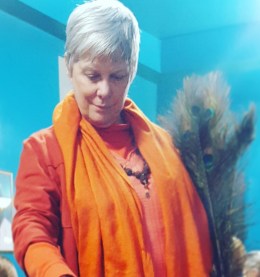 In our first article Swamiji wrote, “My heart calls out with the same yearning on your behalf, adding my yearning with yours, so that you can come to know your own Self.” As I write this for my Svaroopa® community, my heart calls out to each of you to experience the deepening that comes through a Year-Long Programme and retreat. My hope is that you will give your Self the gift of a
  New Year’s Eve is a night of lights, music, connecting with other people and ushering out the old. It’s supposed to presage your resolutions for the new year as well. Our Ashram resident event includes all of the above, both the night before and the morning of the new year.
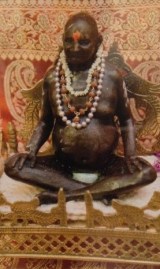 Baba always said that what you do on the morning of the new year sets the tone for the whole year. Thus, we are beginning with an abhishek, the formal ritual bath of our Nityananda murti.
 SVA Blog