
 Participants Interviewed by Varadananda King
I came to the January Yoga Therapy Intensive Retreat in a lot of pain from a recent injury that hadn’t fully healed,” says Eric Gibbons. “What I experienced is nothing short of miraculous. I watched the pain in my back shift, and then disappear altogether. I am very grateful for my time in this immersion, and for the support from the teachers and fellow participants.”
“I am in love with this retreat,” says Kalyani Zavolas-Wallis, who has enrolled “every time it has been offered, except once.” She continues, “I was sad about having to miss the one, as I wanted perfect attendance. This retreat is so incredibly rejuvenating — physically, mentally, emotionally and spiritually. While it is complete and full, yet there is still enough ‘down time’ to make it feel like a true retreat. I was able to nap, and to take a bath.

blissfullyoga.com
“I love the daily Vichara, which brings up and unravels whatever my mind is churning. Together, yoga therapy and morning classes open my spine more deeply. The chanting and meditations bring me closer to God. All this along with Swamiji’s talks/lectures create a wonderful retreat for those of us looking for deep healing, a deepening of spiritual practices, knowledge about healing, and REST.”
Kushala (Kat) Conner responds, “When I think about why I chose to come to the yoga therapy intensive this past January, a stanza from William Wordsworth’s “Ode: Intimations of Immortality” comes to mind:
There was a time when meadow, grove and stream,
The earth and every common sight
Did seem to me
Appareled in celestial light,
The glory and the freshness of a dream.
“Many moments in my life, particularly when practicing yoga, there was a vitality, a freshness and a longing for something more. The longing for something more felt alive — enlivened — ‘light.’ Also resonating with Wordsworth, I have often felt as if I have been living in and playing out a dream:
It is not now as it hath been of yore.
Turn whereso’er I may,
By night or day,
The light which I have seen
I now can see no more.
“I chose the Yoga Therapy Intensive as a gift to myself, to step away from the dream of my life, to be inspired by practices to help me find my way back to that place of aliveness within myself.
“The experience I encountered was a weaving together of chanting, meditation, conversation and practices to help me uncover those places within myself still stuck in the dream — in the deadness. The retreat offered me time to practice and reflect on where I am today with support on practices tailored to my specific needs. I’m very grateful for the time and awareness of Swamiji, Vidyadevi and Kusuma that worked with me to start unlocking those tight spots in my being.”
Feeling honored to have assisted, Tirtha Hale, says, “This retreat occurred during the time when Lokananda was undergoing remodeling with new rooms being added, floors being laid, and apartments being built. Even with construction, hammering and power tools sounding off, I felt enormous Grace flowing. It’s always here! What a lovely way to experience this truth, that deep healing and Grace are always available regardless of what’s happening on the outside.
 “Now, all the upgrades are finished! When you come to a future Yoga Therapy Retreat, it will hold you in a blessed cocoon of transformation, and you will emerge shining brightly from this metamorphosis of healing. Every day offers chanting and meditation; a series of Vichara and yoga therapy sessions, asana class and special small group Swami time with discourses on healing. You will be nourished with good food, and you’ll enjoy rest and recovery from all that ails you. After just a few days, the change was splendidly visible in those who participated. Pure radiance!”
 By Aanandi Ross
 Ujjayi Pranayama heals your body, mind and heart, while it opens up profound dimensions of spiritual experience, its true purpose… Ujjayi Pranayama prepares you for the mystical experience that opens up in the pause between your breaths… “When you’re in that momentary suspension, an easy place of profound stillness, you’re ready to explore within.” —
  By Gurupremananda Lynn Cattafi, SVA Board President
 We have reached our fundraising goal. Your donations, especially in the last few days, have matched the Board’s generous gifts. Your $22,000 has been doubled, giving the Ashram the ability to offer you so much. Thank you for your part in making this possible.
 So, with words that are never enough, I thank you for reaching inside to find the ability to take care of your Guru, bu investing in your Svaroopa® Vidya Ashram and supporting your community. If you would like to add a last minute year-end donation to our campaign, please
  By Peter Gallagher, SVA Board Member
 We Board Members together have now pledged $22,000 in matching donations. When you donate to the Ashram during this fundraiser, you double your investment in your Own Self. The return to you on this investment is priceless. Our matching donation enables us Board members to join with your offering to the One Self Being All.
 By Sakalananda Goss, SVA Business Manager
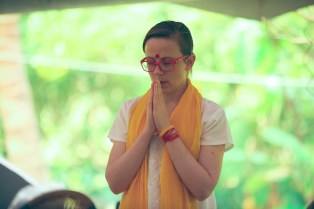 Still, I knew there was more. I knew that my mind could very quickly pull me away, as I had witnessed so many times before. I wanted my mind to be more engaged and cooperative in my sadhana. I started to do more mantra throughout the day. At one point, I consciously decided to allow Grace to flow through my mind. I envisioned being the Lord of my mind and having Swami by my side; it was as though I became Arjuna on the battlefield of my mind. Swami Nirmalananda was Krishna being my charioteer. She was providing guidance and Grace. What a gift to invest my mind into the practices. Investing my mind in Grace. Investing my mind in Consciousness.
 Your Ashram Board of Directors have also made the decision to invest more into the Ashram. Jointly, they have contributed $22,000 in matching fund donations. Please join us in giving more to the Ashram. Any donation you make will be doubled! You will invest in your Self as well as support the Ashram in helping others know and live from the One Self Being All.
 Reported by Matrika Gast
 Now Frances is grateful for the YLP distance learning that lets her study with Swami Nirmalananda without leaving her Calgary home. “I am lucky not to have to climb a mountain in Kashmir to receive these ancient teachings on being enlightened. I simply click a button to download Swamiji’s articles, listen to her discourse audios and join the conference calls for group discussion. Her articles are deep and rich. In the current programme,
  “And there’s more. Swamiji herself is a model of how to be. Her teachings radiate with Truth. It’s the concise way she presents vast information. It’s the humor and the clarity. Paradoxically, the course draws me into my Own Self within. Specific teachings provide me with insightful understanding and instructions for concrete action. I especially rely on her poem, which so beautifully captures the main point of the whole course:
 (Kristine) Freeman, SVA Board Member
 When you invest in your Ashram, you invest in your Self. Your donation enhances programs, provides salaries for essential support staff and funds improvements at Lokananda (our retreat center). This infrastructure is crucial. The energy of your donation supports and strengthens it. Thus, you help spread Swami Nirmalananda’s teachings to more people worldwide. And you experience the “More” of yoga. You experience the inner upwelling of your own joy-full Self.
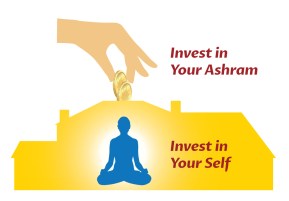 Take the challenge! Join with your Svaroopa® yoga community to invest in your Ashram. Simultaneously, you invest in your Self. When you give financially to the Ashram, investing your energy, you open yourself even deeper to abundant returns from Source. Challenge yourself to open your heart and your wallet. Then challenge yourself to be aware of how your support — your investment — comes back to you, outside and inside.
 By Matrika Gast, SVA Board Member
 Throughout May, when you donate to support the source of the teachings that have so filled and empowered you, you double your investment in the Ashram. Because we SVA Board Members have committed to $22,000 in matching pledges, you double the power of your dakshina. For every $1 you donate, the Ashram receives $2. When you thus double your investment, what amazing ROI will you receive?
 By Gayatri Barbara Hess
 We Svaroopa® Vidya Ashram Board members feel passionately about Our Mission. Together we have pledged to give $22,000 in matching funds. Yes, for every dollar you give, your Board will match it dollar for dollar. I still have a habit of getting excited about “More Bang for Your Buck”! By giving in this April fundraiser, you send your “money energy” to support a mission replete with Grace. You also double the gift through the Board’s matching fund.

 You’ve heard that money can’t buy you happiness. In this case, I heartily disagree. By investing money in an organization dedicated to you knowing your own Self, you gain something valuable.
 SVA Blog